MAEVE MULRENNAN REVIEWS THE HELSINKI BIENNIAL.
The third edition of the Helsinki Biennial (8 June – 21 September), entitled ‘SHELTER: Below and Beyond, Becoming and Belonging’, vibrantly continues the ecological discourse of the previous two editions. Founded in 2021, this focused biennial has so far been largely concerned with the climate crisis and the place of art in conversations on mitigation, adaptation, and resilience. An enduring enquiry into the relationships between the maritime city, nature, and art is the conceptual foundation of the biennial. In its third iteration, this relevant and pressing thematic is still fresh and far from exhausted.
Curated by Blanca de la Torre, Director of the Institut Valencià d’Art Modern (IVAM), and Kati Kivinen, Director of the Helsinki Art Museum (HAM), this iteration offers somewhat hopeful perspectives on the climate crisis. None of the 57 artworks feature humans as the main subject, although the environmental destruction caused by humans is all too present. De la Torre and Kivinen’s curation harnesses innovative approaches, genuinely rooted in an ecological ethos, with ‘SHELTER’ seeking to address the imbalances between humankind and nature, offering a multi-species and holistic alternative future.

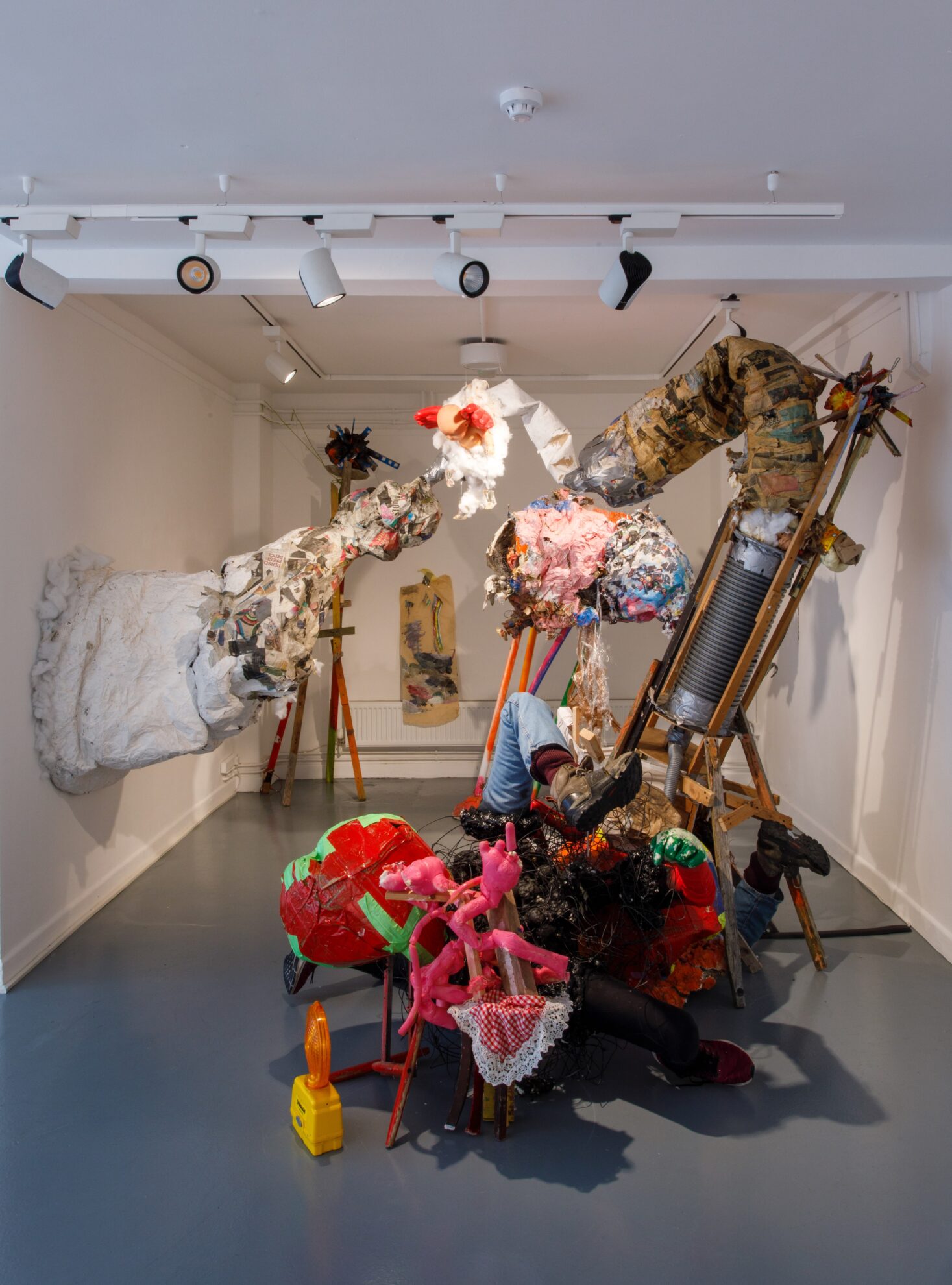
The work of 37 artists and collectives is presented across three venues: HAM and Esplanade Park – a long, narrow greenway – are in the city centre, while Vallisaari Island, a now-uninhabited nature reserve, is a short ferry ride from Helsinki. A military site until the 1990s, many of the empty military buildings on Vallisaari Island make perfect, if somewhat dystopian, settings in which to encounter artworks. Disembarking visitors are greeted with the visual spectacle of Pia Sirén’s Under Cover (2025) – a gateway installation of a mountainous landscape, made from tarpaulins and plastics, which camouflages a large, derelict building. Under Cover creates space for viewers to contemplate this artwork and prepare for the others they will encounter on the island.
Located on the trek around the island perimeter is Hans Rosenström’s Tidal Tears (2025). The work comprises a circle of petrified wooden columns, a pool of water, and an ethereal audio piece that sounds like a primordial opera, borne from the earth. As with many of the works presented on Vallisaari, the audience is cast into the role of witness. Islands lend themselves to interstices, and this setting is the perfect curatorial device for works exploring alternate realities and non-anthropocentric models.
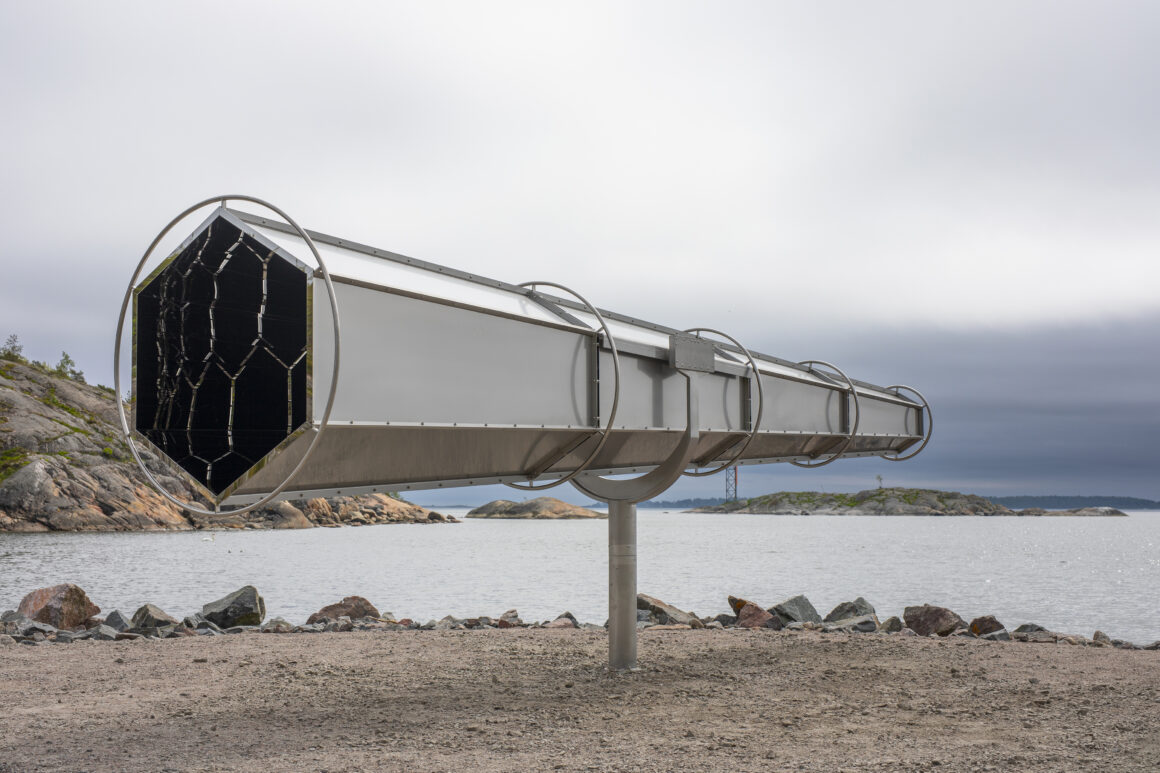
The Helsinki Biennial has a practice of commissioning permanent artworks, which includes a number of new commissions this year for ‘SHELTER’. Sara Bjarland’s sculptures, entitled Stranding (2025), are bronze casts of semi-deflated, dolphin-shaped, plastic swimming floats, beached on the rocky shore. These emotive works are forever trapped in the liminality of half-inflation, underlining the permanence of plastic waste and the fragility of marine ecosystems.
Irish artist Katie Holten’s work, Learning To Be Better Lovers (Forest School) (2025), straddles two separate sites: an indoor ‘classroom’ set-up on Vallisaari, and an installation of flags along the Esplanade. The classroom offers a communal, participatory experience, which gently asks viewers for their time and contemplation. Holten presents a reimagined alphabet, which includes letters from the Finnish alphabet as well as drawings of trees, plants, fungi, and birds from the island. An accompanying guide includes walks, instructions, conversations, breathing exercises, and a considered text, written by the artist. The alphabet and guide are available to download from the biennial website (helsinkibiennaali.fi).
As with many of the other works, Learning To Be Better Lovers is concerned with the climate crisis without inciting feelings of helplessness or hopelessness. There is a direct dialogue between art and landscape, with plenty of space to meaningfully connect with this proposition. However, the busy Esplanade promenade in Helsinki city centre is a tough site to present work. Holten’s work is exhibited as a set of flags, which manage to both stand apart from the busy site while appearing to integrate into the fabric of the city. The flags contain ‘letters’ of the Forest Alphabet. Even if a viewer does not read the accompanying explanatory text, there is still the feeling that the flags are communicating something. Esplanade Park has a colonial appearance, with manicured lawns and trees planted in rows, casting dappled shadows on bronze monuments. Holten’s work reminds us that there are alternatives to prevailing systems, with re-foresting and re-wilding conceptualised as acts of love.

HAM contains works that benefit from a gallery space rather than an outdoor environment. Ofrenda (Offering) (2024), an installation by Regina de Miguel, comprises paintings, engravings, and a mural, which read as a visual encyclopaedia of a multi-species, harmonious universe. Engravings on metal plates are reminiscent of the Voyager Golden Records – phonograph records, launched aboard the Voyager spacecrafts in 1977, containing sounds and images, selected to portray the diversity and beauty of life on Earth to extraterrestrials.
Artist/activist Jenni Laiti and photographer/reindeer herder Carl-Johan Utsi, both Sámi, present the beautiful video work, Teardrops of Our Grandmother (2023). It is a poetic meditation on the precarity of Sámi life and culture, due to shifting arctic weather conditions and other persistent threats to Indigenous communities. The piece explores the relationship between intergenerational trauma, the land, and the animals bonded to it. Like Holten’s work, the piece invites the viewer to slow down, nurture their relationship with the natural world, and participate in nature’s healing.
The curators describe ‘SHELTER’ as a “caring space where all lifeforms can thrive” (sttinfo.fi). The focus on non-human nature and indigenous narratives creates perspectives not traditionally prioritised within the Western art canon. However, across a former military site, manicured park, and white cube museum space, we are reminded of the negative impacts of colonialism and capitalism on our world, which cannot be disregarded.
Maeve Mulrennan is Assistant Arts Officer in Cork County Council.