Cultúrlann McAdam Ó Fiaich
23 October – 27 November 2025
‘Fallen Tree / Crann Leagtha’ is a collaborative exhibition at Cultúrlann by Sharon Kelly and Pádraig MacCana – Belfast-based artists who are also a married couple. The exhibition features six mixed-media works and three collections of drawings, all dating from 2025.
With the majority of works being attributed to both artists, it was very much a collaborative endeavour (rather than a two-person show) or, to cite the contraction employed by Ellen Mara De Wachter in her research on artist collaborations, an example of ‘co-art’ in which “dialogue between sameness and difference, and the practice of sharing and contesting ideas [remain] essential.”1
Opening the exhibition is The Tower / An Túr. At almost six metres tall, the piece takes full advantage of the gallery’s multi-storey height and vertically curved wall. A gallery text informs visitors of the artists’ “conscious decision […] to utilise basic everyday materials”. As with several works in the show, The Tower makes ample use of corrugated cardboard packaging; three large, shallow boxes are stacked precariously to form the eponymous tower. Balanced at the summit is a female figure, whose outstretched arm dangles a set of ‘listening cans’, like the scales in the allegorical hand of justice. A primitive form of communication, this tin-can telephone has previously appeared in other works by MacCana (not exhibited here), while the broken or fragmented body is a central motif in Kelly’s practice.
Inside the cardboard structure are two more figurative cut-outs, flanking a continuous collage of an Ordnance Survey map of Hadrian’s Wall. The orange line that traces the Roman-built barrier echoes the twine linking the tin cans. In the lowest box is a small cut-out tree. This conjunction of tree, Hadrian’s Wall, truncated figure, and the general destabilising nature of the tall piece, calls to mind the act of environmental vandalism visited upon the Sycamore Gap Tree in 2023. Speaking about the work, the pair said that the “long strip of map could also reference parts of the world that are under oppression and attack.”
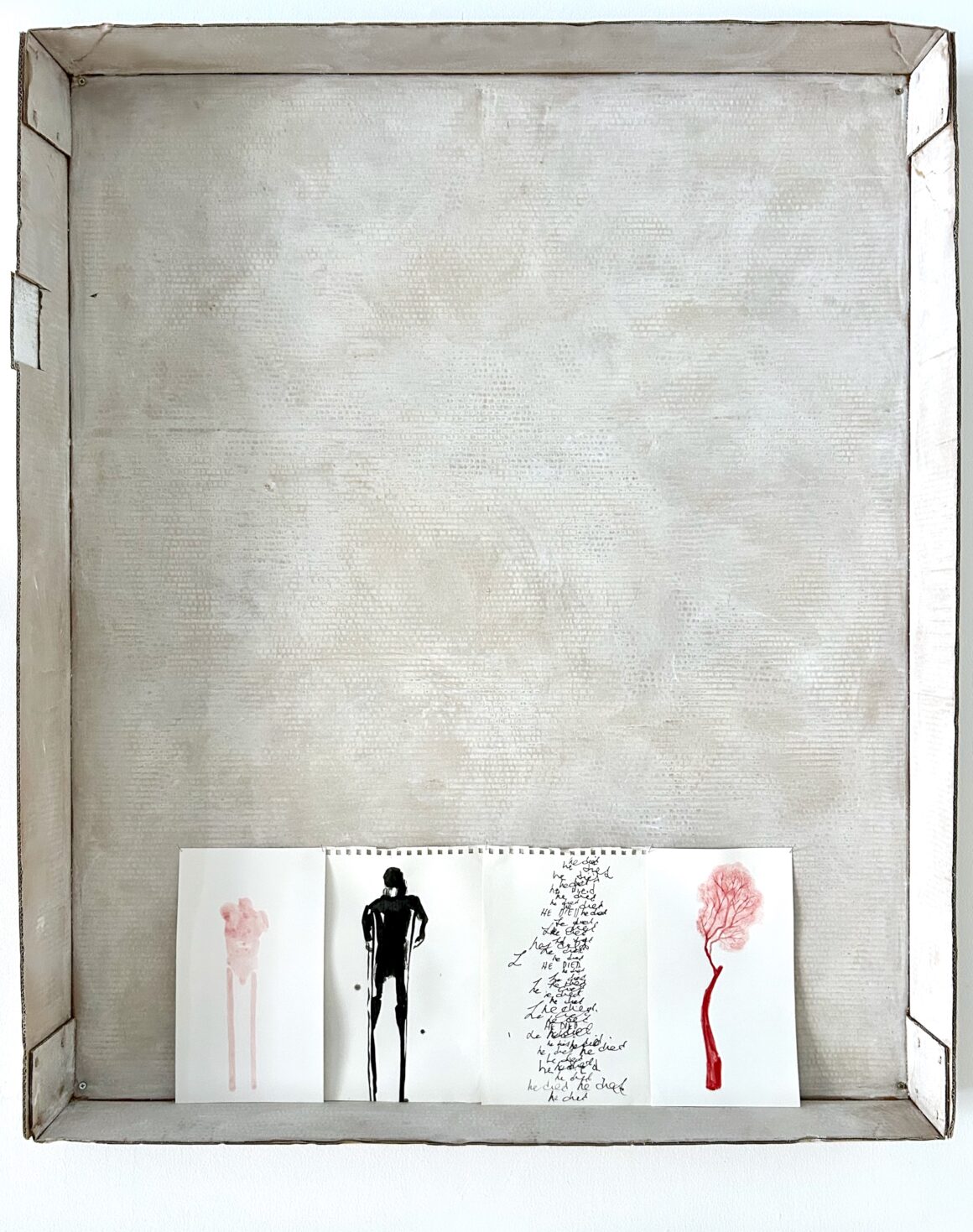
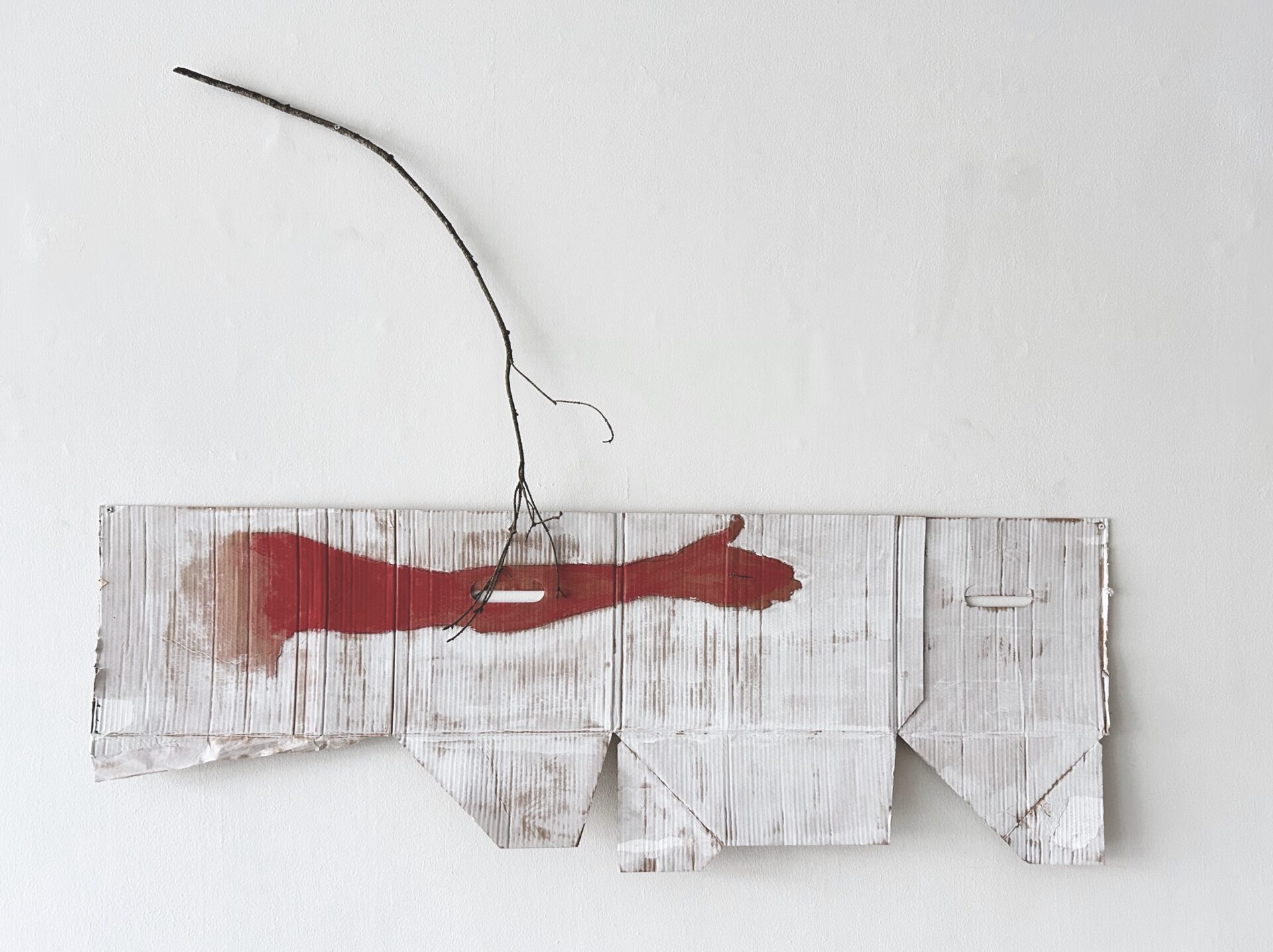
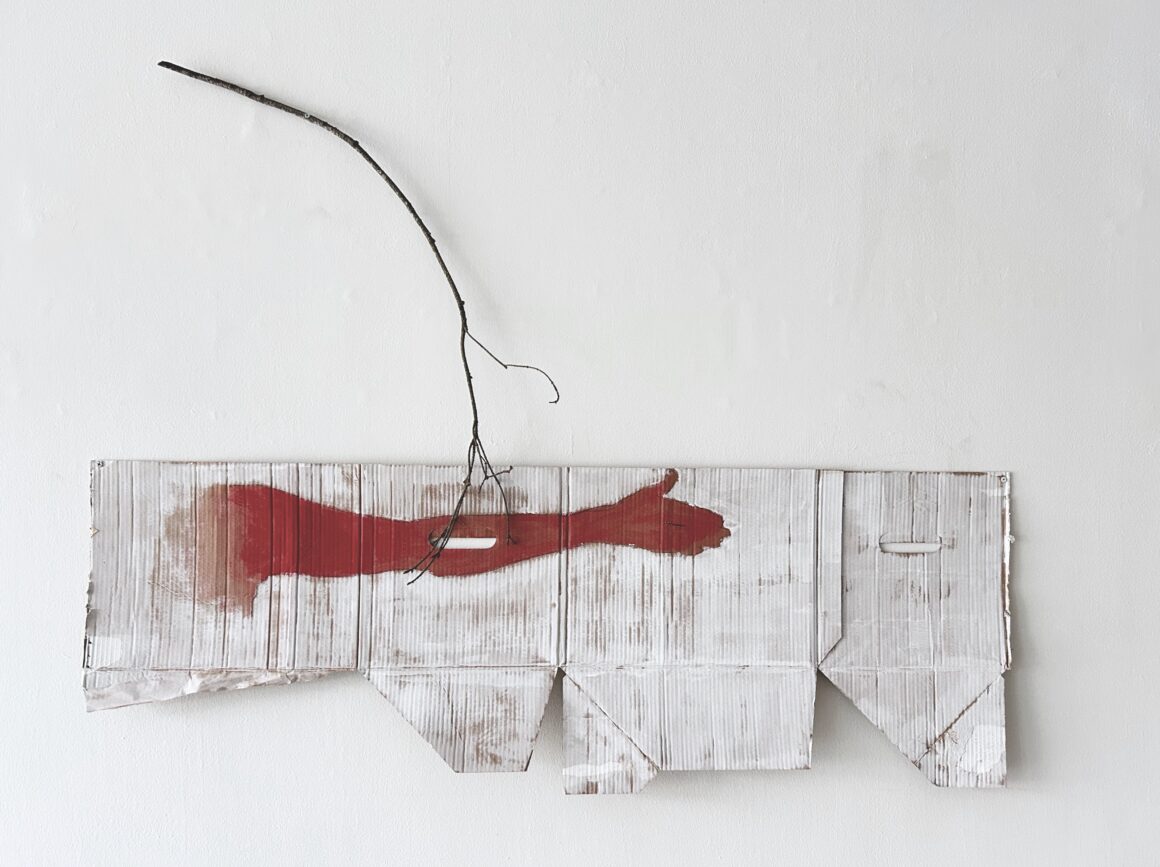
The body-tree juxtaposition features more explicitly in subsequent works. The Treatment / An Chóir Leighis, for example, shows a slender curving branch overlapping an extended arm, painted in red on primed cardboard. The positioning of the branch, as well as the artwork title, suggests an intravenous drip. Elsewhere, in He Died / Fuair Sé Bás and Manuscript / Lámhscríbhinn, the words ‘He Died’ appear in the former as frottage in a Roman font, over scribbled, black crayon; in the latter, it is written repeatedly in black ink. Both works suggest personal loss and attempts, perhaps, at acceptance. In Fallen Tree / Crann Leagtha, rags are tied in strips to a section of a found tree, reminiscent of the rag trees located near holy wells, often dedicated to specific cures.
Three sets of drawings appear towards the end of the show, each attributed to an individual artist. MacCana’s Roman Tree Series is a grid of 20 graphite sketches of several tree species, some visible in their entirety and others cropped. They each have a sense of being completed works, rather than preparatory studies. Many contain lines at right angles that hint at borders, tiered terraces, pathways, or background buildings, generally indicating a constructed landscape.

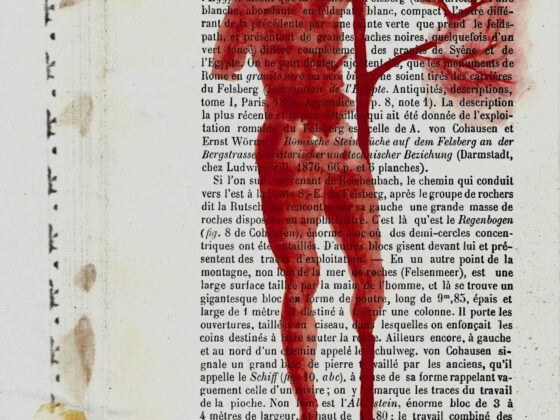
Kelly’s Roman Book Pages comprise red watercolour studies on pages of text, repurposed from Italian and French vintage books. Here, and in the adjacent Statues / Dealbha series, female forms are variously juxtaposed or merged with trees. I later learn that the depicted trees are those of the Villa Borghese Gardens, drawn by the artists while on residency at the British School in Rome. I think of Bernini’s marble sculpture, Apollo and Daphne (1622-25), housed in the Galleria Borghese, located within the same gardens, which depicts the nymph’s transformation into a laurel tree – her hair becoming foliage and flesh turning to bark, as her feet grow roots. In other drawings, and indeed other collaborative pieces throughout the exhibition, trees are represented as struts or supports to missing limbs, suggesting the natural world as an armature for healing.
Jonathan Brennan is a multi-disciplinary artist based in Belfast.
jonathanbrennanart.com
1 Ellen Mara De Wachter, Co-Art: Artists on Creative Collaboration (Phaidon Press, 2017).