Queen Street Studios + Gallery
12 March – 16 April 2026
‘Watching a sunset, 8.49 pm’ is an exhibition at QSS in Belfast of new work by Sligo-based artist, Andy Parsons, created over the last two years. This is the first iteration of a touring exhibition that will change and adapt to six different venues around Ireland. The time in the exhibition title will gradually increase with each presentation, culminating early next year at Esker Arts Centre in Tullamore with ‘Watching a sunset, 8.54 pm’. The exhibition comprises nine paintings, mostly acrylic on canvas, all sharing the title Watching a sunset, as well as a large group of objects called Sculptures of watching figures.
Watching a sunset (red quartet) shows four figures seated on the ground – striped forms indicating towels or picnic blankets – with knees drawn up or in various states of recline. Facial features are evoked in shades of cobalt blue, mixed wet on wet, with scarlet undertones. One figure smokes; another smiles. The figures seem at ease, all facing in one direction, as if waiting for something to take place – a ceremony, spectacle, or initiation.
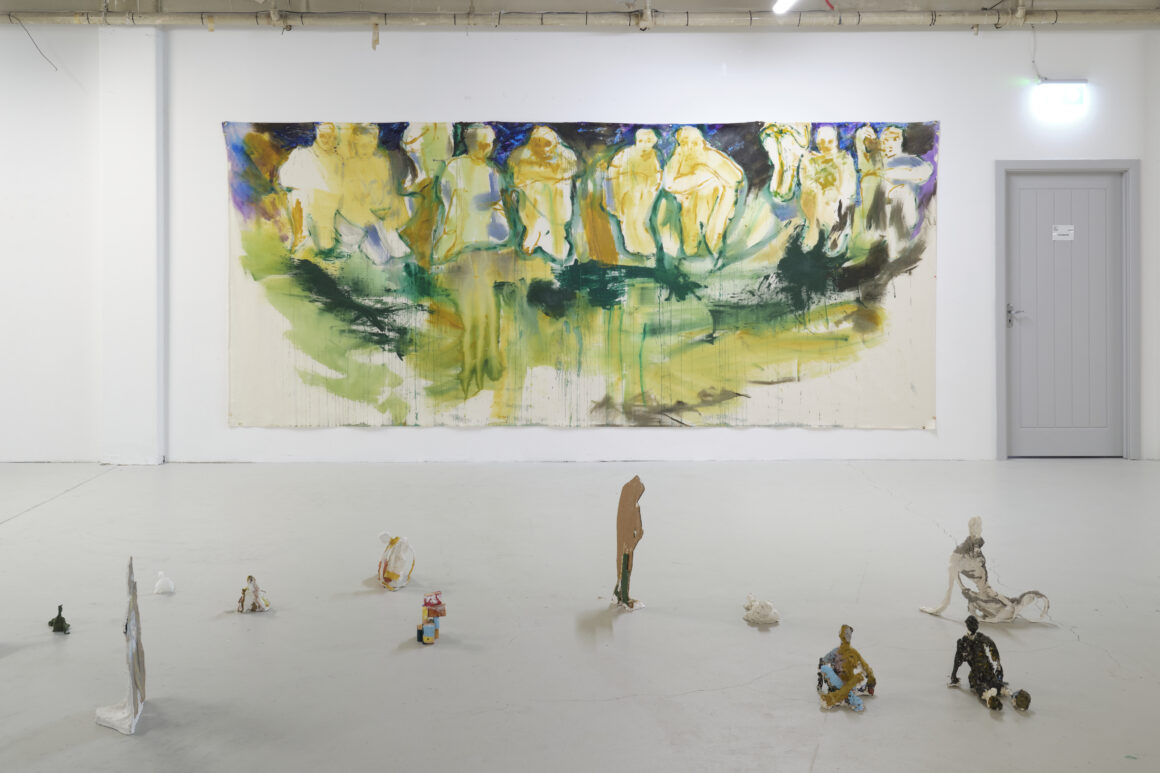
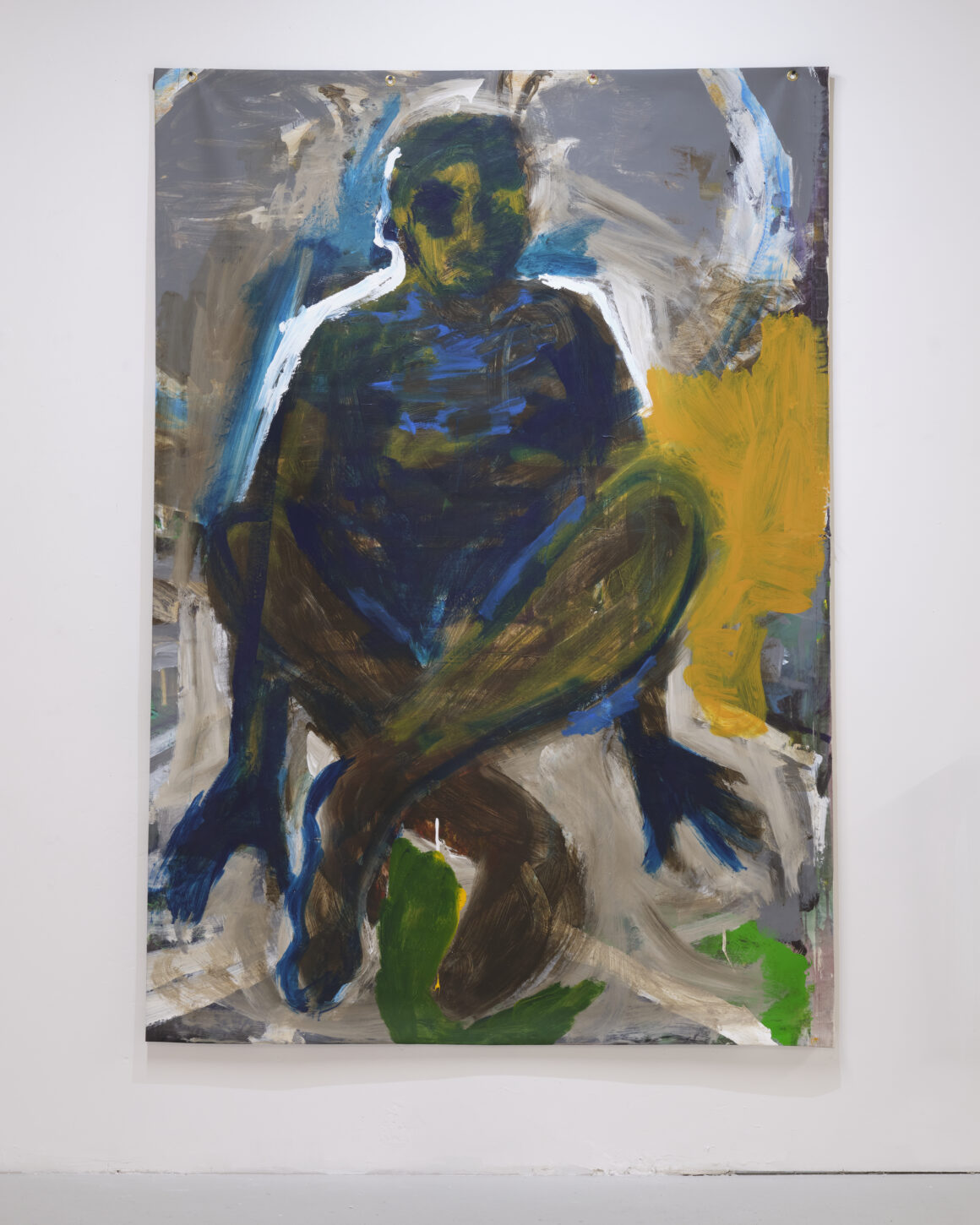
Watching a sunset (after Henry Moore) and Watching a sunset (through a phone) act as a pair; both are acrylic on canvas and are hemmed and fitted with eyelets. Each features a supine figure, with knees raised and legs crossed at the ankles. The Henry Moore reference could denote any of the sculptor’s reclining forms, yet it is the foreshortened body in Mantegna’s Lamentation over the Dead Christ (c.1480) that first springs to mind, despite details like shoelaces that indicate modernity. The figure opposite, painted almost entirely in yellow apart from the white trainers, holds up a smartphone that obscures the face, engrossed in the virtual world or in a mediated version of reality, while a yellow wax sculpture, one of the ‘watching figures’, mirrors the painting in miniature. In total there are 42 figures, striking every conceivable pose, and fabricated in multiple styles, using an impressive array of materials – from clay, plaster, and acrylic, to wire, wood, card, and 3D-printed elements.
Watching a sunset (after Michelangelo) takes the voyeuristic theme of ‘red quartet’ to a monumental scale. Populating the upper half of the five-metre-wide canvas is a group of some ten figures seated on the ground, some only partially visible, alone or in groups, while several engage with mobile phones. They are delineated in earthy tones, blocked in with yellow, and outlined in darker greens, blues, and mauves. A lot is left to interpretation, the loose brushwork suggesting half remembered things. The lower section is an abstract swathe of washes and broad brushwork indicating a body of water. Again, the group has the air of relaxed expectancy of music festival goers waiting for a performance to begin. The work’s title references Michelangelo, and perhaps specifically his fresco for the Sistine Chapel, The Last Judgement (1536–1541), yet my thoughts also drift to the huddled coven of Goya’s Witches’ Sabbath (1798).
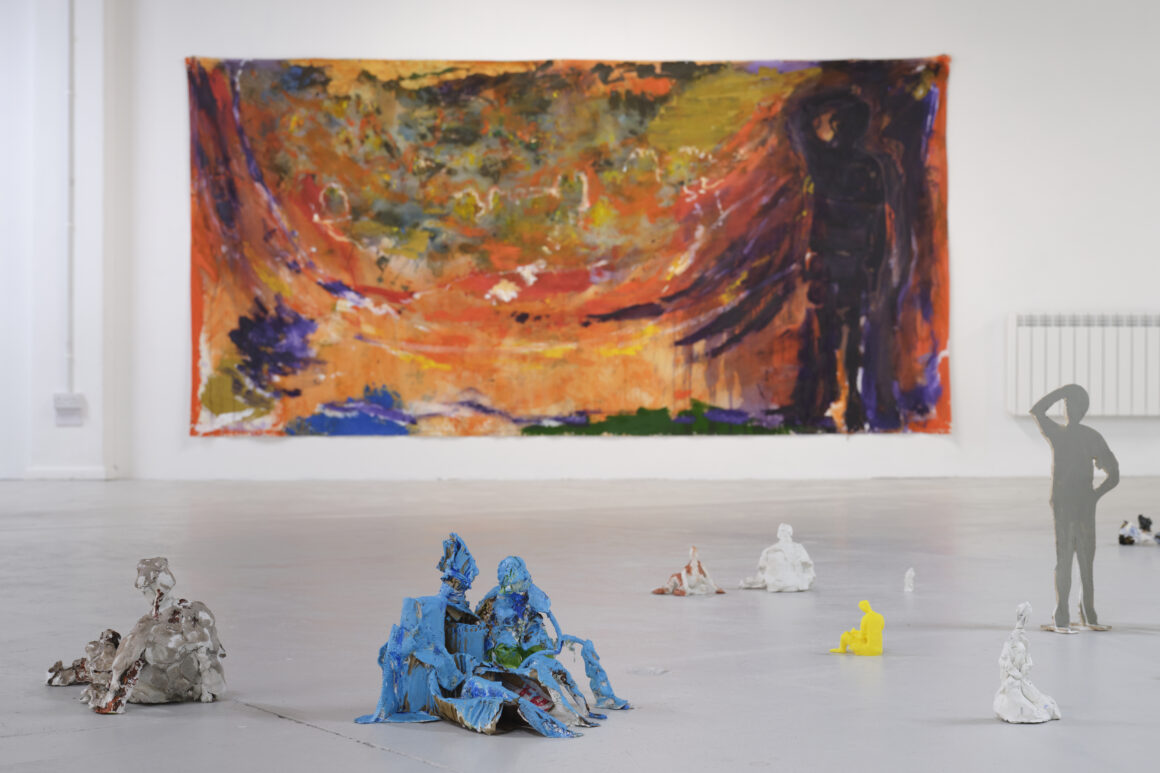
Watching a sunset (Love’s easy tears) (2026) is of a similar scale but employs a very different colour palette and composition. To the right, a large figure in silhouette raises a hand to screen their eyes to view the sunset. The rest of the unstretched canvas is filled with colour fields of orange, red, purple and yellow that conjure up a riverbend or natural amphitheatre. On closer inspection, this section reveals small groupings, reminiscent of the cavorting couples in the desert scene of Antonioni’s 1970 film, Zabriskie Point. In fact, there is something quite nostalgic about people gathering in nature, yet the appearance of smartphones grounds these works in the contemporary era.
Punta Cometa is a headland on Mexico’s Pacific coast where people gather to watch the sunset. I remember a person there beating a drum, the tempo slowly increasing as the sun dipped ever closer to the horizon. Parsons, speaking of the “human need for fellowship and beauty through interactions with the natural world,” sums up this memory for me perfectly. Even if elements of the modern experience of this simple activity might, due to the ubiquitous smartphone, lean towards the performative, or be mediated by screens, surely now, at a time of imminent environmental collapse, the communal act of celebrating a beautiful natural phenomenon, free and open to anyone, is worth commemorating.
Jonathan Brennan is a multi-disciplinary artist based in Belfast.
jonathanbrennanart.com