SO Fine Art Editions
5 March – 4 April 2026
Michael Corrigan, a Dublin-based photographer and former Chair of Visual Artists Ireland, presented his new exhibition, ‘Margins’, at SO Fine Art Editions. ‘Margins’ reflects on the evanescent borders between land, sea, and sky.
On first encounter, the exhibition presents a wide array of black-and-white landscape photography, focusing largely on the shorelines of Sligo, south Dublin, and Wicklow. Coastal photography has an immediate attraction: poised between the organic and the sculptural, the forms of the shoreline blend upper vastness, tidal patterns, and mineral formations shaped by millennia of erosion. It is no wonder that Immanuel Kant, father of modern aesthetics, felt that beauty and sublimity were registered most eloquently in nature – the monumental forms, and raw energy they embody, stirs an ancient fascination.
By chance, I happened to bump into Corrigan during my visit to the gallery, and our conversation turned to method. First, he explained that his instinct is to use a wide-angle lens, drawing background and foreground into a single field, in order to foster a sense of forces held in balance. In some of his work, this balance is fraught – in others, magisterially tranquil.
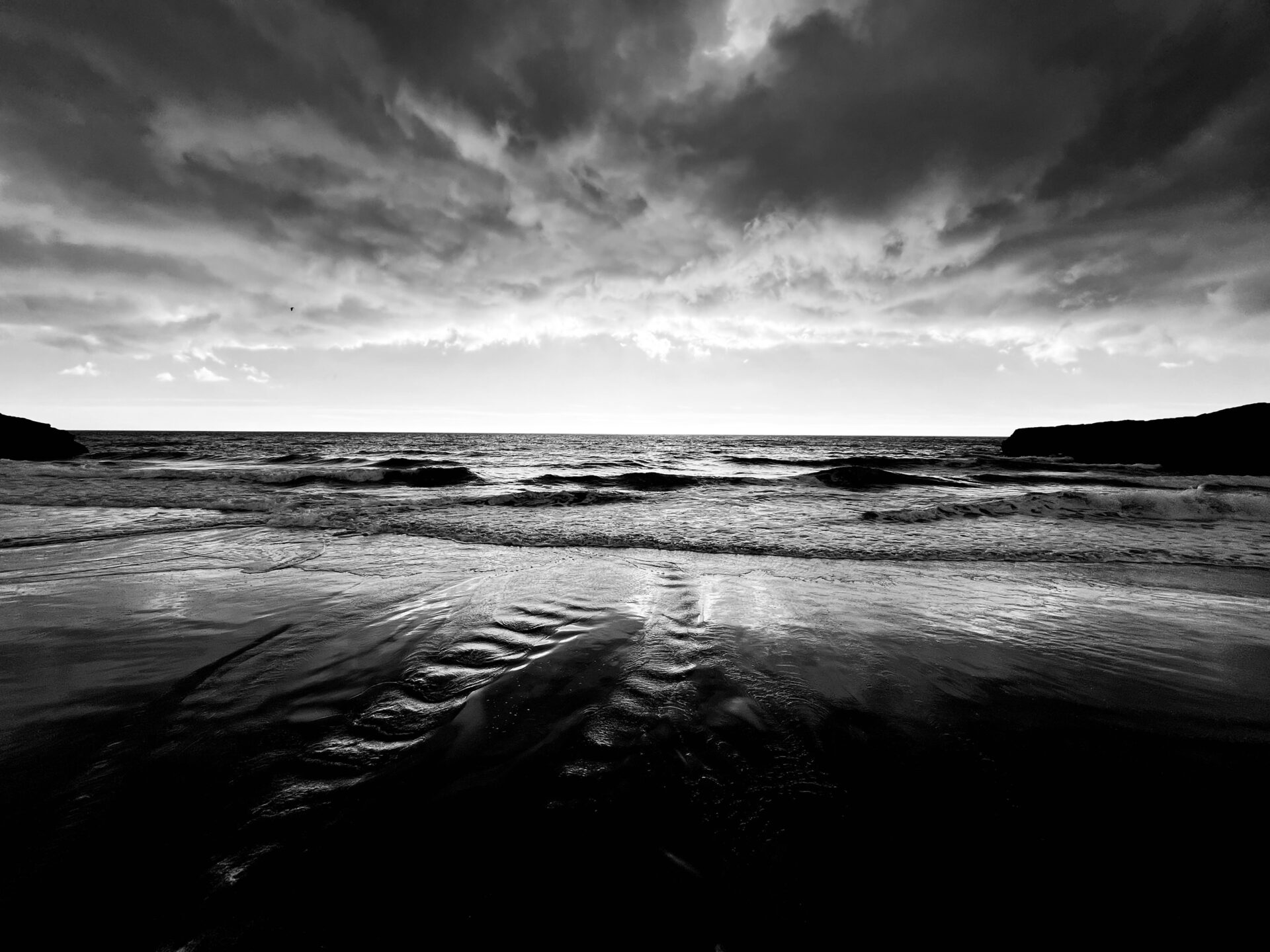
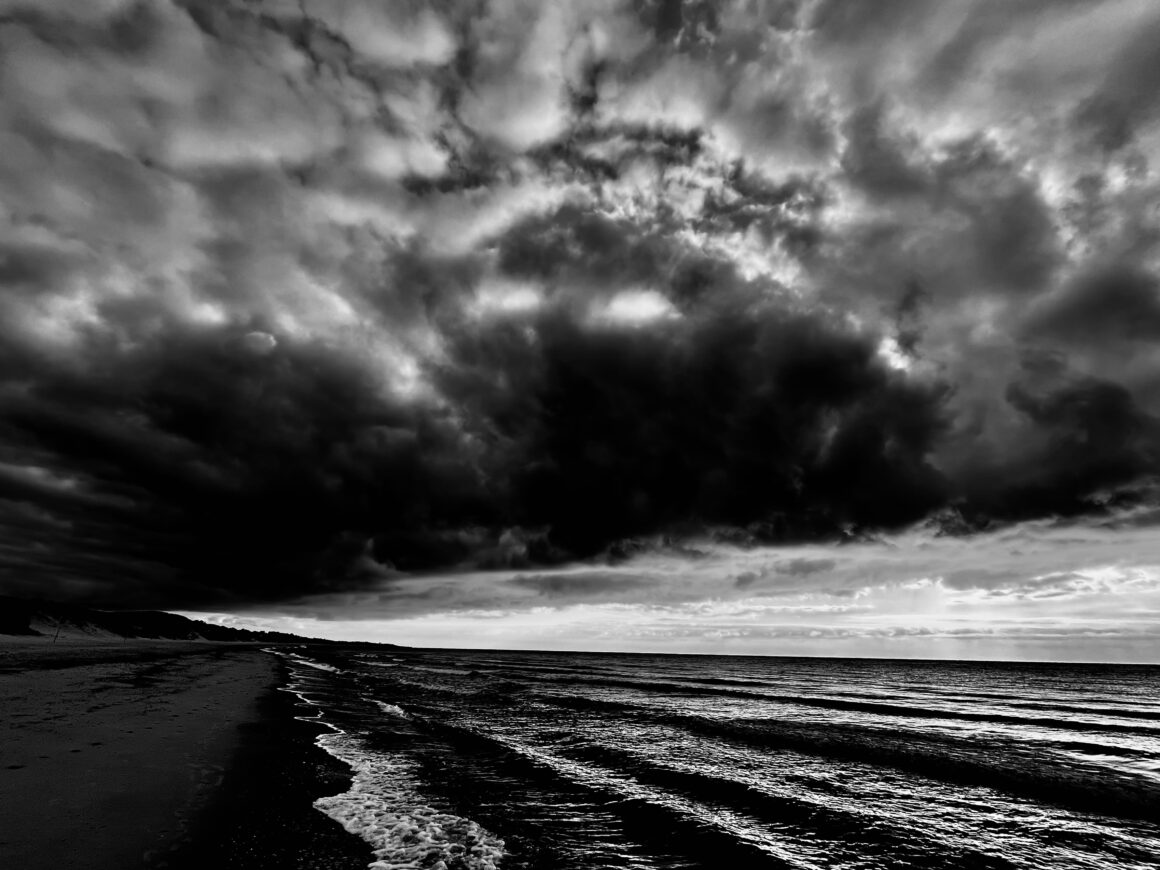
Take the imagery of Strandhill, Sligo. The elements seem to abide one another tensely, almost in open hostility, as though each are vying for dominance. Skies loom, clouds race, coastlines tilt, and the horizon becomes a metamorphic seam where earth melts, and water evaporates into the air. These monochrome stills convey a sense of turbulence, of struggle, and this effect is amplified by Corrigan’s technique of turning into the light. By defying standard photographic guidance, the artist is able to render clouds as luminous, backlit masses within the frame, thickening their presence with an internal, threatening intensity.
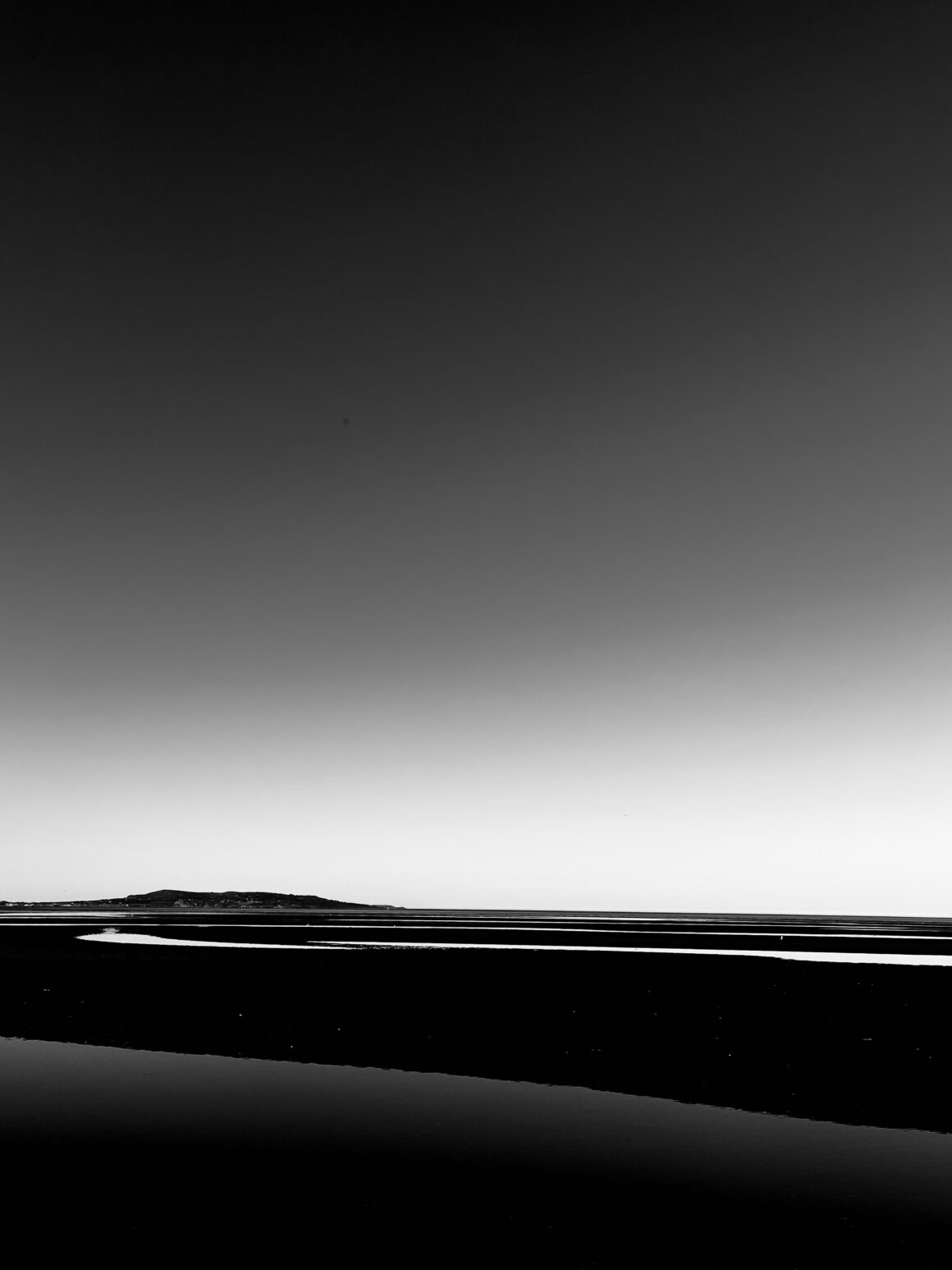
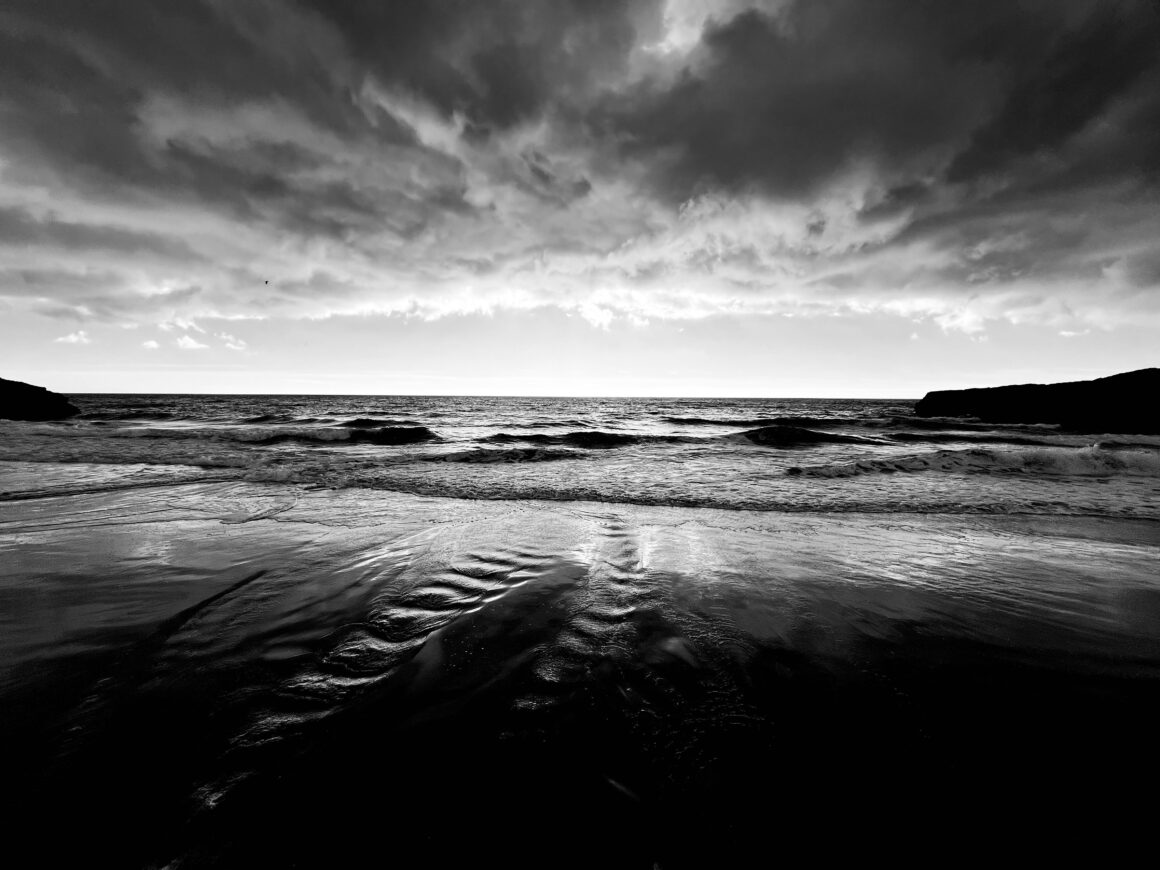
Yet other landscapes seem to convey the opposite – freezing time in a delicate, harmonious composition. The Booterstown, Dublin, imagery may be the zenith of Corrigan’s efforts in this direction: meditations on the co-existence of disparate elements, each component residing peacefully, though forcefully, in its own plane. These photographs, perhaps more than any others in the series, employ signature stark contrast to dramatic effect. To achieve this feat, Corrigan was required to adopt an early morning routine. By working at dawn, the artist could take advantage of that time of day when clouds are haloed by sunlight, and the ground remains in relative shadow.
We should reflect a moment on the title. The word ‘margins’ entered the English language sometime in the 14th century, and names spaces that are at the edge, the periphery. By their nature, such spaces have no fixed location – they are beyond the centre, but lack the definitional clarity of a border. Margins, consequently, blur boundaries: coastline dissolving into ocean, sky into horizon, water into air. As Sarah McAuliffe suggests in her accompanying text, Corrigan’s landscapes are also spaces that are marginalised – pushed aside, treated as unimportant or unglamorous – by our contemporary, image-saturated culture, which is so attuned to spectacle.
To my mind, the title also productively evokes the borders of a page or text, those blank spaces where notes and personal reflections accumulate – small interventions within an impersonal surface. More specific to analogue photography, print margins allow space for handling without touching the image during the chemical developing process. And, in the popular phrase ‘margin for error,’ the term is associated with a sense of accommodation, or permissible deviation – imperfection without catastrophe. These allusions, nestled within a single word, draw the audience further into the artist’s perspective on his subject matter.
Corrigan’s work sits in dialogue with the photographic tradition, and, in our conversation, he explicitly cited Bill Brandt as an influence. Brandt, a German-born British photographer apprenticed to Man Ray, was deeply shaped by photographic modernism. His work ranged from stark social documentary during the Second World War to later experiments with the female nude. Corrigan’s use of the wide-angle perspective and his sensitivity to tonal contrast echo aspects of this legacy. In ‘Margins’, Corrigan demonstrates that the periphery is not a site of absence but of intensity.
Tom Lordan is a writer and art
critic, motivated by contemporary European philosophy and its historical inheritance.
tomlordan.com