WRITER MAYA KULUKUNDIS INTERVIEWS FIRESPINNER, AERIALIST, AND PERFORMER, POLINA SHAPKINA.
Maya Kulukundis: Your work encompasses a wide variety of forms. I would be reluctant to pigeon-hole you into any one category, so I would like to ask how you would describe your practice.
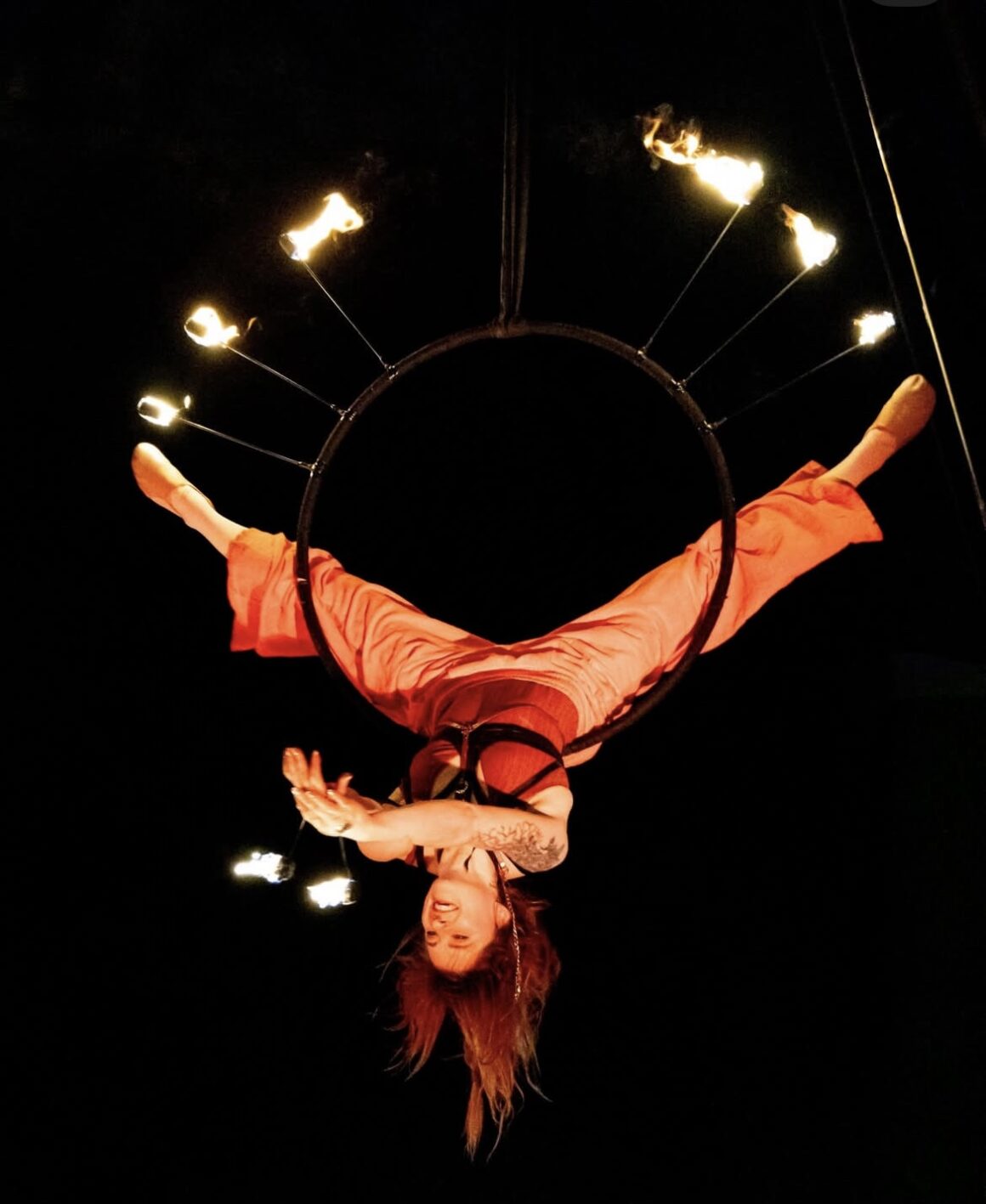
Polina Shapkina: The way to survive as an artist in Ireland, financially, is to do a variety of different things. Officially, I’m a circus performer. I work with a variety of companies and do middle-of-the-road circus acts. Being a freelance performer is very liberating because you’re just there to have fun with an audience.
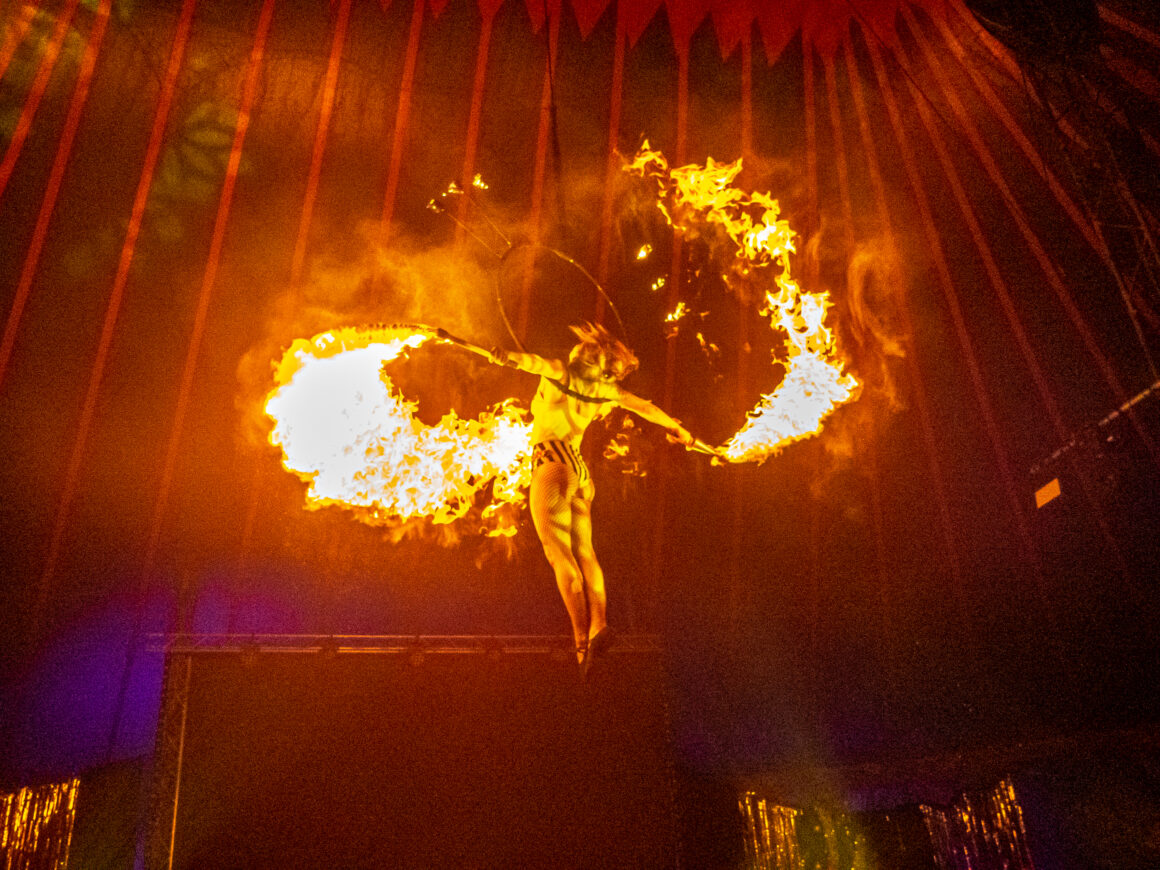
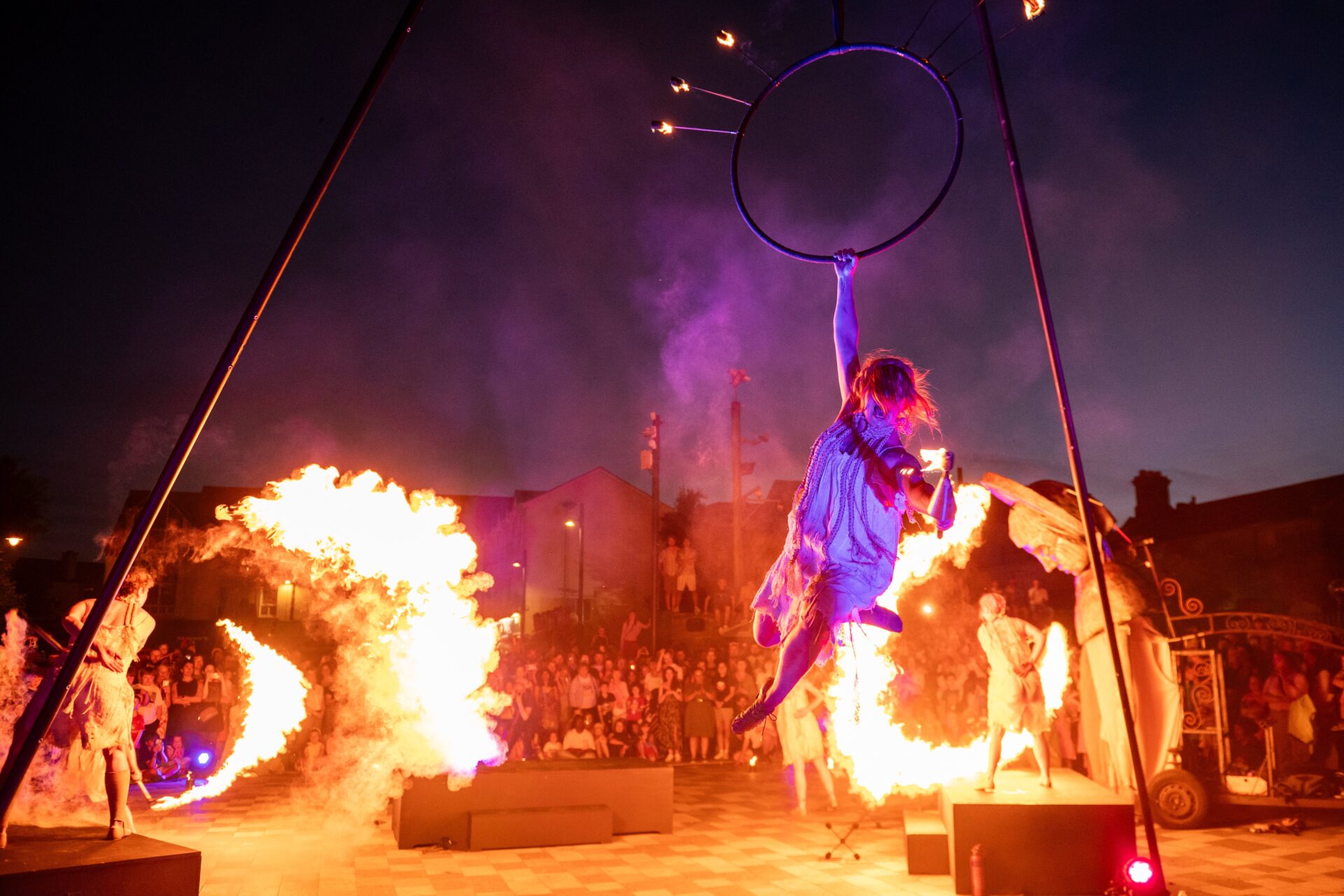
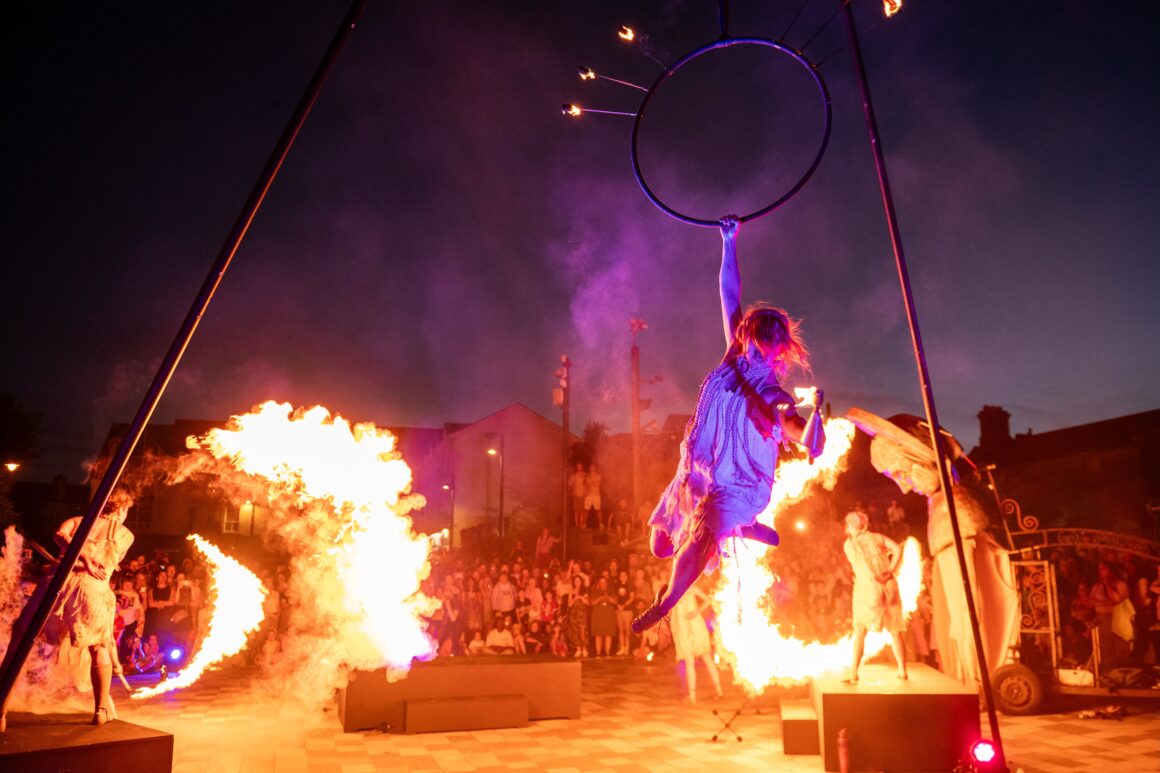
I am also the artistic director and a performer in a spectacle company called ‘VolkiDána’. We mostly do outdoor street work encompassing fire, aerial acrobatics, and storytelling. ‘VolkiDána’ is about making people mystified and bringing them into a new world. It is about experiencing joy alongside an audience.
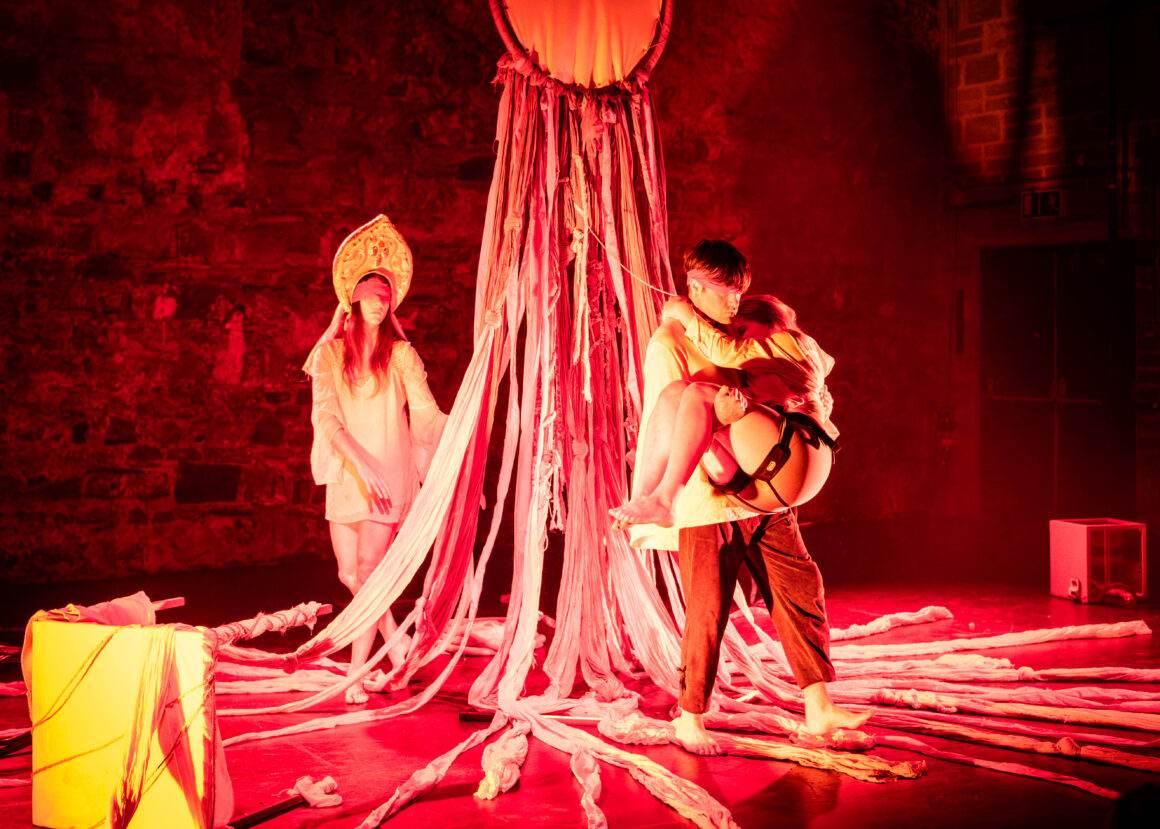
Then, I make more experimental work, which includes aerial dance and physical theatre. For those performances, I am starting to go under the name ‘Unhinged Village’, because it feels funny putting my name on the projects when it takes a village to make them. It’s a very collaborative process.
MK: You’ve previously spoken about returning to a childhood sense of wanting to be ‘an artist’ after a long period of disconnection from art, which was at times quite destructive. How do you understand that journey now?
PS: I couldn’t be more grateful for the cards I’ve been dealt. It has taken a lot of hard work, but honestly it was by chance. I wandered into aerial arts as a hobby, and it led me away from a very self-destructive path.
I’m not sure why I was so destructive. I had a real melancholy about me as a child and as a teenager, like many people do, but it followed me into early adult life. I think that in the Western world – where we don’t have to think about starving to death, and where most of us have some form of shelter – there is a lot of space for the mind to wander. Suffering is a part of being, so if we do not have a physical form of suffering, we have a mental or spiritual form of suffering.
The physicality of aerial classes gave me a new kind of endorphin that pulled me away from the drinking, the drug-taking, the being miserable. So one addiction replaced another and then I got addicted to pushing myself physically. And then one addiction replaced another, because I got addicted to pushing myself physically. Then, I remembered that I had wanted to be an artist as a child. I had always thought that meant being a painter or a writer, but I realised: “Wait, I can express this impulse physically.”
MK: Carl Jung’s idea of the ‘shadow self’ is a recurring feature in your work. How has it informed your creative process?
PS: I first looked into Jung when I was about 14 because I loved a rock band called Tool, and they have a song about the shadow. I became obsessed with the concept, even though I didn’t fully understand it.
As I got older, I noticed I had a deep sense of shame. I was aware that I hated or despised in other people things I could also recognise in myself. So, I ended up hating both myself and the other person, because we were doing things that felt at odds with my sense of morality or fairness – things like jealousy, slyness, or aggression, traits I perceived as undesirable. These are all linked to the shadow self: repressing certain parts of yourself that feel at odds with who you think you should be. For me, engaging with the shadow was about accepting my darker instincts. Admitting that can be liberating and empowering – you have the capacity to be someone you might be ashamed of. We all do.
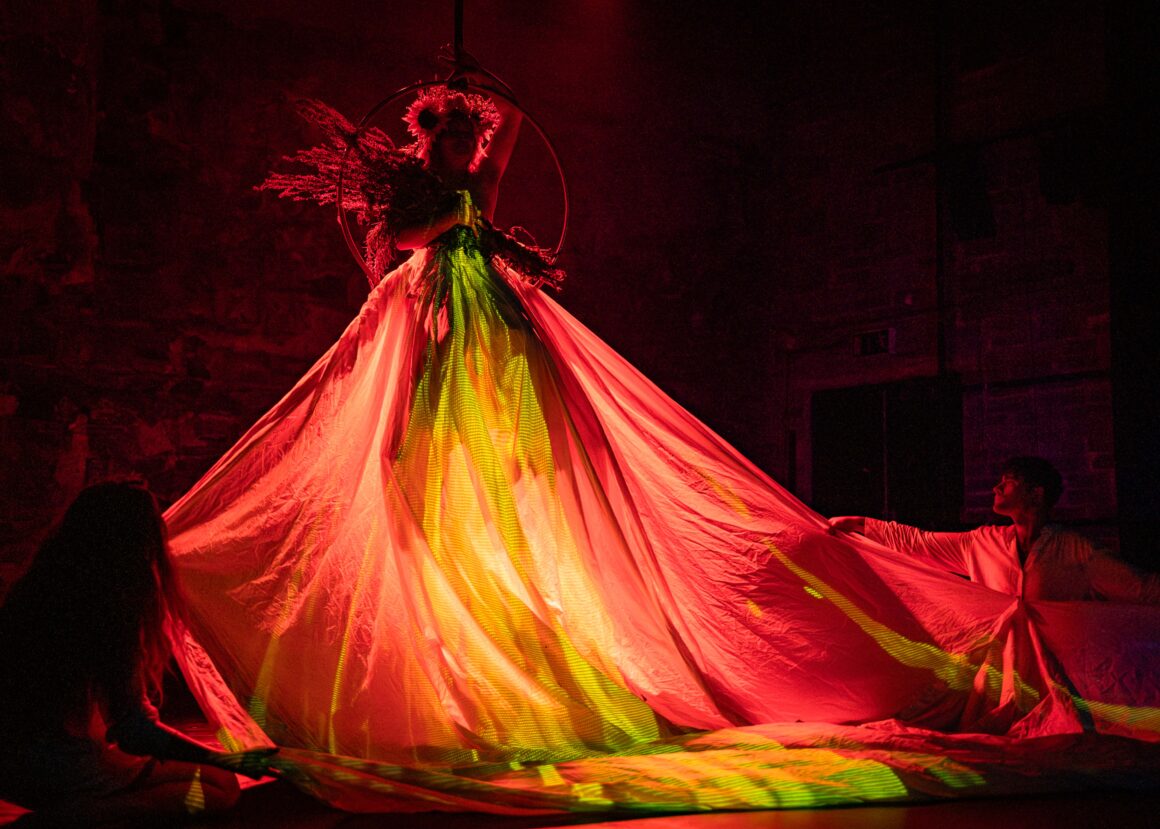
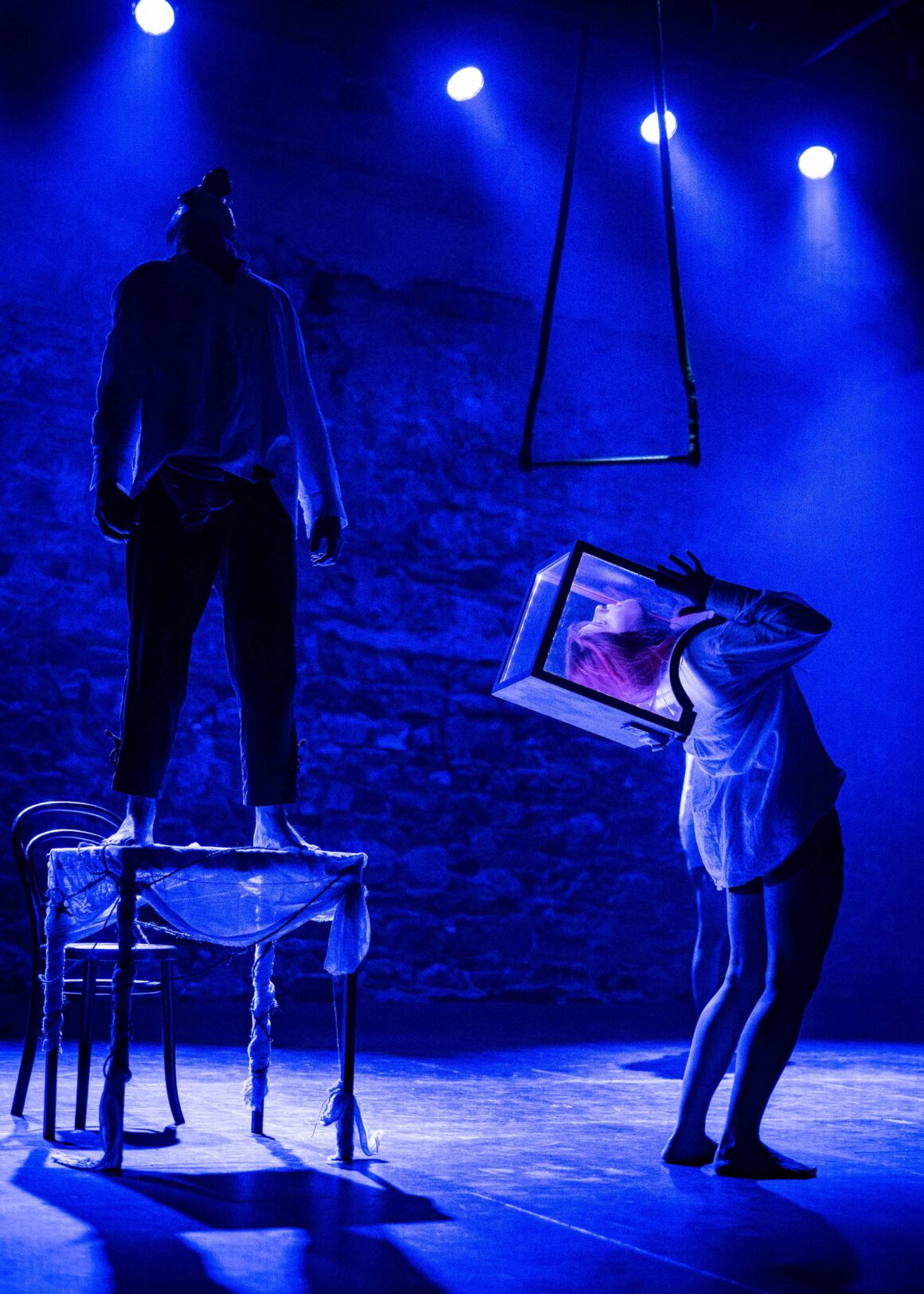
In my 2023 aerial performance, Makosh, which is autobiographical, I was exploring my personal shadow. Then, while I was making it, Russia invaded Ukraine, and the piece took on a societal dimension. I was born in Russia and raised in Ireland, and I have a lot of loved ones in both Russia and Ukraine, so the war created a huge internal conflict.
Growing up as part of the Russian diaspora meant being in love with where I came from and feeling proud of it. And suddenly I saw that I had been romanticising a culture that carried an immense shadow: the endless colonisation of its neighbours. I saw that this was something I had wilfully ignored for most of my life. All of this concentrated for me around the idea of a societal shadow: one that emerges when everybody agrees on one thing, and that herd mentality becomes contagious.
There’s a scene in Makosh where the characters are wearing gas masks. The masks are a symbol of uniformity, but also of protection. They protect you from admitting to the darkness within your group – because the stakes of doing so would be so high.
MK: In Cartographies of Diaspora, sociologist Avtar Brah considers ‘home’ as a ‘mythic place of desire’ rather than a physical location. As I was researching your work, I found myself returning to this idea. But it seems like the making of Makosh and the start of the war was a break for you from this ‘mythic place’. Would you agree with that?
PS: Absolutely. It’s funny you mention that; I just got a bursary to explore a project called Diaspora. The project is about mythologising a place so much that it becomes a fantasy – a holy fantasy. We’re redesigning an aerial rig as a shrine and we plan to interview diaspora members about visual and sensory elements of their culture that they would put on this shrine, to symbolise this fantastical place that lives inside them – one at odds with the actual country.
I used to go back to Russia all the time, but when work got really busy, I gradually stopped going. Then the war started, and now I’m afraid. I feel spooked by the idea of going back. In my mind, there’s still a home there, but my family members are slowly passing away. The reality is that ‘home’ isn’t there anymore, and most of those people aren’t either. I don’t like thinking about it. It’s painful. And romanticising my home doesn’t even feel soothing anymore because there is a darkness about it. There is real darkness in the world. We can all feel it.
MK: How do you feel about creating art in that darkness?
PS: I know we should always be interrogating, always fighting for change, but there’s something to be said for keeping the general morale high too. I think of art as a spectrum. On one end is existential, introspective work, and on the other is glitter and explosions and fireworks and happiness and claps. I think all of it is valid and important. But I have started to wonder whether putting out darker material is as beneficial.
What I’m questioning is the balance between the audience’s experience and my own creative desires. What do I gain from making a show, from a performance, and what does the audience take from it? Maybe the less self-indulgent approach is to focus on the giving side: what experience do you want to give someone else? But perhaps when you remain true to yourself, what you give to the world will ultimately be authentic and powerful.
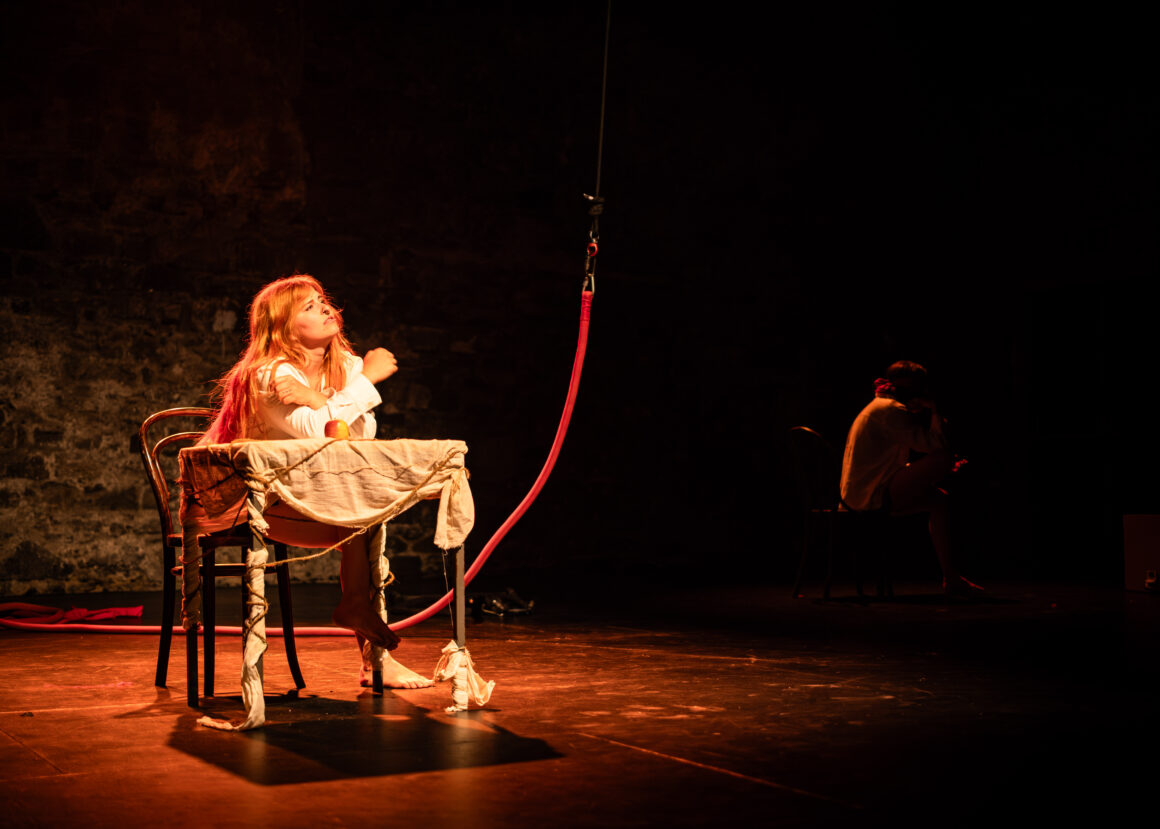
Sligo-based artist Polina Shapkina is a performer and director of Contemporary Circus. Her work spans from Spectacle to experimental theatre, and disciplines include aerial dance and experimental theatre. Through her work, she relishes exploring themes around existentialism, mythology and ritual.
Maya Kulukundis is a fiction writer and critic whose work has appeared in outlets including Banshee, The Irish Times, The Lilliput Press, Books Ireland and The Irish Examiner. She is the assistant curator at the Festival of Writing and Ideas.