JOANNE LAWS REPORTS ON A PILOT INITIATIVE TO ENHANCE THE INTERNATIONAL EXPOSURE OF IRELAND-BASED ARTISTS.
When attending the 12th edition of the Liverpool Biennial in June 2023, I was perplexed to find that no Ireland-based artists had been selected to participate in the programme. Notwithstanding the creative synergy that had been cultivated with the Irish visual arts community in recent years, Liverpool has always held robust historical connections to the Irish diaspora. An accessible port of entry during the Great Famine and beyond, the city’s demographics and cultural landscape have been significantly shaped by Irish immigrants.
Curated by Cape Town-based independent curator, Khanyisile Mbongwa, and titled ‘uMoya: The sacred Return of Lost Things’, the 12th edition aimed to “address the history and temperament of Liverpool” – a city deeply intertwined with the colonial era, when it served as a major port for the exchange of goods and enslaved people between the West Indies, Africa, and the Americas. Indeed, the city even has an International Slavery Museum to mediate this dark history, and several key exhibitions were staged for the biennial in a former tobacco warehouse in Stanley Dock.
If ‘uMoya’ was a “call for ancestral and indigenous forms of knowledge, wisdom and healing” I could think of more than a dozen Ireland-based artists who would have been ideally positioned to contribute to this critical conversation, not least Alice Rekab, whose work emerges from their mixed-race Irish Sierra Leonean identity, and whose astonishing exhibition, ‘Family Lines’, had been presented at the Douglas Hyde Gallery the previous summer.
What were the possible explanations for such an omission? I briefly considered whether this could be partly due to the increasingly complex customs and shipping bureaucracy caused by Brexit. Perhaps deficits within Irish infrastructure or policy-making were somehow failing to equip artists with the funding or commercial leverage to prominently showcase their work abroad? Gradually, it seemed most likely that there were simply tangible gaps in the knowledge of international curators about the vibrancy and tenacity of the Irish visual arts.
Around the same time, Culture Ireland launched Ireland Invites, a new initiative in partnership with the Irish Museum of Modern Art (IMMA) and the Hugh Lane Gallery, aimed at enhancing the international exposure of Irish-based visual artists by hosting biennial curators. As the three-year pilot project reaches is conclusion, an impact report has recently been compiled to relay the findings, including some optimistic participation statistics.
According to the report, 52 Ireland-based artists hosted studio visits with invited curators, which resulted in 14 artists being chosen to participate across seven different international biennials.
The first curator to participate in the initiative was Inti Guerrero, Artistic Director of the Biennale of Sydney, who visited in May 2023. Having curated the 38th edition of EVA International in Limerick in 2018, Inti was well-placed as the first invitee. During his visit, Inti gave a talk at the Hugh Lane Gallery, and subsequently selected Breda Lynch to present her Cyanotype print, Cake Bomb (2016) – part of a long-running series focusing on identity, hidden histories, and queer culture – at the 24th Biennale of Sydney.
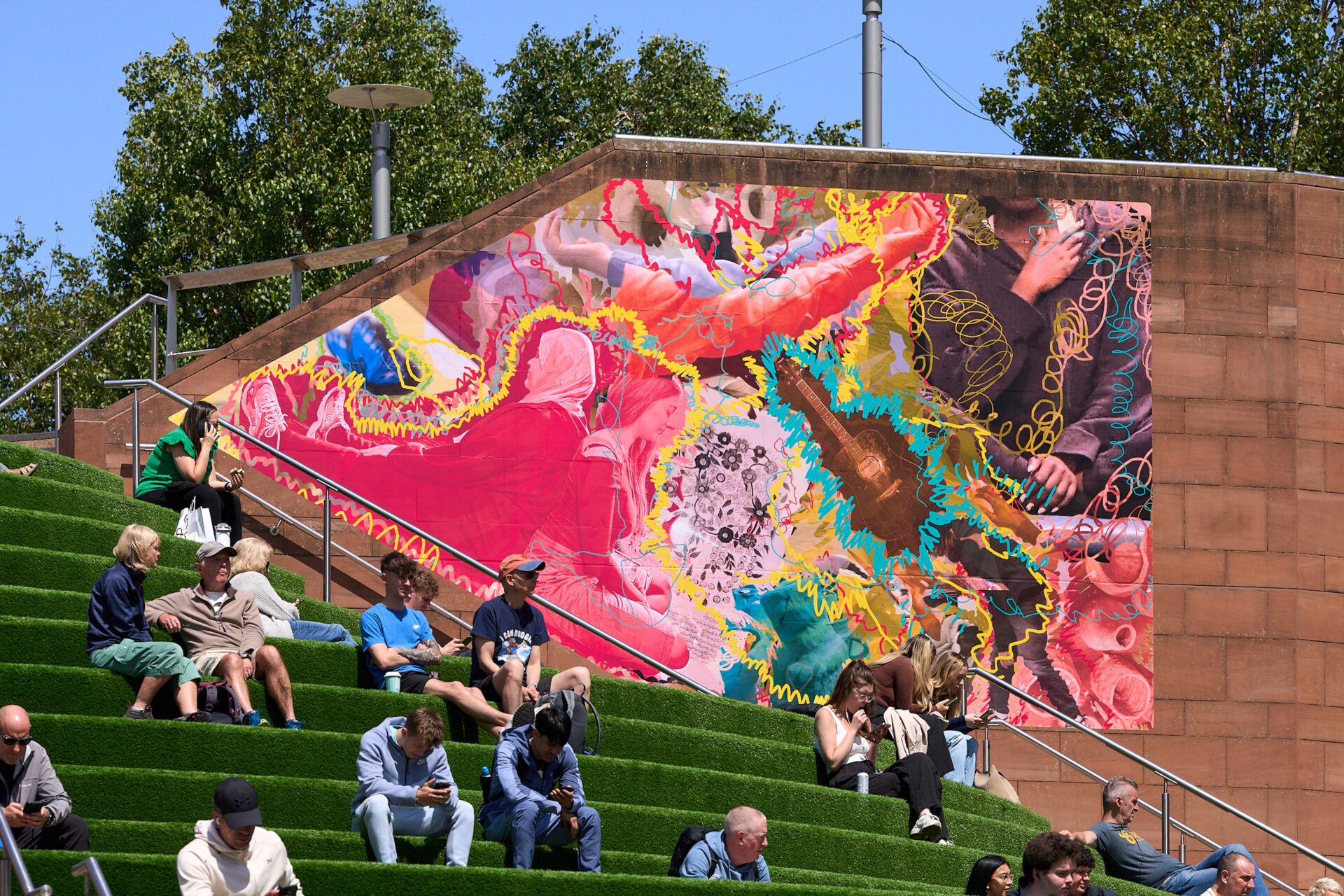
Dominique Fontaine and Miguel A. López, co-curators of the Toronto Biennial of Art 2024, visited Ireland in August 2023 whereupon a public conversation was held with Annie Fletcher at IMMA. Artist Léann Herlihy was subsequently invited to install their photographic work, to be nowhere (2022–ongoing), in downtown Toronto as an enormous, iconic billboard. Speaking of their participation in Ireland Invites, artist Léann Herlihy said: “Meeting the curators of the Toronto Biennial of Art 2024 […] was a pivotal point in my practice, opening up space for a plethora of disparate narratives to crossover. Subsequently participating in the Toronto Biennial, I witnessed the transformative potential of reciprocated care within curatorial practices and how this care and attention drew out the joyous rage within artists’ practices. One of the highlights of this opportunity was meeting the other participating artists and learning about their work and life worlds – an accumulation of knowledge I hold dear to me.”
Binna Choi, one of three curators of the Hawai’i Triennial 2025, visited Ireland in February 2024, undertaking several studio visits and delivering a talk at the Hugh Lane Gallery. Binna’s visit resulted in four artists (Vivienne Dick, Kian Benson Bailes, Isabel Nolan and Belinda Quirke) being invited to contribute to a bespoke triennial programme, called Kīpuka Ireland, in April 2025, comprising sonic performance, film screenings, and workshops. Speaking of her experience, Bina said: “Ireland Invites opened up new, unexpected lines of resonance, connection and friendship between Ireland and Hawaii. My visit to Ireland allowed me to meet a number of artists in Dublin as well as other areas whose practice and concerns resonate with artists of Hawaii so much in terms of its geographic positionality, colonial experience and the politics of decolonization, value of culture, land, tradition, and critical practice of indigenization. This led me into conceiving the visiting program Kīpuka Ireland within the context of Hawai‘i Triennial 2025: ALOHA NÕ. This could not be realized without inspiring encounters in Ireland as well as the relationship forged with new colleagues and institutions in Ireland.”
Blanca de la Torre, Head Curator of the Helsinki Biennial, visited Ireland in July 2024 and subsequently selected Katie Holten to participate in the third edition of the biennial, which launched in June of this year (see pp. 38–39). Speaking of her visit to Ireland, Blanca said: “I had the privilege of engaging with a remarkable community of Irish artists whose practices closely align with my curatorial research interests. The programme offered the opportunity to deliver a lecture at IMMA and collaborate with its exceptional team of women professionals. This experience provided valuable insights into the contemporary art landscape in Ireland and facilitated meaningful dialogues that will continue to inform my curatorial practice.”
Ailbhe Ní Bhriain and Basil Al-Rawi were selected by John Tain for the Lahore Biennale 2024 through his participation in Ireland Invites, while Aideen Barry, Amanda Coogan, George Bolster, and Kira O’Reilly were selected by Apinan Poshyananda for the Bangkok Biennale 2024.
Returning to my opening lines about the Liverpool Biennial, I was thrilled to see the inclusion of Alice Rekab this summer in the 13th edition, as a direct result of Ireland Invites. Isabel Nolan was also invited to participate, and both artists created ambitious, site-responsive works for gallery settings and the public realm. ‘BEDROCK’ continues across Liverpool until 14 September (see pp. 34–35).
Commenting on her visit to Ireland, Liverpool Biennial Director, Dr Samantha Lackey stated: “In 2024 Ireland Invites extended the opportunity to join a group of international curators and directors, visiting the brilliant EVA International. My time in Limerick and subsequently Dublin enabled me to further explore the deep connections between Liverpool and Ireland and convinced me of the importance of bringing in a curator who had existing connections with Irish artists to curate our 2025 festival.” Curator of the Liverpool Biennial 2025, Marie-Anne McQuay, added that: “Working with Isabel Nolan and Alice Rekab has been a joy and a privilege. The work exhibited by both artists has a special resonance with the city – Isabel responding to the city’s historic art collections and lost architecture, while Alice engages with stories of migration and belonging, narratives shared between Dublin and Liverpool. I can’t thank them enough for their outstanding contributions.”
Overall, the documented successes of Ireland Invites attest not only to the effectiveness of the initiative in the short-term – insofar as the collegiate gestures of invitation and hosting clearly result in the more prominent showcasing of Ireland-based artists on the international biennial circuit – but to its less tangible and longer-term influence on international curatorial knowledge. One hopes that this can be consolidated and progressively expanded upon in the future, with each new round of curatorial invitation.
Joanne Laws is Editor of The Visual Artists’ News Sheet.
visualartists.ie