AENGUS WOODS DISCUSSES THE PARTICIPATION OF IRISH ARTISTS AT THE 61ST VENICE BIENNALE.
There is something discomfiting about walking through the national pavilions that occupy the Arsenale and Giardini sites at the 61st Venice Biennale. Perhaps it has been ever thus, but in 2026, as far-right ideologies gain potency across the globe, conflicts around nationality and statehood rage unabated in Palestine and Ukraine, while migrants everywhere, desperate for a life of safety, continue to fall foul of border and flag, this microcosmic spectacle of nations jostling for cultural glory and validation, in this particular moment, feels jarring to say the least.
Efforts are made here and there by players and participants to conspicuously place themselves on the right side of history. The Russian pavilion is predictably boycotted, demands are made for Israel’s exclusion, and of course the work of Alma Allen in the American pavilion is summarily dismissed by most commentators as merely reflective of the cultural bankruptcy of the Trump Administration. This latter point may well be true: Allen’s biomorphic sculptures are indeed almost comically bad exercises in faux monumentality. However, there is plenty of questionable art to be found all over the biennale and he is hardly the worst offender. Ultimately, there is a sense in which the very structure of the biennale, profiting from and reinforcing compulsions toward nationalistic chauvinism, display and defensiveness, does little to question and much to reinforce the more problematic taxonomies by which humans have chosen to arrange themselves, in this day and age.
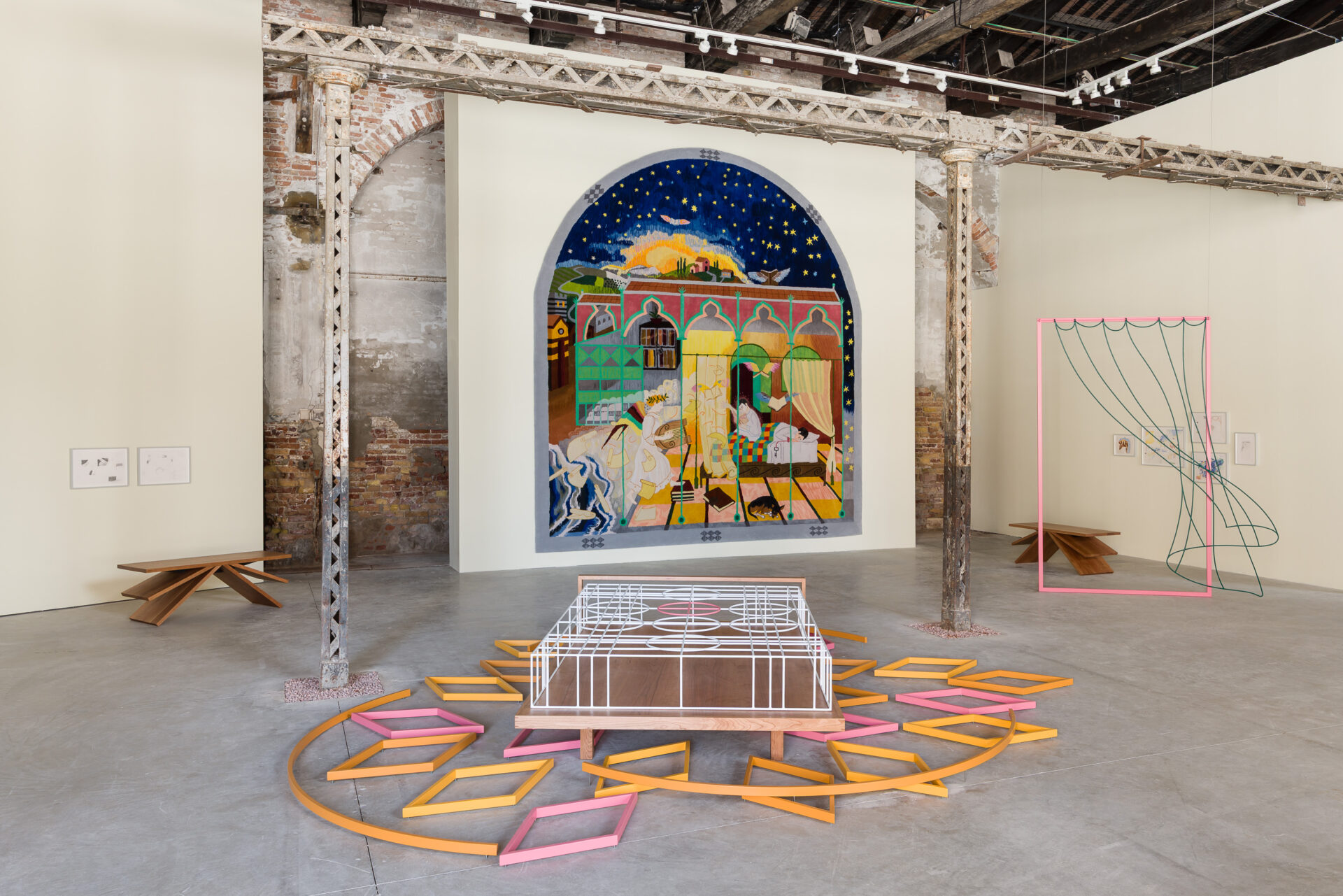
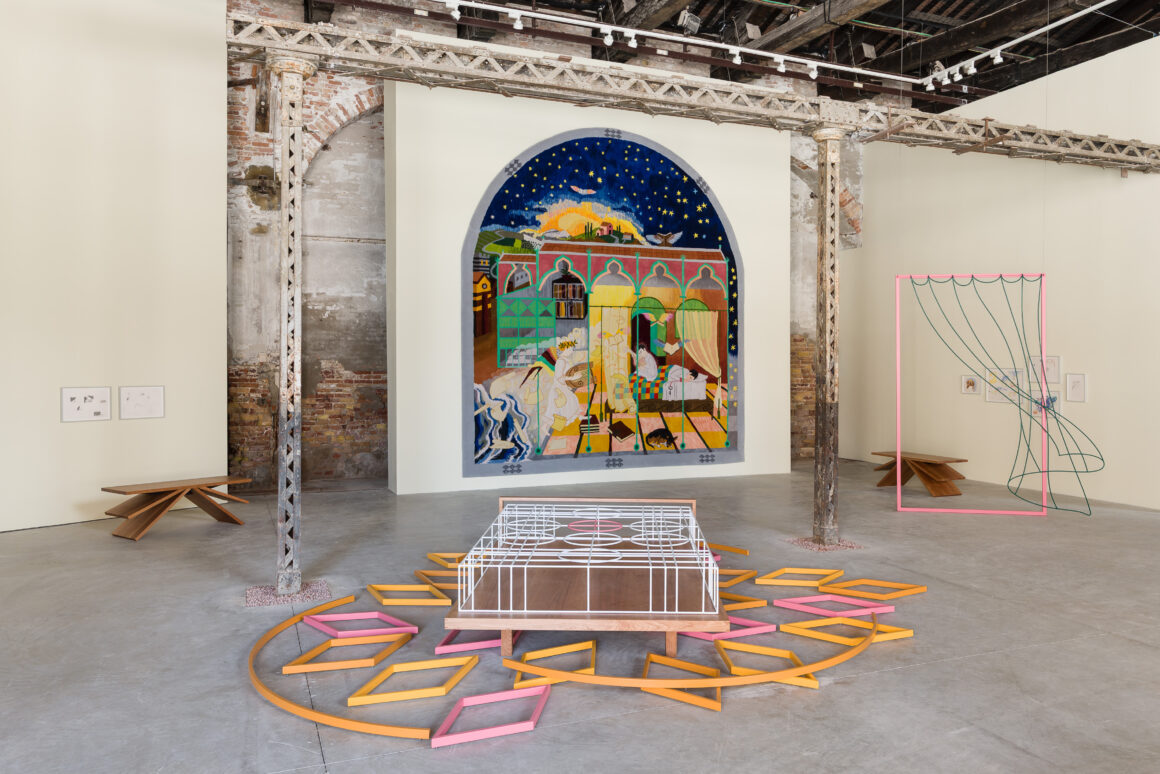
It is in this light that Isabel Nolan’s presentation at the Pavilion of Ireland takes on a particularly apt resonance. In harking back to a moment at the very dawn of the Enlightenment, ‘Dreamshook’, a series of works centering on the early Renaissance artist and printer Aldo Manuzio (c1450–1515), gestures hopefully to a kind of open humanism, built on knowledge and learning. Based for most of his adult life in Venice, where he established The Aldine Press in 1494, Manuzio was a pioneer in bookbinding, producing pocket-sized editions of classical works. His efforts to disseminate the great Greek and Roman texts as widely as possible reflected a utopian desire to make a shared cultural inheritance available to all. In this way, the particular moment that interests Nolan here presents itself as almost an antidote or alternative to the kind of nationalism that would soon begin to emerge, as Enlightenment thought provided the technical grounds for the vast industrial and colonial projects that would follow.
The work itself is sumptuous. Three hand tufted tapestries nicely translate Nolan’s drawing style into arresting tableaux of dream scenes, drama and allegory. Aldus Dreams of a Plentiful Supply of Books (2026), with its arched window shape, foreshortening, angelic figures, and the dreaming Aldo, gently echoes late Byzantine art, while Make Haste Slowly (2026) seems to map the sedimented layers of history, from primitive spiral forms through scrolls and codices up to modernist geometrics. These are offset by three sculptural works in painted steel, each continuing with the dream thematic. Oh! (2026) is a graceful pink frame with a beautifully wrought blown curtain, outlined in green. A Hole into the Future (2026) melds architectural forms with echoes of the geometrics found in the neighbouring tapestry, yet it seems literally grounded by an anchor, rendered in blue.
Threaded through the show are a series of works on paper in which notes, sketches and quotes from Manuzio, Erasmus, and John Berryman, amongst others, are interspersed. Presented in groups with a series of artist-made benches before them, they serve simultaneously as clues, indexes, and flights of fancy. Manuzio’s pocketbooks and their dissemination have taken on a strange and unforeseen resonance, as recent stories in the press describe AI developers buying rare books en masse to feed their insatiable Large Language Models (LLMs) before shredding them. Yet, dissemination has always been a complex process with varied outcomes. We might remember too, as the great Anglo-Irish political scientist Benedict Anderson argued in Imagined Communities: Reflections on the Origin and Spread of Nationalism (Verso, 1983), that the strange coagulation of nation states around single languages was, in no small part, a result of the power of the printing press.
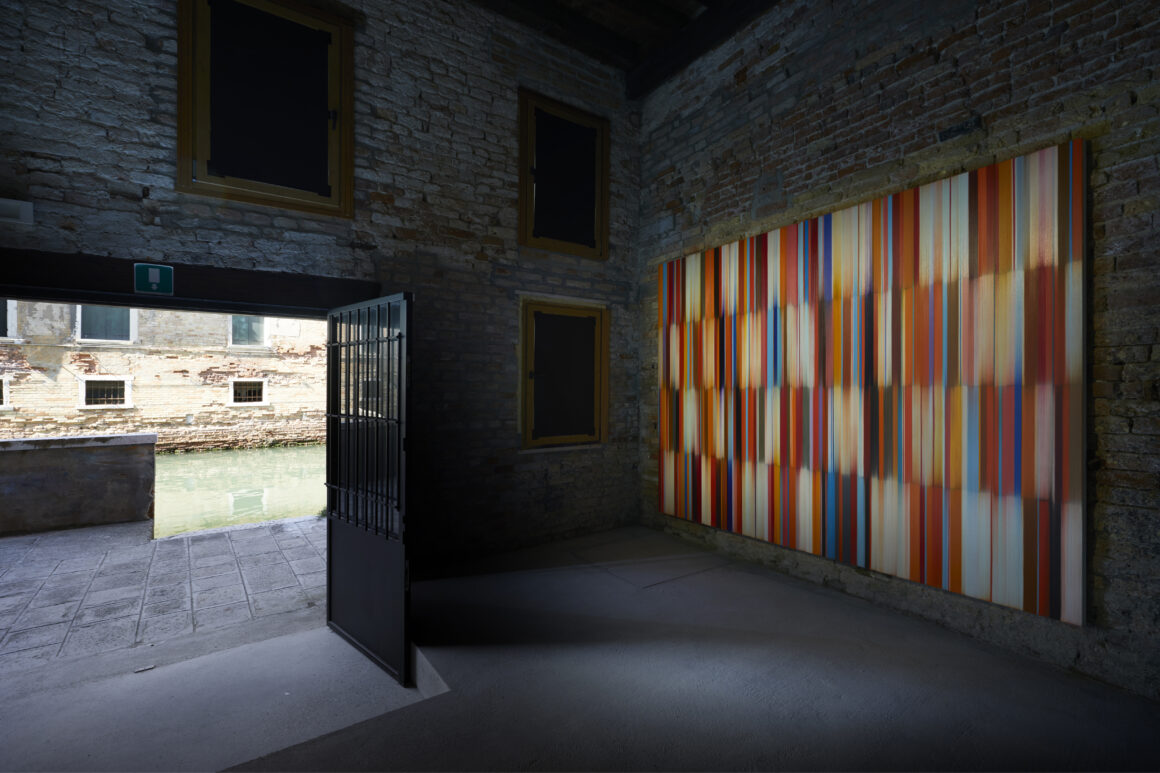
Representing the Republic of San Marino, an exhibition of paintings and film by Mark Francis continues his exploration into the visualisation of acoustics and time. ‘Sea of Sound’ presents 12 canvases and a looped audiovisual work, Listening Field (2025), originally commissioned by and presented at Solstice Arts Centre. The paintings are tightly unified, all achieved through similar techniques to produce a stuttering series of vertical patterns that oscillate with colour. There is a temporal feel that calls to mind the hypnotic dream machines of William Burroughs and Brion Gysin. Despite the considerable size of some of the individual works, they are well presented in the narrow confines of the Tana Art Space. To be surrounded by and in such close proximity to the rhythms of the canvases only deepens the sense of pulsation running through them. In a darkened room, Listening Field is accompanied by a small number of spot-lit works and has been scaled to complement their dimensions. This serves to create a strange oscillation, both within the works and between them, the eye and ear flitting from screen to canvas, stasis to movement, sound heard to sound seen.
In contrast to the bombast surrounding the national pavilions, ‘In Minor Keys’, the main curated exhibition, provides an altogether more sombre and considered tone. This is, of course, due in no small part to the untimely passing in 2025 of Koyo Kouoh, the artistic director for the 61st biennale. Kouoh had previously forged strong connections with Ireland as curator of the 2016 edition of EVA International in Limerick, which informed the inclusion of several Irish artists in her Venice lineup.
In the aftermath of her death, the vision for ‘In Minor Keys’ was followed through by an international team of her collaborators. As might be expected, in the absence of Kouoh’s unifying presence, the show has a sprawling, tentacle-like expansiveness to it. Craft, textiles and ceramics abound, and there is a sense that ritual and traditional practices exemplify those ‘minor keys’ that the curators are listening out for. A particular highlight is the substantial selection of work by Beverly Buchanan (1940–2015), a multi-faceted but long overlooked sculptor and land artist, born in Ann Arbor, Michigan. Her work has been rarely seen in Europe until recently; a major survey of her work at Brooklyn Museum in 2016 at last brought her to a wider global audience. Here, her unassuming shack sculptures, based on the small, vernacular, hand-built homes dotted throughout the wilds of the American Deep South, are mesmerising. As with much of the work throughout the show, their inclusion displays a curatorial sympathy for elemental materials and overlooked practices. Yet, arguably standing as something of a hollowed out heart to all this, is Alfredo Jaar’s installation, The End of the World (2023–2024) a cavernous, church-like room, lit in a pungent blood red, at the centre of which stand a small cubic stack of rare earth minerals. These are the commodities feeding our demands for phones, microchips and AI components, posing only the latest threat to the kinds of cultural practices celebrated here.
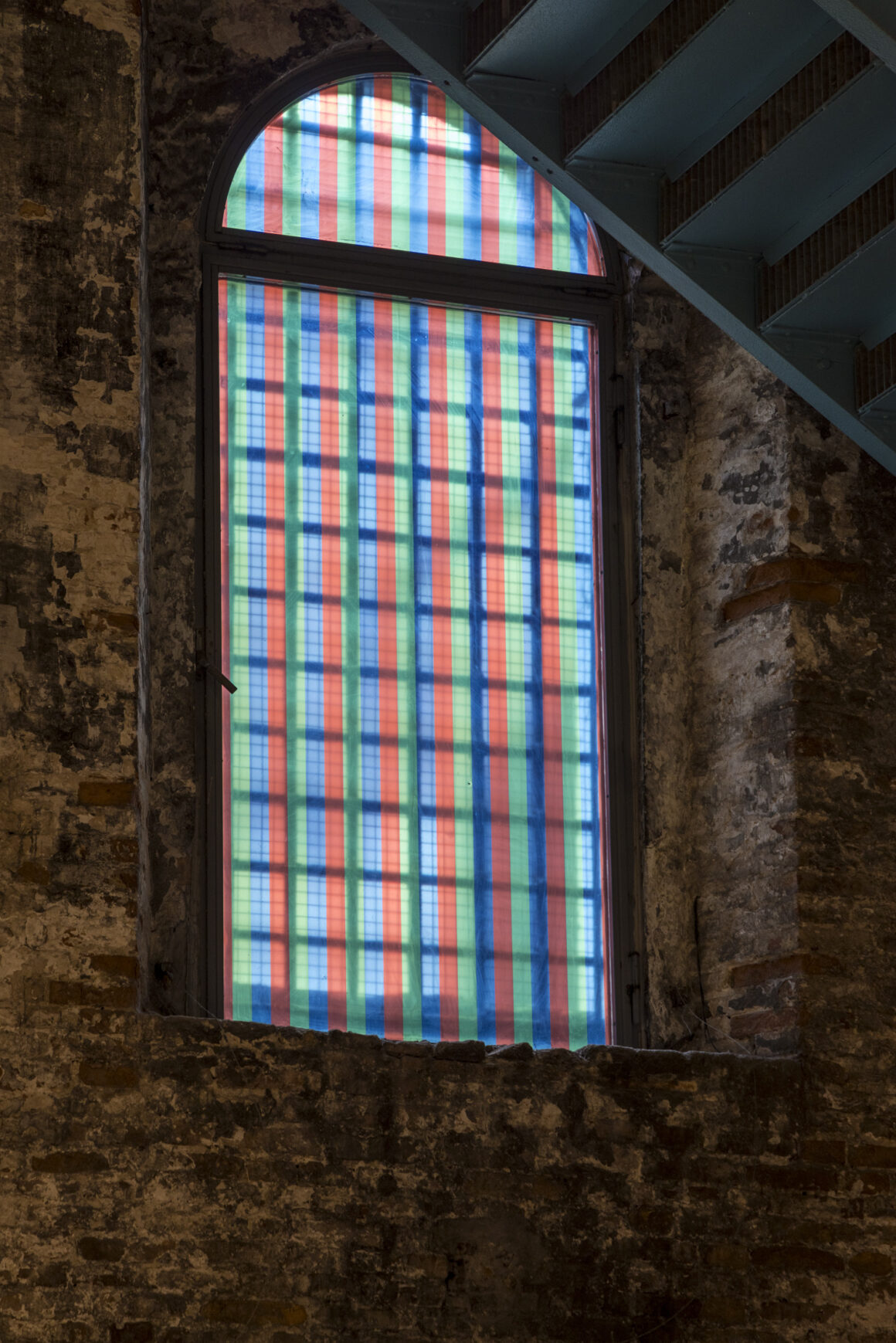
Amongst this plethora of 110 artists, works by Alan Phelan, Alice Maher and Rachel Fallon comfortably take their places. Phelan’s explorations with the Joly screen process are presented across a freestanding zigzag wall and overseen by his transparent vinyl RGB stripe interventions on the windows of the Arsenale. 18 Joly screen photographs – backlit colour images covered in the tight vertical lines of the filter screen – offer a combination of still life and portraiture. There is a linguistic dexterity and gentle humour to the works – Underpants Darth, 1977, when it’s best to remain hidden (2019) a case in point. Yet the titles, like the images themselves, serve to simultaneously reveal and conceal. Faces are consistently obscured, feathers and plants take on symbolic overtones, and a kind of performativity also reveals itself as a strategy for hiding things in plain sight. In this manner, something like a queer history is imagined within the strictures of Joly’s analogue process. This queering strategy is then extended into space through Phelan’s architectural interventions, most notably a Carlo Scarpa designed window in the Central Pavilion, its bisecting circles contrasting beautifully with the vertical RGB bands.
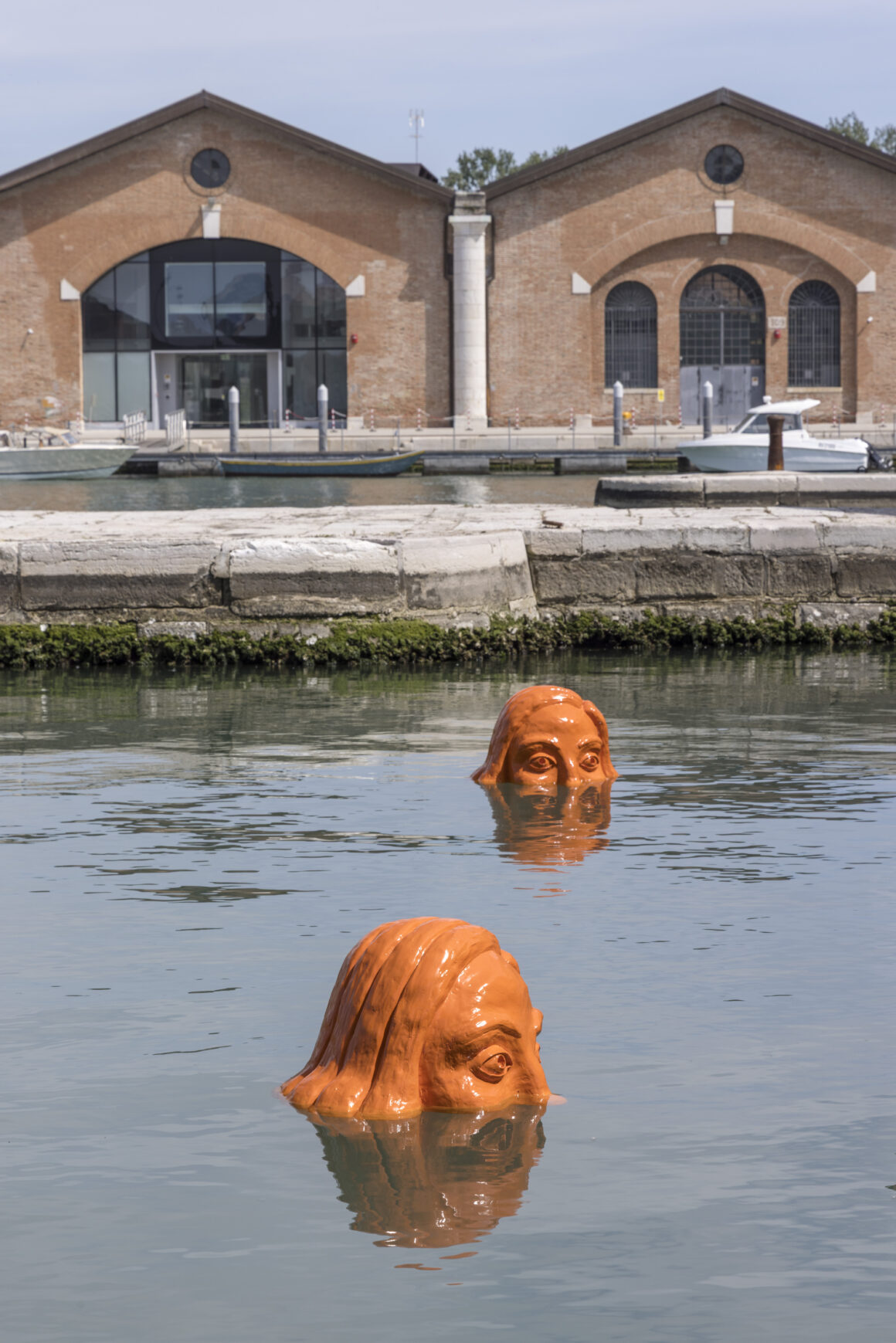
The Map (2021), a large-scale cartographic tapestry by Alice Maher and Rachel Fallon, which has been widely exhibited around Ireland and internationally, finds itself suitably ensconced among other craft and textile work. It too offers an alternate history of sorts, weaving mythology, folklore and the all too real story of the abuse of women by church and state, into a defiant exercise in the assertion of female autonomy. Created by the artists in a collaborative to-and-fro during the pandemic lockdown, its razor sharp locations (Heterotopia, Outer Sanctimonia, Slag Island) are presided over by the expansive red tresses of Mary Magdalene’s hair. It’s a powerful work of righteous indignation and one whose mythic and symbolic connotations are further enriched by two other bodies of work by Maher included in the show. Les Filles d’Ouranos (1996/2025), a series of red heads floating in the shipyard docks of the Arsenale, references the birth of Aphrodite, yet the multiplication of the half-submerged heads gives them a powerful aura, both tenacious and fugitive. Most satisfying of all is The Sibyls, an installation of three large-scale drawings with sculptural elements. Sibyls were Greek oracles identified with prophetic priestesses. Here, Maher renders them faceless with impossibly long and burdensome hair. Before each drawing is a darkly reflective disc upon which biomorphic globs of metal rest, imbuing the figures with an elemental quality.
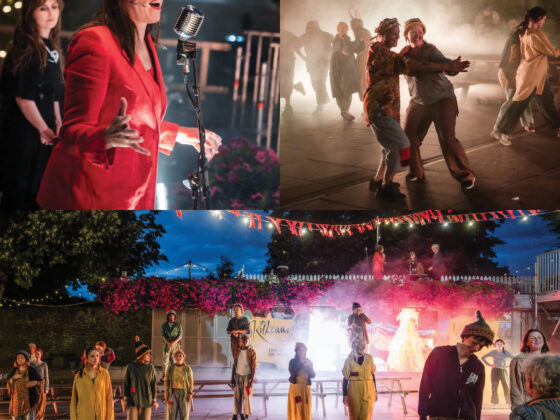
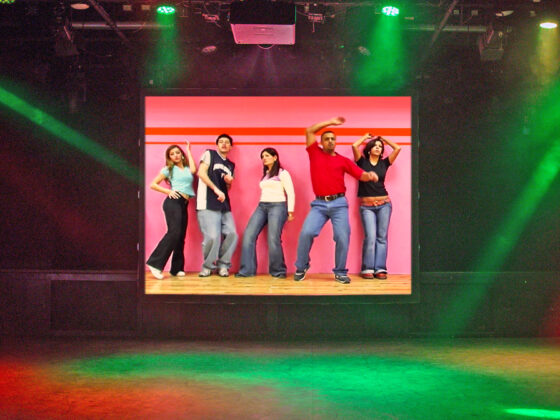
One of a number of collateral exhibitions alongside the biennale, ‘The Spirits of Maritime Crossing’, presented at Palazzo Rocca Contarini Corfù, featured work by 20 international artists, including Amanda Coogan. It was curated by Dr Apinan Poshyananda of the Bangkok Art Biennale (and curator of EV+A in 2002). Coogan presented a video of her group performance, Ode to Joy – Thai Sign Language (2024), and also delivered a live performance over several days. Dressed in red, Coogan moved among and through artworks by Parada Wiratsee and Ruangsak Anuwatwimon. A sign language user, born to deaf parents, Coogan seems to offer a kind of amplified, fully embodied language in her work, its non-verbal yet highly communicative nature creating moments of intensity between audiences and fellow performers. Much like Nolan’s dreamlike encounters with Manuzio, Maher and Fallon’s entanglements with Irish history and mythology, or Phelan’s imaginings of alternate queer narratives within the history of an obsolete photographic process, Coogan offers a way of engaging our cultural inheritances that open them up to fresh possibilities, rather than isolating them within the domain of the privileged.
Aengus Woods is a writer and critic based in County Louth.
@aengus_woods