PHILLINA SUN RESPONDS TO A RECENT EXHIBITION BY PHIL COLLINS AT THE MODEL IN SLIGO.
As an MFA graduate of Belfast School of Art and a former member of the artist-run gallery, Catalyst Arts, Northern Ireland in the late-1990s proved formative for visual artist and filmmaker Phil Collins, who later achieved prominence as a Turner Prize nominee in 2006. A major exhibition of his films was presented at The Model in Sligo this summer. “Many of the questions I’m still trying to answer came from that time,” Collins noted in an interview for The Berliner (the-berliner.com). “Belfast is a city with a terrible history of division and fracture, so my work became all about the political aspects of art and how to engage the public.”
Like many of his works, the films presented at The Model variously feature marginalised people in places marked by conflict, political turmoil, or military occupation, often interweaving pop and youth culture references to elicit tensions between individual experience and collective struggle. This includes An Interval (2018/2026), featuring a long single-take shot of traffic on a busy street in Pyongyang, North Korea – a mundane scene that could be found in any city in the world. Suddenly, the screen glitches, replaced by footage from the Arirang Mass Games, a large-scale state spectacle involving thousands of people, from children to adults, engaged in militaristic and acrobatic activities. The loose ordinariness of the everyday is interrupted by the jarring artificiality of propaganda, as synchronised masses of bodies are abstracted into overwhelming, garishly coloured patterns, accompanied by a pounding, machine-like soundtrack.
Home to You (2019) uses the pop video format to present life on an eastern Slovakian housing estate, made in close collaboration with the resident Roma community. The film follows residents throughout their daily routines – working, caring, playing, or meeting friends – intercut with scenes of a community orchestra and choir performing Welsh singer Cate Le Bon’s eponymous song. For a marginalised people, ‘home’ is charged, at once alienating and sustaining, as suggested by the alternately bleak and buoyant lyrics: “Home to you/ Is a neighbourhood in the night kitchen/ Home to you/ Is atrocity in the town.” The emotional urgency of pop provides a scaffolding of feeling for a marginalised community’s shared struggles and pleasures.
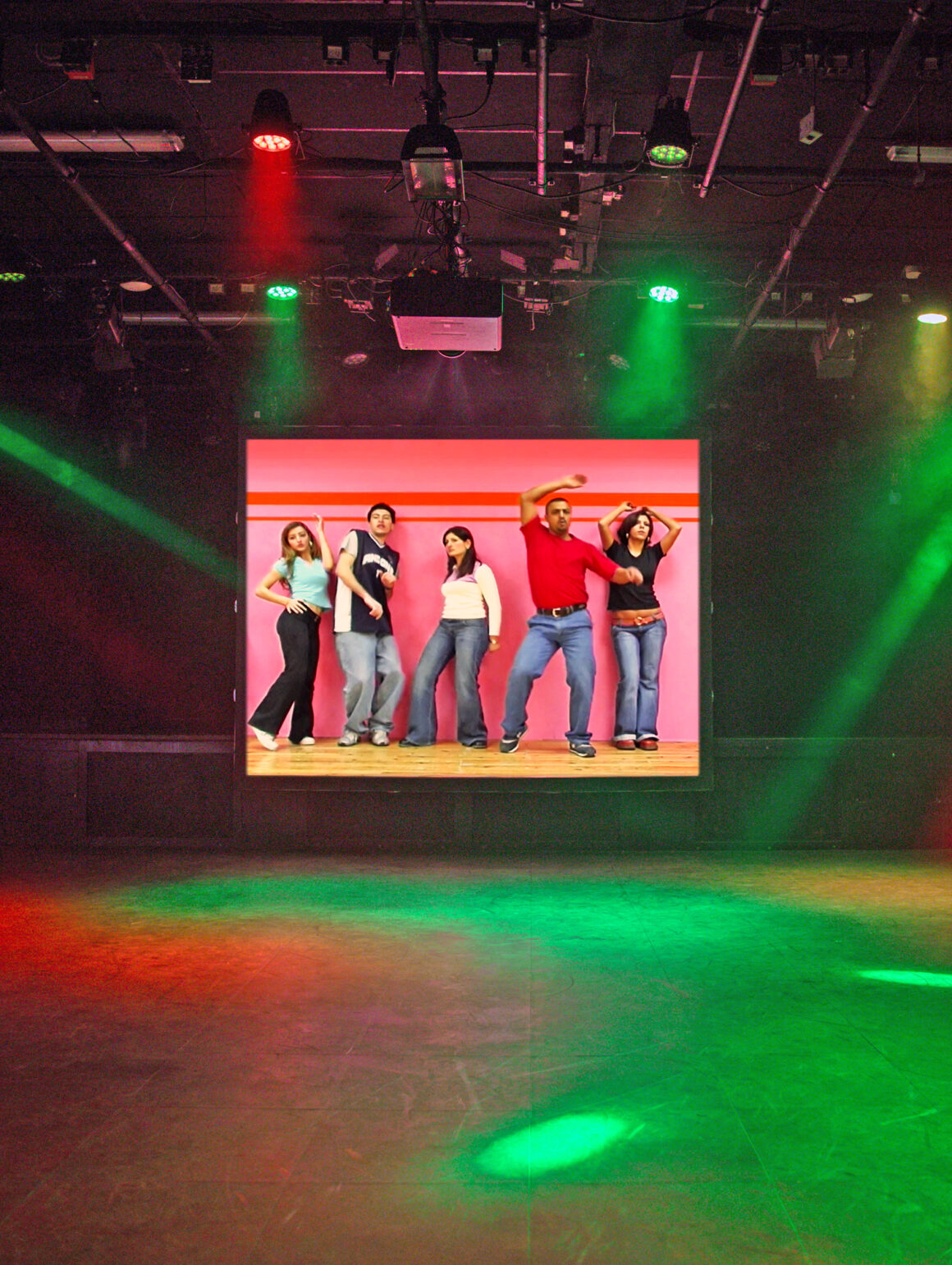
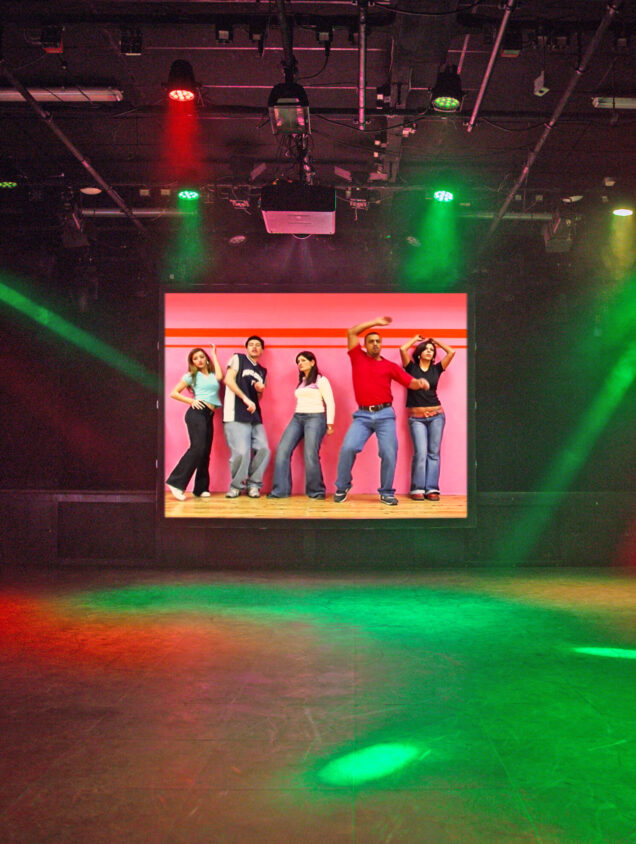
The installation, they shoot horses (2004), features an eight-hour video of a disco dance marathon Collins organised with youth in Ramallah, Palestine, during the Second Intifada. On two screens, teenagers dance to pop hits from the 1960s onwards, in states ranging from ecstasy to exhaustion. Durational video invites the viewer into an intimate relationship with the observed subjects, further enhanced by the exhibition space, which has been set up as a disco, complete with strobe lights and smoke machine. As we read their faces for moods, quirks, and gazes, we mirror their bodies with our own, and sway to the music. In a haven beyond the geopolitical forces of occupation and genocide, we are invited to vicariously experience the teenagers’ defiant joy and bittersweet yearning.
Ceremony (2018) follows the journey of a decommissioned Soviet-era statue of Friedrich Engels – co-author with Karl Marx of The Communist Manifesto (1848), which established the political and philosophical system of Marxism – from an eastern Ukrainian village to Manchester, England, where Engels lived for more than 20 years. While the Manchester scenes introduce us to the struggles and longings of various individuals, the wider film traces Engels’s life as his statue is transported through Europe, ruminating on the applicability of socialist thought to a contemporary moment riven by the violence of austerity and migration, posing Engels’s most urgent question: “Socialism or barbarism?”
After crossing the border via Calais, Engels’s statue arrives for its unveiling at an open-air socialist conference. The atmosphere is festival-like. To the tune of “Communism is coming home”, people congregate, wearing mock-Engelian beards, and wielding balloons or lilies, united in their belief that a better, fairer world is possible. This jubilant scene embodies art as proposed by John Berger in ‘Past Seen from a Possible Future’ – a 1979 essay on the instrumentalisation of the European painting tradition with the onset of modernity – offering “a tentative vision of another kind of freedom, a freedom other than the right to appropriate.”
Collins’s films emerge from emotional relationships with their subjects, harbouring a deep sympathy for the oppressed. During a public conversation with Declan Long at The Model on 4 July, he described his process as “being alive to the things you cannot see.” Collins calls on us to pay attention, to recognise the invisible, and to experience liberation, however fleetingly.
Dr Phillina Sun is a writer based in County Leitrim.
@phillina.sun