Having graduated with a Fine Art painting diploma in the late 90s, I returned to education in 2004, studying Youth Arts at Maynooth University. The course, aimed at working creatively with young people outside of the mainstream education system, would affect my life immeasurably. On the course, I met theatre-maker Louise Lowe and the two of us would work together on our end of year project, Tumbledowntown (2005). The project saw us collaborate with 26 young people from Ballymun in a local abandoned flat across an entire summer. We worked across theatre and visual art, exploring the young people’s attitude to their area. This interdisciplinary college project was funded through a Breaking Ground Per Cent for Art commission, and was shown as part of Dublin Fringe Festival 2005, winning the Spirit of the Fringe Award.
I returned to Fine Art Painting, graduating in 2010 with a master’s degree from NCAD. While there, Louise and I continued to work together and in 2009, decided to form ANU. ANU is a multidisciplinary production company that presents award winning theatre, visual art and socially engaged artworks in offsite contexts. We place the audience at the very centre of each work creating an immersive, live experience in which audiences have agency and proximity to the mesmeric worlds we create. Together, we’ve created over 50 seminal works, public art commissions, gallery installations, and museum interpretations growing a national and global reputation for excellence.

My practice is multidisciplinary and has evolved across set design, visual art, and socially engaged artworks. These disciplines are always in orbit of each other, linked and informing the other. Part of this is a keen interest in history, archives, space and place, and social and cultural issues. I’m drawn to the spaces between disciplines and subjects. My work is predominantly made as offsite, large-scale, multi-room, immersive installations.
The designing and building of an immersive environment outside of the traditional theatre space has two main roles, for me. Firstly, it needs to support the performers through the construction and curation of their world. For each immersive show, I create a space to support, chart and provide a backdrop for the performers. This begins very early through conversations with the director, and evolves as the piece develops with the cast and creative team, eventually finding a finished form during rehearsals.

The second role essential to my off-site design is to support the audience’s experience of that world. This world is perceived in full immersive 360 degrees, and is required in order to engage the audience at all times, from the smallest prop to the largest set piece. The design of the environment is required to be as seamless as possible, to ensure that audiences are always immersed in the moment of the performance. I endeavour to create spaces where the audience cannot see the join between the physical building and my set design. Paradoxically, I know that the designed space is successful when the audience fails to notice that it has been designed. When this happens, my designs support both the viewing audience and the viewed performer simultaneously.
THE MONTO CYCLE: The Beginning of a Design Practice

From 2010 to 2014, I made World’s End Lane (2010), Laundry (2011), The Boys of Foley Street (2012), and Vardo (2014) with ANU. Known as the ‘Monto Cycle’, it explored four key moments over the last century of The Monto, a quarter square-mile of Dublin’s North Inner City and, at one time, Europe’s largest red light district. Across the four works, I created installations, videos, and sound pieces that were encountered and experienced alongside the live performance.
As part of The Boys of Foley Street, I turned a flat in Liberty House (since demolished) into a fully furnished 1970s flat. This creative intervention was done to support the performers, the performance, and the audience experience and saw my practice begin to include immersive design, although I still viewed it through an art installation lens.

THESE ROOMS: A Gear Change
In 2016, ANU and CoisCéim Dance Theatre collaborated on a project responding to a lost history of eyewitness accounts of the execution of 15 men by the British Army during the Easter Rising in a row of ten houses on North King Street. These Rooms was an immersive live performance and installation project that cross-pollinated contemporary dance, visual art, and theatre.
Working across a four-storey building in close proximity to the location of the original event, I designed and installed 22 fully immersive installation spaces. I worked closely with the team to build an immersive world in which dance, theatre, and visual art could exist in balance. Folding time and space, we set our work in 1966, giving us distance from the original 1916 event and our own 2016 centenary commemoration, which was in full swing at the time.
The audience journeyed through the building, encountering hyper-real and hyper-surreal spaces. Engaging with this lost history, I created a space that thrust the row of ten houses into one host building. I always felt that the ten houses had incrementally disappeared over time, along with their story. My design reflected this, as I pushed rooms and structures into and up against each other, as if the building was consuming itself.
This project felt like a gear-change in scale and ambition, as a strong personal visual language was beginning to form. Something was happening, something was evolving, and this was a really important moment for my work, as it brought all the facets of my practice into focus.
HAMMAM: Immersive Design
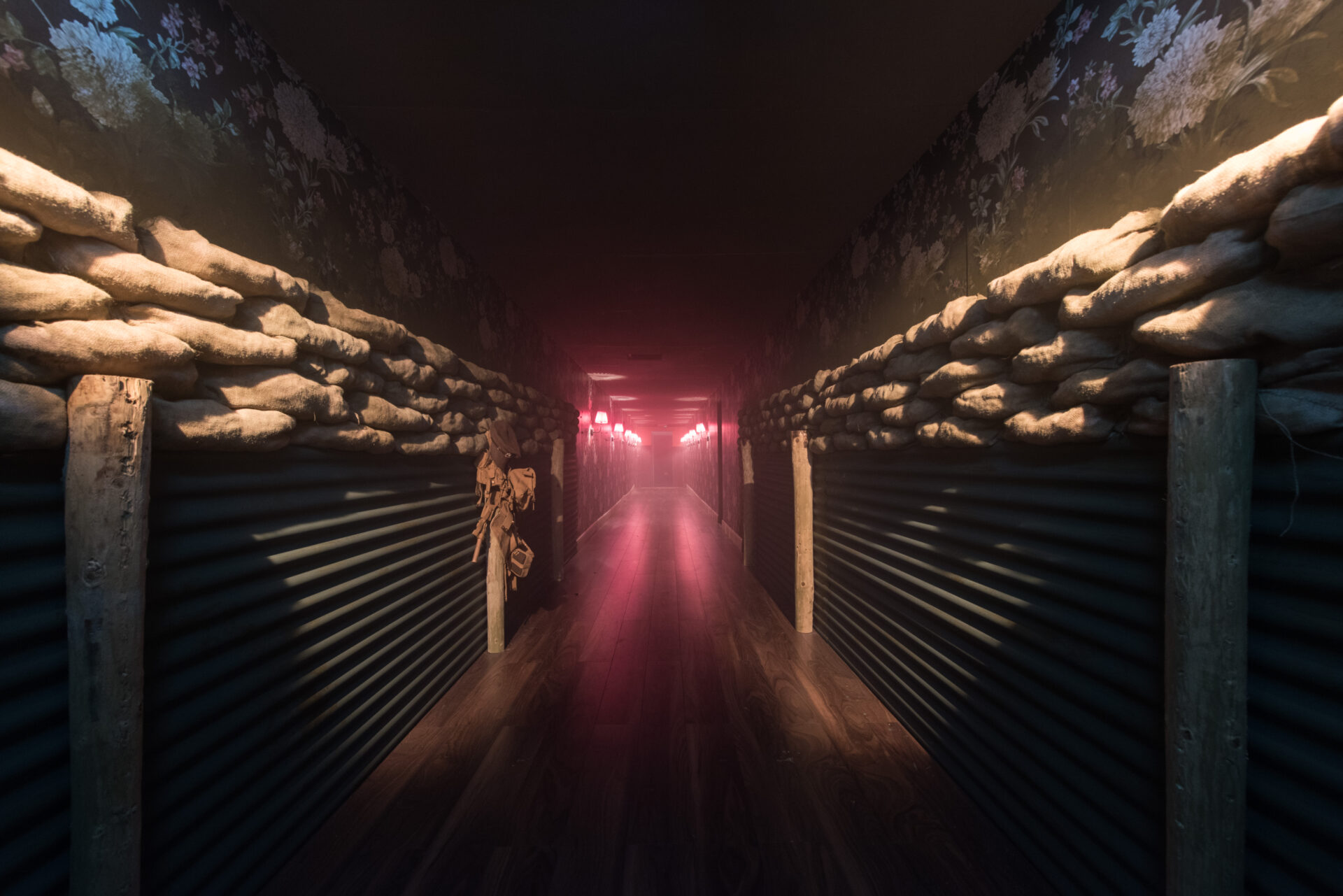
Hammam (2023) at the Abbey Theatre co-designed with Maree Kearns brought ANU’s creative response to the Decade of Centenaries to a close after a staggering 22 projects since 2013. Responding to the final moments of the Battle of Dublin during the Irish Civil War, audiences were invited to traverse the depths of the destroyed buildings of O’Connell Street. I designed and placed these ruins on the stage, the auditorium, and backstage areas of the Peacock Theatre itself. Playing with space and structure, I folded buildings and rooms on top of one another. Walking through a door could bring you to the Hammam Turkish Bath or into the Hotel Granville bedroom or to a temporary field hospital.

Using insurance records held at the Irish Architectural Archive, I was able to ascertain what had been lost in the destruction and to design accordingly. Again, I created a totally immersive site for our performance. My intervention in the building was incredibly complex, overlaying an orthodox theatre floorplan with a much more unusual and complicated layout where non-public areas, such as the greenroom, were transformed and intersected the playing space. I wanted regular visitors of the Peacock Theatre not to know where they were at any moment; to change their perception of a really familiar place, enabling them total immersion in the space, narrative, and performance.
Upcoming work
ANU has been invited by the National Archives to respond to the 1926 census (the first census of the newly formed Irish Free State). The result is an ambitious, immersive, site-specific production, premiering next summer inside the National Archives’ new state-of-the-art repository, before the return of 350,000 archive boxes, due to be housed there. This extraordinary portrait of a nation at a crossroads becomes the launchpad for FRAMING THE NATION, a bold new multi-year cycle exploring the moments that forged modern Ireland.

We’ve also been working with the Drumcondra-based organisation ChildVision on a socially engaged art project examining contemporary urban design and the impact on people with disability. I have concluded a series of workshops and am at present collating the information into an artwork, also to be presented in 2026.
Owen Boss is a designer and visual artist based in Dublin. In 2009 he co-founded ANU and is the Co-Artistic Director.