Butler Gallery
22 November 2025 – 8 February 2026
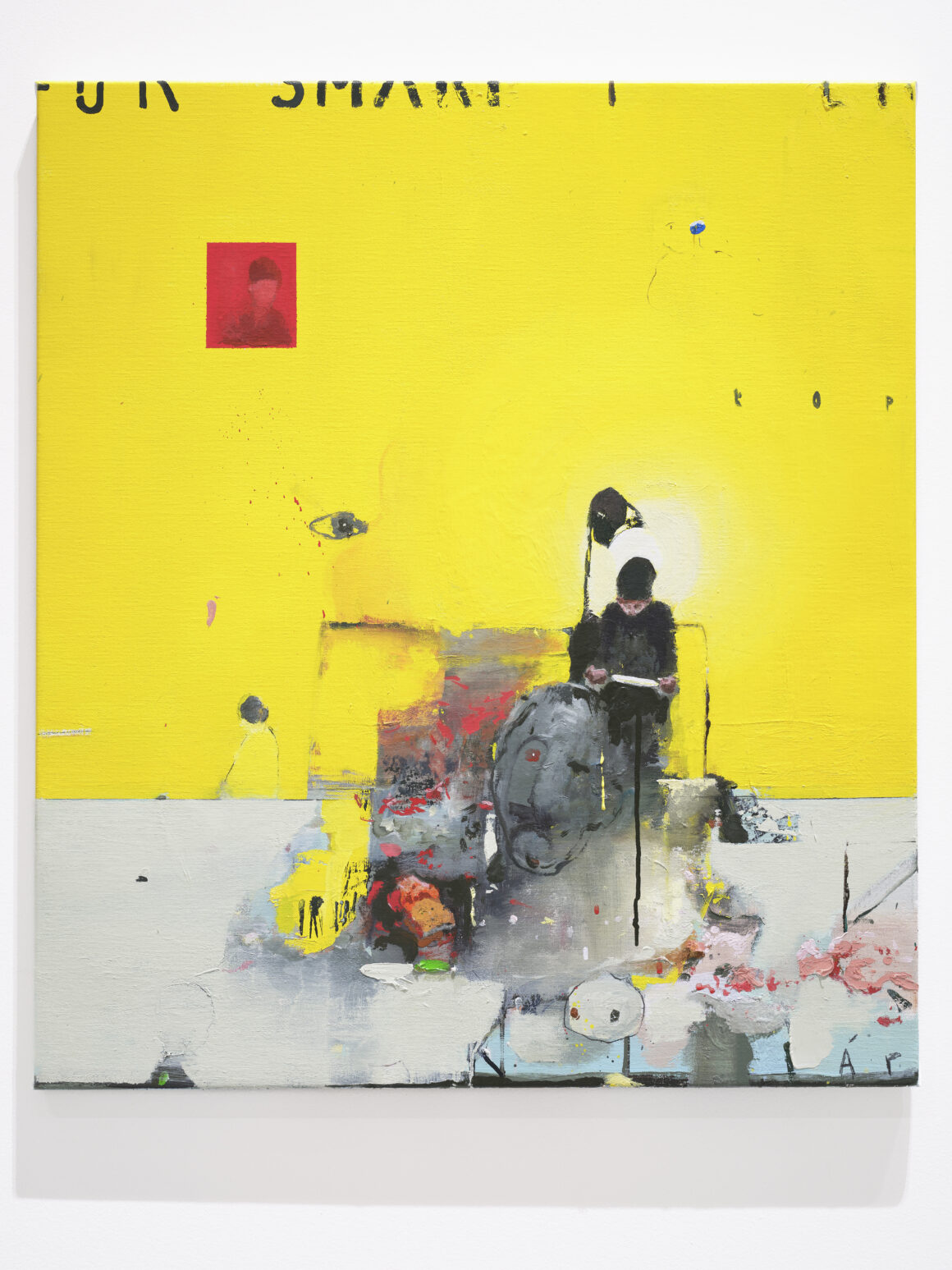
To begin with, a confession: I didn’t know Brian Harte’s work until I wandered into his show at the Butler Gallery in November; however, I have been living in a sea of his primary colours ever since – yellow and blue, especially. Other artists use colour in powerful ways, but what is transportive about Harte’s painting is that the colour seems to have attached itself to the linen ground effortlessly, like the softest snow, falling onto an already saturated landscape.
When asked to talk about his work, both Harte and the critics who write about it tend to go straight to content; references to his domestic life in Clonmel (where he grew up), Kinsale (where he lives now), or other elements that inform his consciousness, are filtered through knowledge of Philip Guston, Georg Baselitz, and other historic painters. But for me, Harte’s use and application of colour is the primary experience against which all other references must be positioned.
It’s not easy to be a painter these days, but being difficult is its own reward for those who can handle it – and Harte certainly can. While unprecedented change is happening around us – in terms of artificial intelligence, the climate emergency, and political power-grabbing – it takes courage to stay with the banalities close to us, knowing that those grounding forces are simply the familiar vehicle through which the ultimate aesthetic challenge is presented. How do you remain alive to the potential of personal experience in the face of overwhelming forces? You remind yourself that you are a painter and must create magic, like an alchemist, from the ingredients to hand, since it is their very ordinariness that forces understanding of the issue of representation itself.
Since graduating from Crawford College of Art & Design in 2002, Harte has been shown widely around the world and is currently represented by three commercial galleries: the MAKI Gallery in Tokyo, GNYP Gallery in Berlin, and the Simchowitz Gallery in Los Angeles. But global recognition doesn’t impinge on his mission as an artist; he has the good sense and courage to embrace the local. Patrick Kavanagh noted that: “[All] great civilizations are based on parochialism… To be parochial a man needs the right kind of sensitive courage and the right kind of sensitive humility.”1 Harte values the local and makes it the centre of his work.
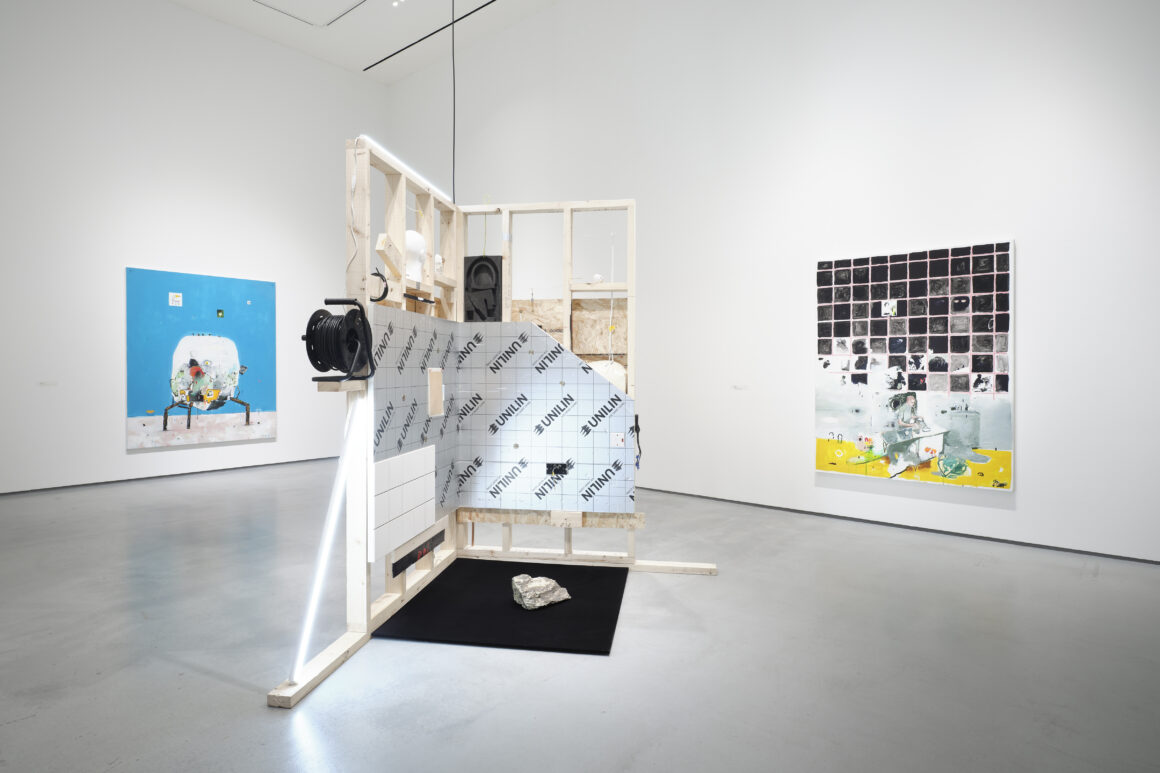
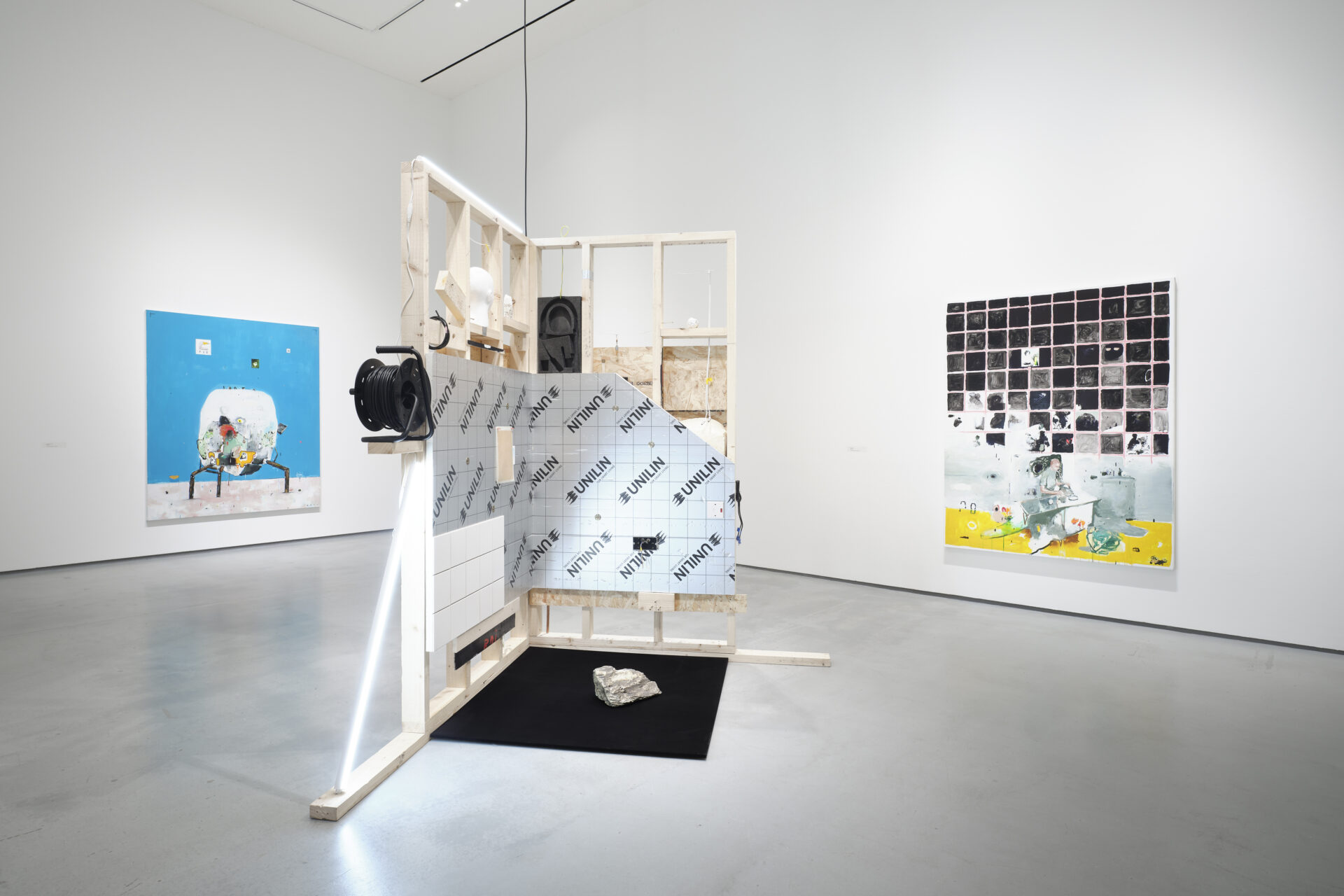
Painting has its origins in magic, and that is key to Harte’s practice. There is magic in the glittering vitality he brings to his domestic springboards, brought out in the careful installation on the walls of the Butler Gallery, but there is a new element too. A mixed-media sculptural arrangement, Corner Piece (2025), occupies the centre of the show, extending the world of the paintings in its accumulation of different objects: insulation boards, dangling electricity wires, Italian marble, and a polystyrene head.
For his previous exhibition, ‘To The Harbour Place’ at the Molesworth Gallery (13 March – 11 April 2025), Harte anticipated this “movement towards more ambiguous spaces, towards landscapes and the outer world.” (molesworthgallery.com) Corner Piece is in a process of becoming, partially constructed in dull brown chipboard and tatty silver-grey insulation material. In its drabness, apparent state of incompletion, and angular arrangement, it directs the eye back to the paintings, playing with the same fragments of ambiguous narrative which artist and audience must decipher for themselves.
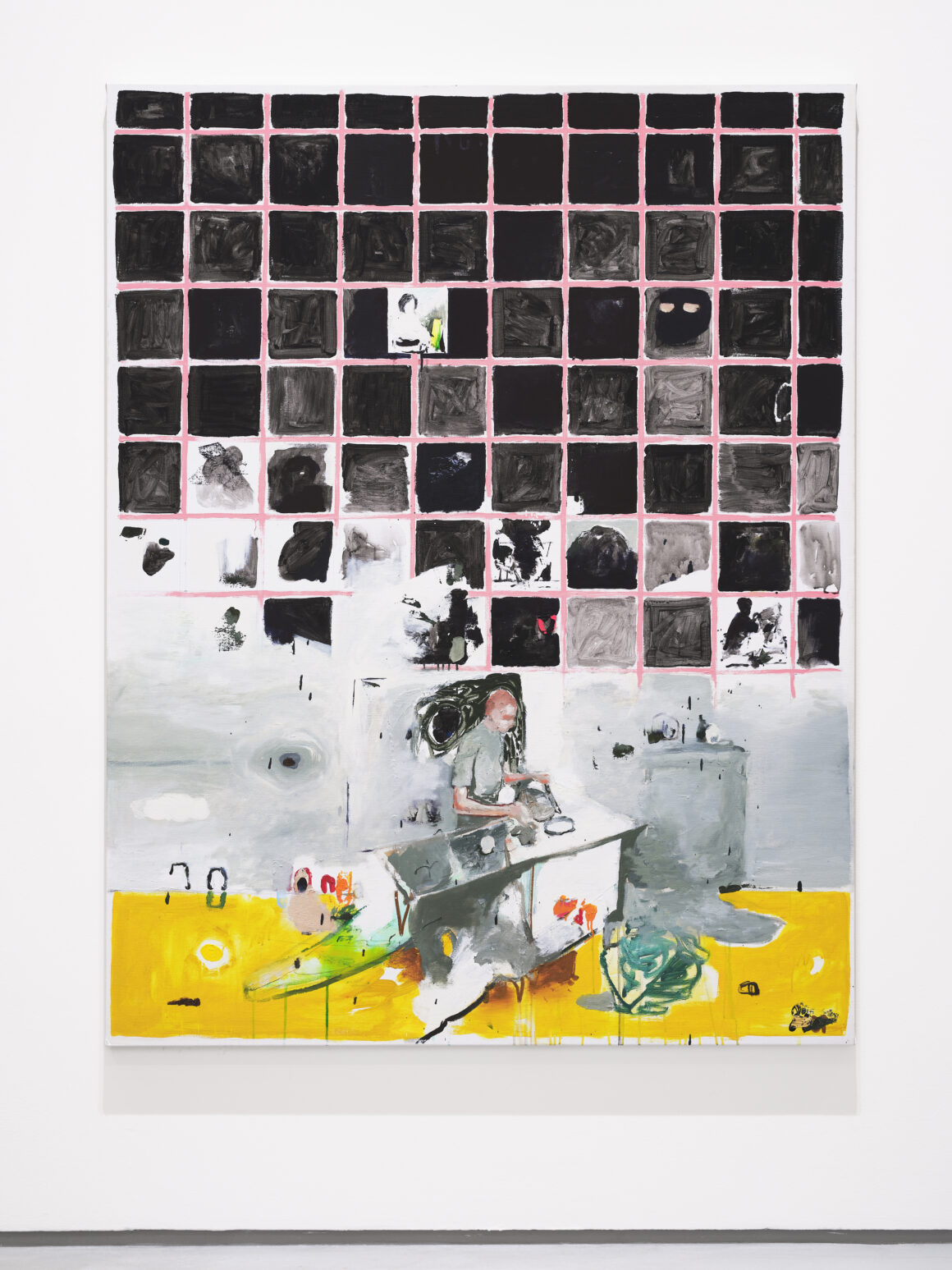
Looking at the future of painting at the end of the twentieth century, Stephen McKenna presciently claimed that the invention of photography made painting indispensable. “For it is painting that paradoxically reaffirms its own spiritual reality and that of the viewer by stressing the physicality and abstraction of its method of representation.”2 Harte’s latest artworks deeply assert this connection between the self and the other. For this viewer, the takeaway sensation was like Angus Fairhurst’s beautiful three-colour screenprint, When I Woke Up in the Morning the Feeling Was Still There (1992), in which the artist tries to hold onto a sense of colour that hovers within reach, but cannot be held down.
Catherine Marshall is a curator, art writer, and founder member of the Na Cailleacha art collective.
nacailleacha.weebly.com
1 Patrick Kavanagh, ‘The Parish and the Universe’, Collected Pruse (London: MacGibbon & Kee,1967)
2 Stephen McKenna, ‘Introduction’, The Pursuit of Painting (Dublin: IMMA, 1997) p 15.