Kevin Kavanagh Gallery
16 October – 15 November 2025
Across Geraldine O’Neill’s latest solo exhibition at Kevin Kavanagh, there are spatial, temporal, and linguistic dualities at play. The first, relating to scale, is immediately apparent upon entering the gallery. At over two metres square, the painting that informs the exhibition title, Flicker, Flicker, Age of Unreason (2025), is by far the largest work, and occupies a wall on its own.
Here, we see a multitude of animals and manmade objects, including a vacuum cleaner and a pair of helium balloons, that root the work in the domestic and the everyday. Due to its commanding size and composition, this painting dominates the space, even when not being directly looked at. The other three walls contain a dozen smaller oil paintings, which vary slightly in size. With their tighter framings, these smaller works feel like microcosms of the more expansive ecosystem shown in O’Neill’s titular work.
The exhibition title references a scientific paper on how ecosystems are at a tipping point; rapid alternations in climate, known as ‘flickers’, are warning signals of potentially catastrophic effects.1 Acknowledging the urgent critical debate surrounding the climate crisis, O’Neill engages with the Anthropocene, a term describing humanity’s role as the driving force of planetary change over the last century.
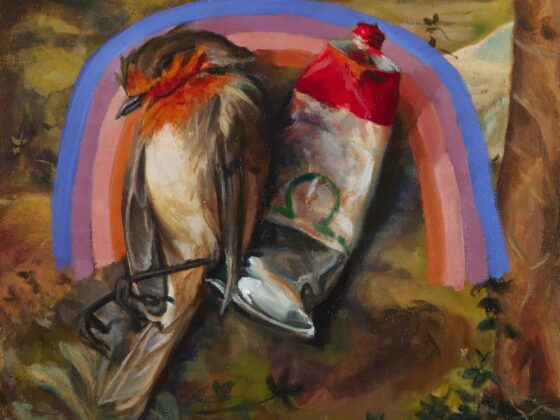
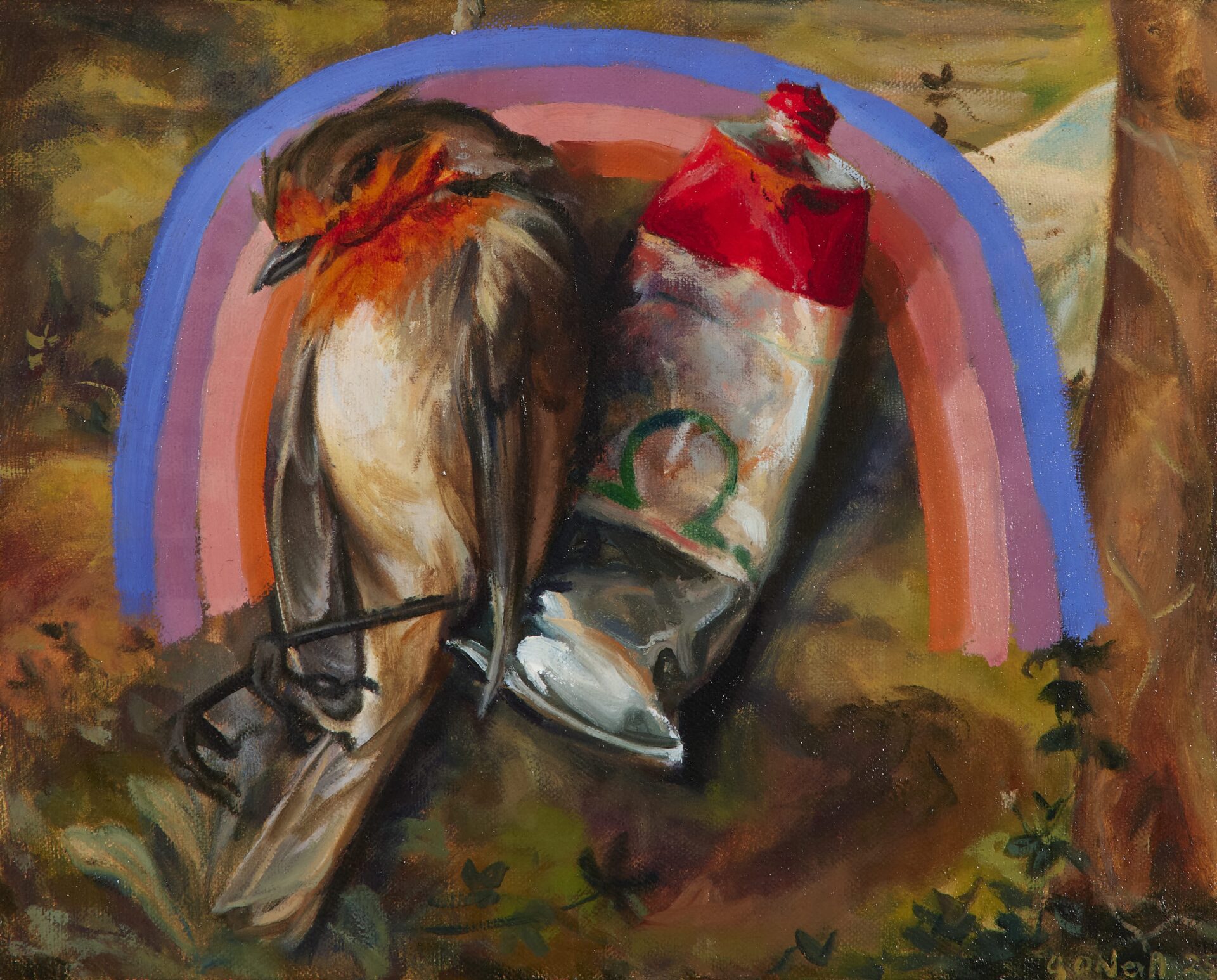
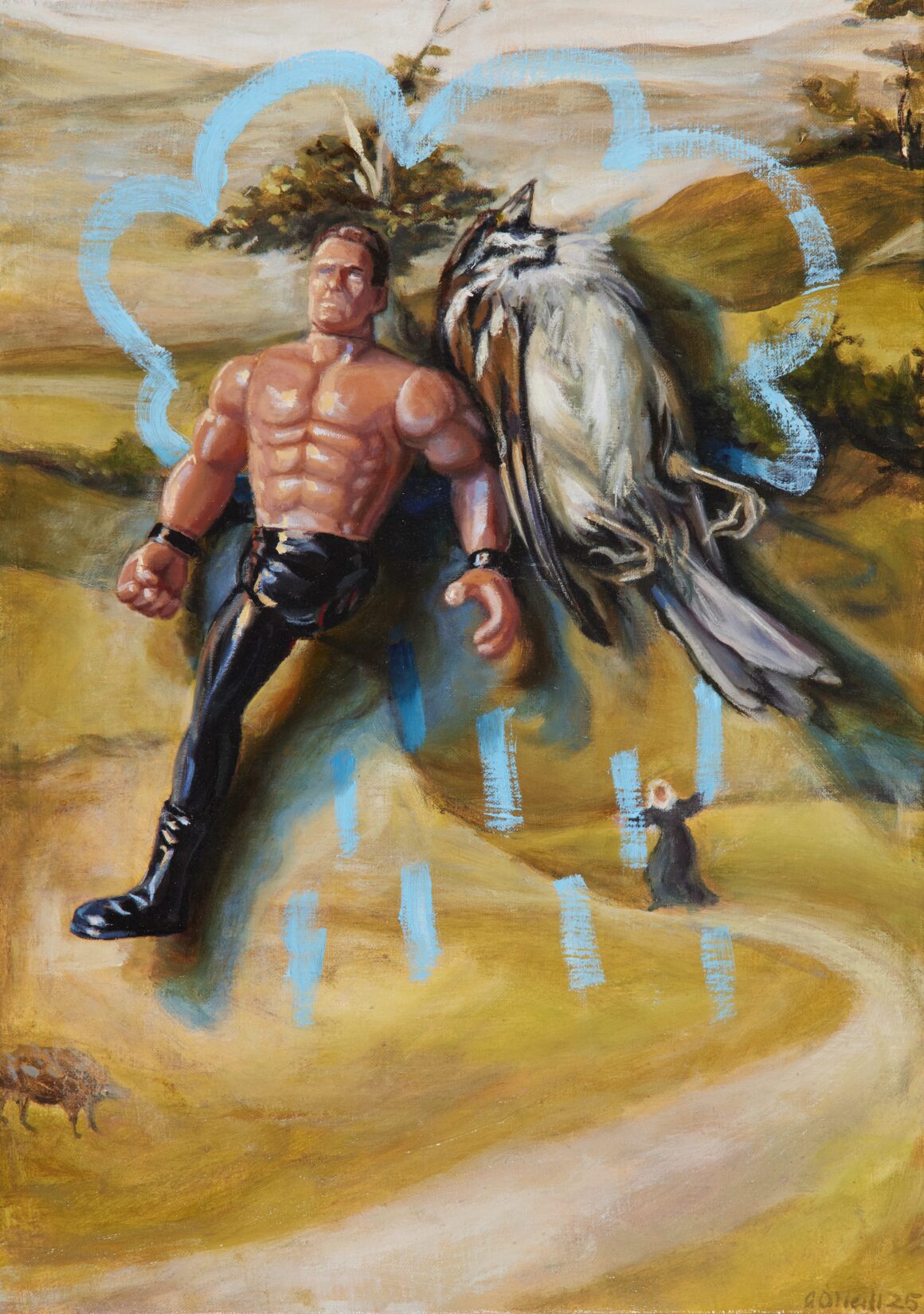
The binaries of contemporary and historical time also manifest across this exhibition. The backgrounds of several paintings draw inspiration from the art historical cannon of past masters. These landscapes serve as sedimentary and layered backdrops, onto which the artist adds various motifs and objects. In the smaller works, objects, often depicted in pairs, include children’s toys, ice-cream cones, and squeezed tubes of oil paint in modern, saturated colours, understood as byproducts of petrochemicals, which contrast with the muted tones of the historical underlayers. Depicted throughout are dead animals, fish, and birds, as well as skulls – common motifs within seventeenth-century European painting, particularly the hunting still life and vanitas genres, where they symbolise transience and the fragility of life.
Across the exhibited works, permanent and transient things are captured by the artist. Fluctuations of pace reflect both the urgency of the climate crisis, and the artist’s slow process. Her works are exquisitely and meticulously painted, and the time required to complete them contrasts with the ephemeral moments they simultaneously represent. Several paintings feature the addition of rough linear forms, including box structures and rainbows, rendered in the style of children’s chalk drawings. Plastic toys with elongated lifecycles exist alongside moments perceived as fleeting – namely, childhood itself.
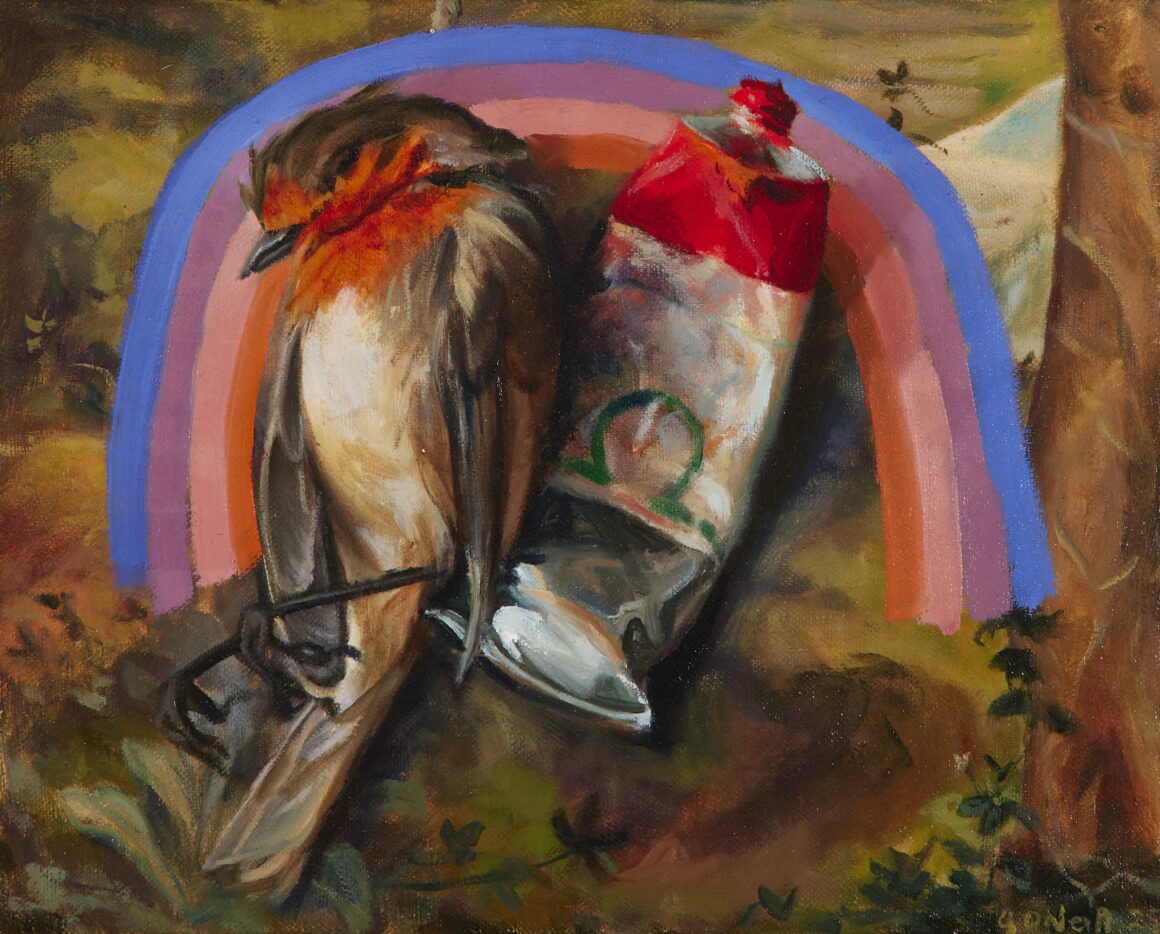
A further dichotomy is evident in the artist’s use of dual languages. Nine of the works have Irish titles, providing a rich history of their own. Some are descriptive – for example, Cre Mharbh (2025), meaning ‘Dead Bird’ – whilst others denote places, both tangible and intangible, such as Gort Na Fola (2025) and Alltarach (2025) respectively. Others highlight forgotten phrases, like ‘bothántaíocht’, meaning to visit houses to play games or gossip. Through these works, we are reminded of the fragility of language. Scéadamán Pangur Bán (2025) draws on an anonymous ninth-century Old Irish poem called Pangur Bán, which tells the story of an Irish monk and his cat who find contentment in their respective tasks of studying and hunting.
Some of the backgrounds, objects, and motifs can be observed in past works. For example, in Bothántaíocht (2025), we can see a variation on the background of Macnas Balbh (2022), previously exhibited in O’Neill’s show, ‘Solastalgia’ at Kevin Kavanagh in 2022. This self-reflective method suggests that alongside the wider canon of art history, O’Neill is also continually revisiting and interrogating her own painting lexicon.
Aidan Kelly Murphy is an artist and writer living in Dublin. He is co-editor of OVER Journal.
1 Trauth, M.H., Asrat, A., Fischer, M.L. et al. ‘Early warning signals of the termination of the African Humid Period(s)’, Nature Communications, 15, 3697 (2024).