Backwater Artists Group
13 March – 24 April 2026
The recent group exhibition, ‘MOTH’, at Studio 12 in Backwater Artists Group in Cork, uses the adaptive evolution of the moth, following the Industrial Revolution, as a case study to consider the impact of capitalist systems on human identity and behaviours. The exhibition is curated by Emma Quin, the second recipient of the Backwater Artists Emerging Curator Award, whose curatorial framework gathers artists Andrea Newman, Lynn-Marie Dennehy, and Pádraig Spillane, in precise and generative ways.
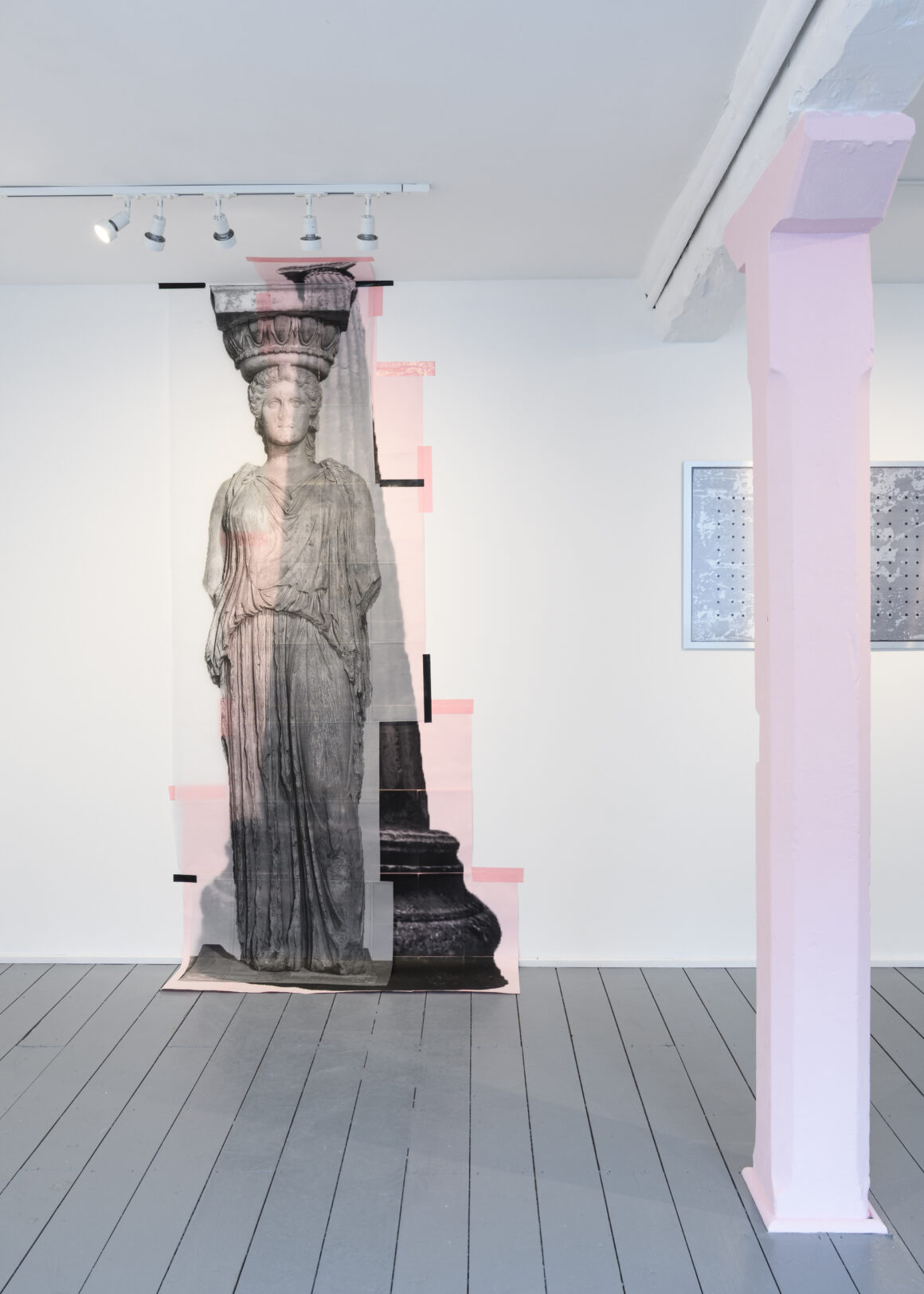
Architectures of surveillance and imperial power structures are foregrounded in Lynn-Marie Dennehy’s sculptural installation, Eyes and ears are bad witnesses for barbarian souls (2026). Tape and paper combine to create an image of caryatid – an architectural support carved in the shape of a female figure – superimposed over a classical Ionic column. The wall-sized print extends, in part, across the ceiling and floor, its papery ephemerality parodying the idea of the monumental. The patchwork nature of Dennehy’s image making calls to mind Hussein Mitha’s essay ‘The Wretched of the City (An Excerpt)’ for Strange lands still bear common ground, the publication for the 23rd edition of TULCA Festival of Visual Arts, curated by Beulah Ezeugo. They ask if the bodies depicted in caryatids have been ‘anthropomorphised’ or ‘petrified’, highlighting the very real human labour involved in their creation and in the upholding of our contemporary institutions and social structures.
Dennehy’s greyscale caryatid, evoking a sense of a shadowy, even nefarious, influence, is suggestive of the unseen role of colonial artefacts in defining our current value systems. The artist is interested in the overlooked Ionic column as a metaphor for disregarded histories. The pale pink highlights that surround the figure and pillar made me think about the ‘gynaopetican’. This term, coined by theorist Alison Winch, is a gendered, neoliberal variation on Jeremy Bentham’s panopticon, that enacts perpetual surveillance, disciplinary power, and regulation by women upon the bodies of other women. This in turn prompts reflection on the complex behaviours that see women upholding aggressive capitalist power systems while simultaneously being oppressed by them.
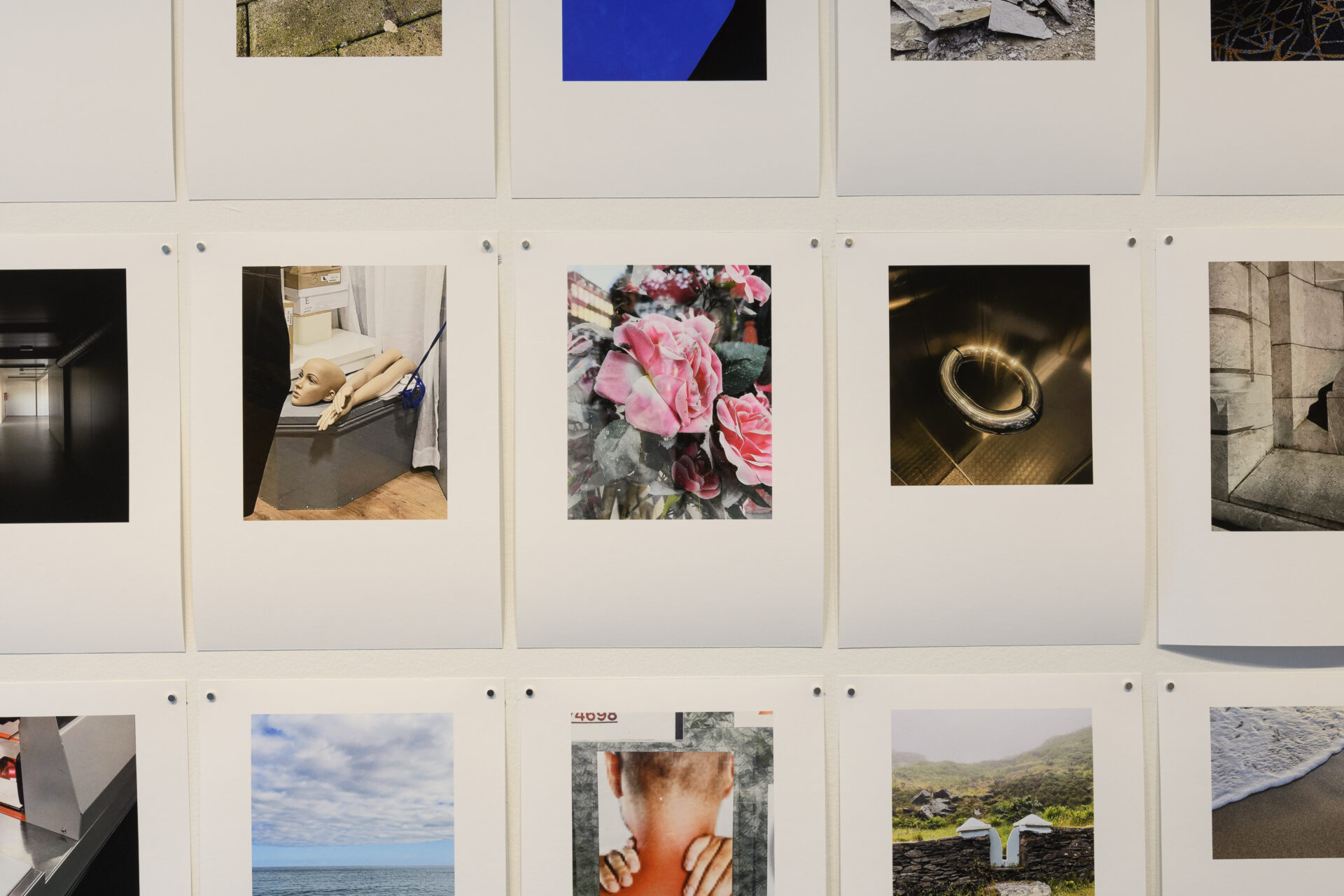
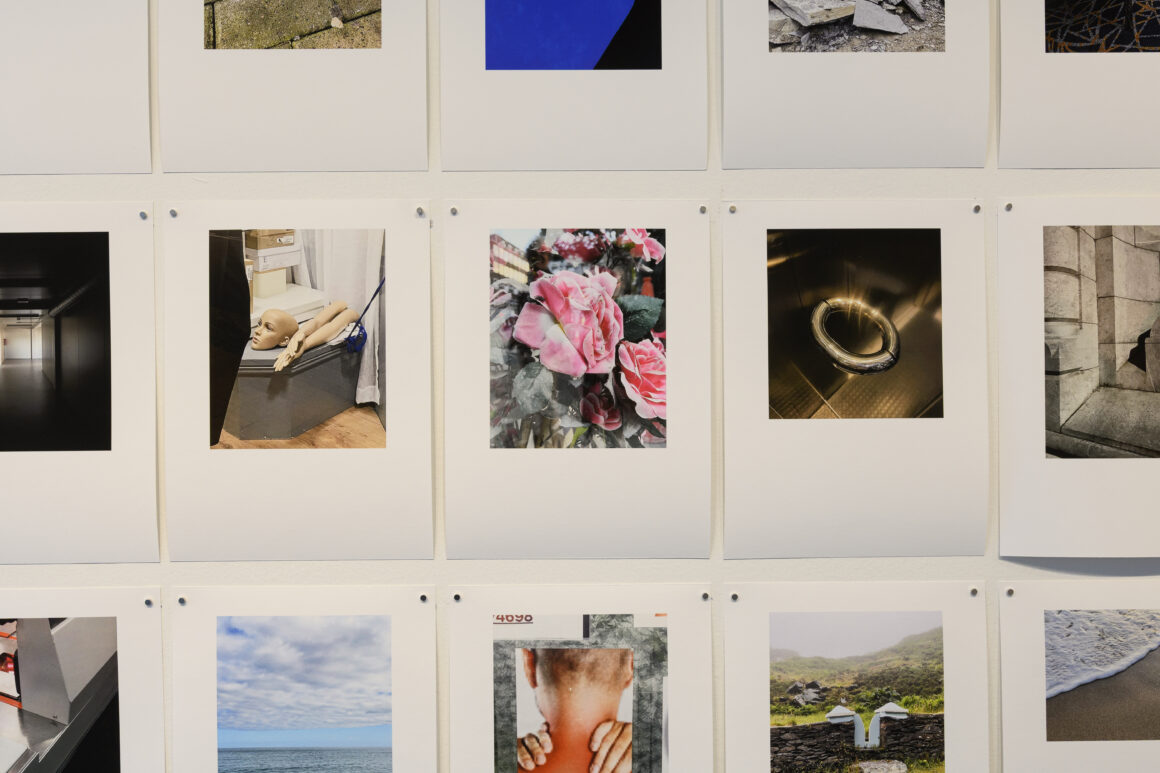
Pádraig Spillane’s grid of photographs, Image Notes (2026), is an immediate manifestation of perhaps the greatest panopticon of all: Instagram. Indeed, the images are a selection from the artist’s social media platform over the past ten years. The effect is, at first, mildly disorientating. The reality that 45 images – three rows of 15 – presented against a white wall, could disrupt my senses, seems absurd, considering how easily I scroll past thousands of images on my screen every day. Once I make a concerted effort to engage with each image individually, the rewards are endless: a curious image of a light fixture reflected in a window that frames a pink sky; a surreal image of a child’s toy car washed ashore; the tanning salon I pass daily, presented within a composition of technical excellence. The presentation draws into question modes of image circulation in a time of intense moral quandary regarding artificial intelligence. Interestingly, in spite of technological advancements, we still think of images in photographic terms – in fixed, framed moments. There is something quite poignant about Spillane’s ‘eye’ creating social and aesthetic connections that resist the ever-changing ratios of online formats.
One and Three Shutters (2024) by Andrea Newman also elicits strong emotion – this time, rage. In a nod to conceptual artist Joseph Kosuth’s One and Three Chairs (1965), Newman arranges a metal shutter alongside a photographic print of the object and its linguistic definition on separate sheets of aluminium. The latter cites a statistic relating to the high-cost Cork City Council have incurred in ‘shuttering’ vacant and derelict properties in recent years. Newman’s three objects combine to resemble a row of headstones – an apt metaphor for the dereliction and socio-economic impact that emerge from the state’s neglect of social housing. The artist also alludes to the role of language in denoting such hierarchies.
In the context of the broader exhibition, it is interesting to consider the shutter more expansively, in relation to the class dynamics of classical architecture referenced in Dennehy’s work, and in the mechanics of photography explored by Spillane. Returning to Quin’s curatorial enquiry, which uses the adaptive behaviours of moths as an analogy for the self-surveillance we reinforce, reproduce and perform under capitalism, ‘MOTH’ is an exhibition that is at times poetic, often polymorphic, and deeply political.
Sarah Long is an artist and writer based in Cork.