Naughton Gallery
4 December 2025 – 29 March 2026
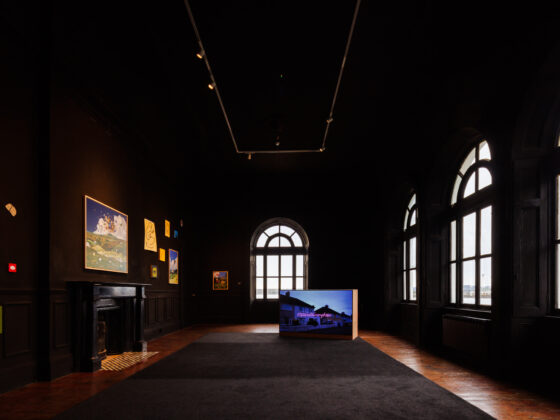
‘Disasters and Interventions’ is an exhibition at Naughton Gallery of over 50 works by visual artist, and hugely successful children’s book author, Oliver Jeffers. This is the first exhibition of his work to take place in his home city of Belfast in over 20 years. It features a series of painted and collaged interventions on different surfaces and found materials – a treasure trove of schlocky paintings, antique engravings, and vintage photo albums. Visually, the work is closest to Jeffers’ charming book, There’s a Ghost in this House (HarperCollins, 2021), in which the artist paints his child protagonist onto archival photographs as she goes in search of hidden ghosts (which appear periodically on translucent pages, overlaying them onto the background imagery).
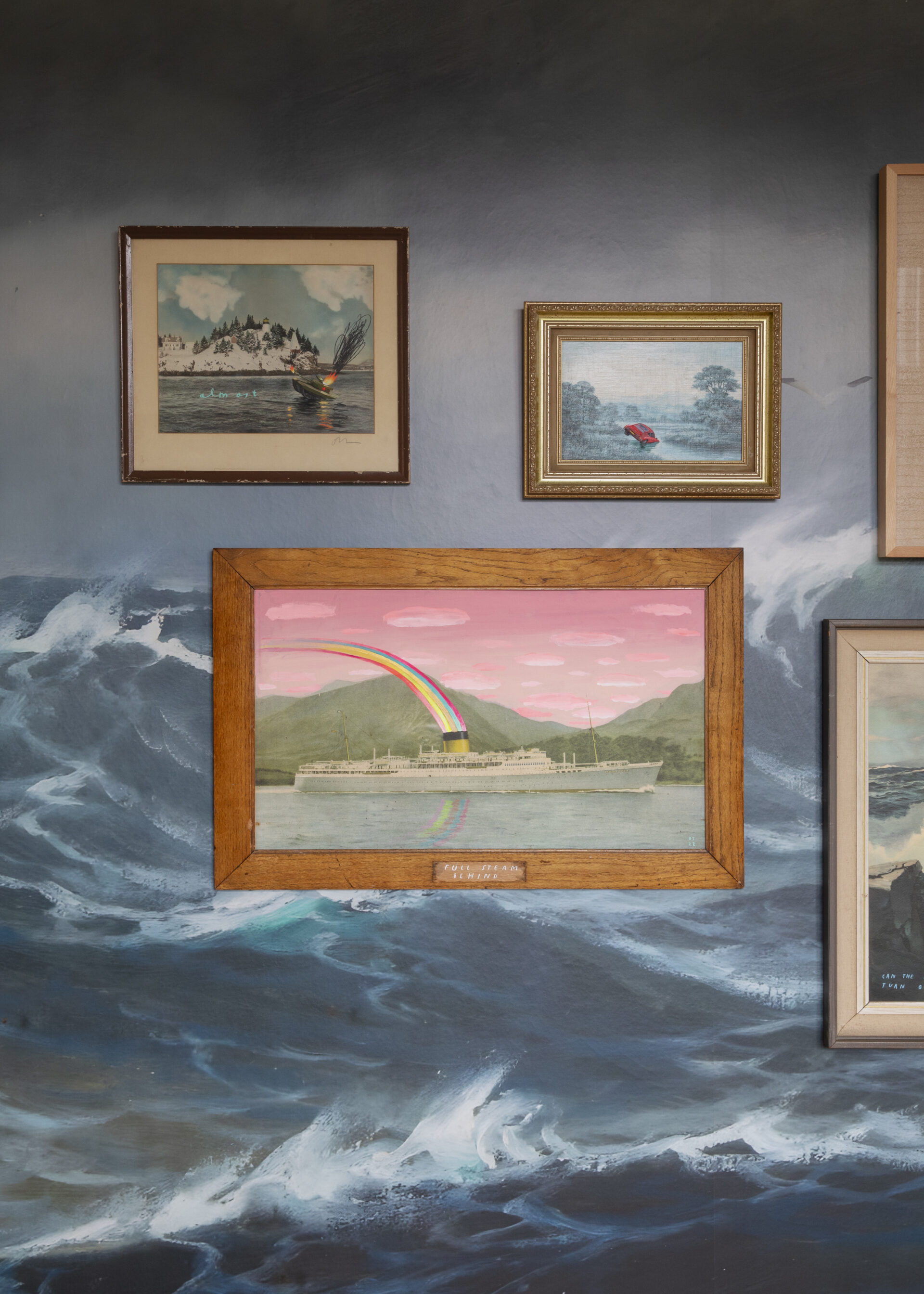
In the exhibition, there are specific references from the author’s oeuvre, not least the Hergé-inspired red space rocket from his book, How to Catch a Star (HarperCollins, 2014). It makes an appearance in A Point of Light in the Dark (2012), embedded nose first, having crash-landed in a reproduction landscape painting, originally hoked out of a Chinatown trash can. The rocket reappears next to a lake in Down on the Range (2025) – another dramatic landscape of distant, snow-capped mountains that could have been lifted from National Geographic. The spacecraft is one of a litany of crashed vessels and machines that includes blimps, jets, cars, buses, unexploded bombs, and Sputnik itself. Their juxtaposition emphasises the incongruity and absurdity of chance encounters.
Some of the titles incorporate humorous statements like “just give me a minute…” (emanating from a burning house); “I’ll be back in two min” (trailing from the cockpit of a flaming fighter-jet); or “I’m fragile right now” (next to a porcelain variant of the crashed rocket). These pithy one-liners are deliberately silly, funny, and inventive, serving to trivialise disaster while exemplifying a typical Northern Irish black sense of humour – or indeed, a coping mechanism.
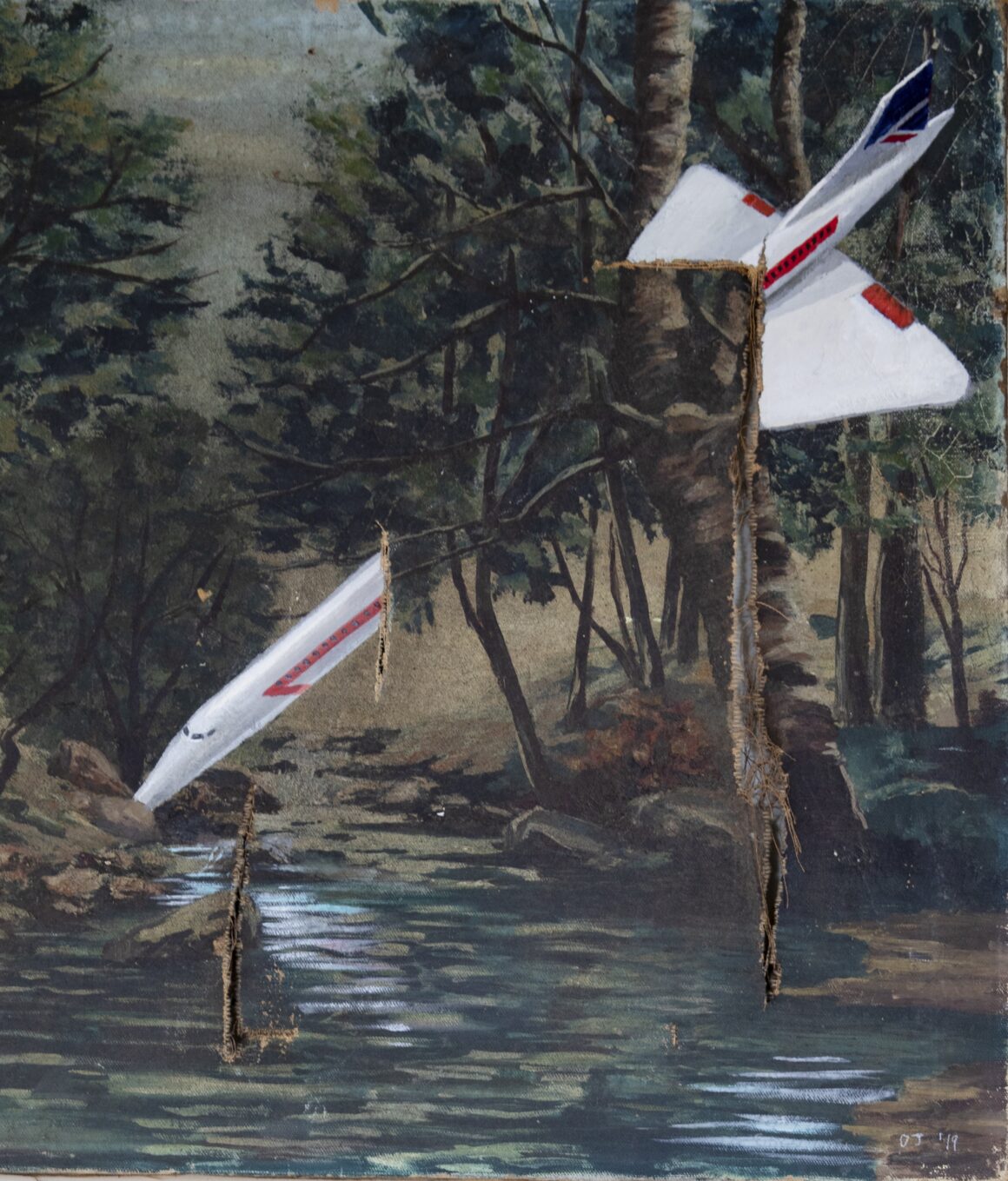
There are local references too: a DeLorean car is depicted, and an old Belfast bus is partly submerged in a lake. The Titanic makes several appearances: sinking impossibly into a small stream in Lost at Snow (2018) and embedded in rolling hills that resemble undulating waves in Lost at Hills (2025). In one torn painting, a crash-landed Concorde peeks through frayed canvas. The disaster works are clustered together over a custom-print wallpaper backdrop, showing a blown-up detail of an ideal Italianate landscape at sunset, serving again to highlight the irony of Jeffers’ drastic intrusions.
In many pieces, there is a distinct sense of characters remaining oblivious in the face of the artist’s interventions. For example, in There’s Nothing to Worry About (2019), a father and son driving two horses through a stream take no notice of the fire blazing in the back of their trap.
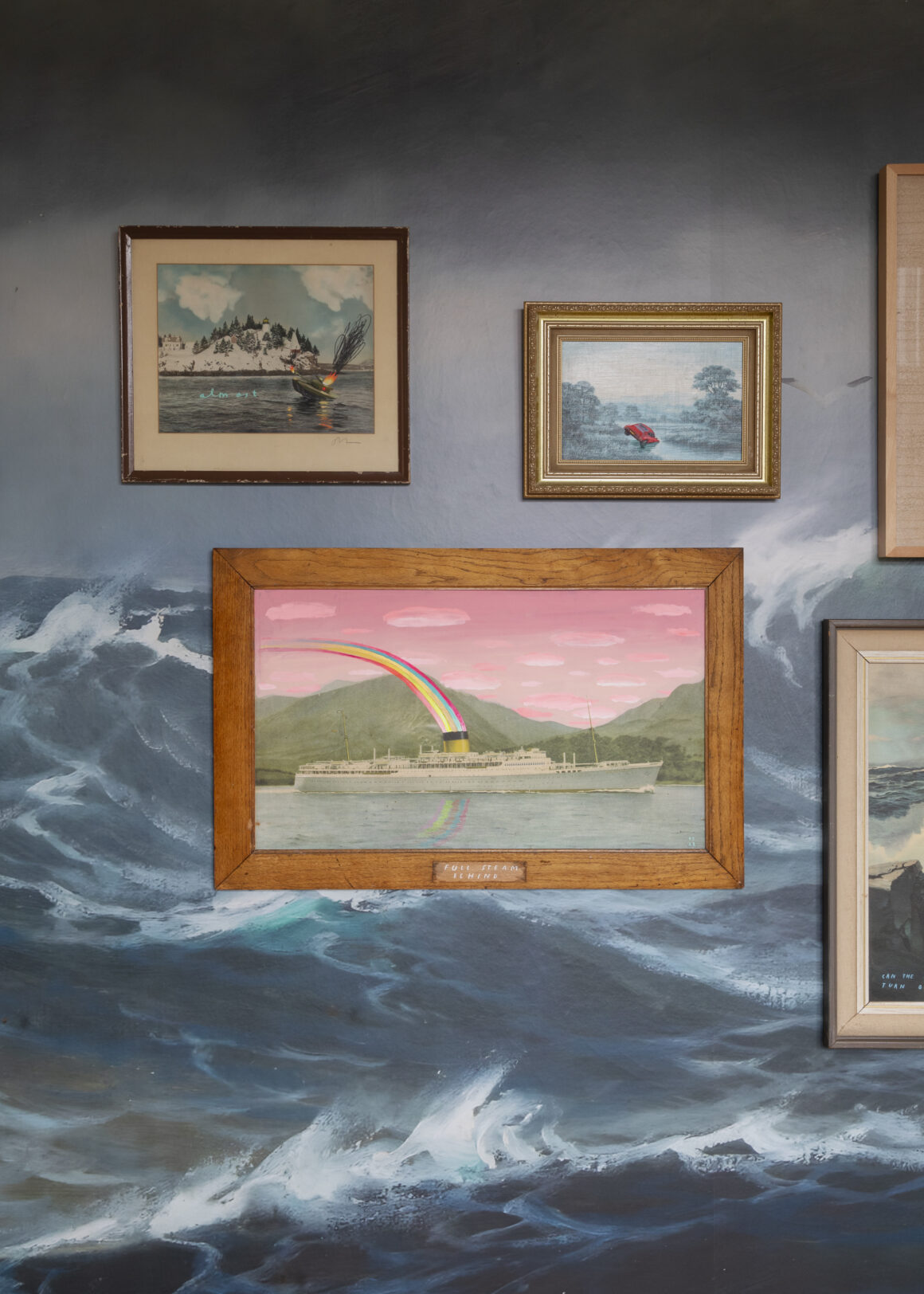
There are instances where the superimposed disaster replaces the perceived focal point of the original image: a flying DeLorean plunges into the sea, perhaps replacing a shipwreck in Rescue the Future (2018); while skiers surround a crashed Sputnik in flames in Moscow, We Have a Problem (2025). Like many of the artist’s additions, the latter shows beautifully observed details, such as the peachy-pink glow of the burning satellite being picked up in the tonality of the surrounding snow and skiers. Yet this trompe-l’œil illusion is sabotaged by deliberately cartoonish flames and scribbly smoke plumes.
This kind of contrast appears in Shoe Shopping (2023), where the source image – a black-and-white photograph of a smiling child, seated in a shoe shop – has been doctored so that her outstretched leg appears to be severed at the shin, leaving a neon pink cross-section, from which juts a classic cartoon bone. Other works include tiny details, such as radioactive cleaning products in a kitchen, or a smoking figure, oblivious to the burning lump of lava about to hit his house.
Overall, in ‘Disaster and Interventions’, there is a sense of the artist’s freedom from the usual constraints imposed by his young readership. However, Jeffers is not one to hold back on geopolitical commentary – from Gaza and Ukraine to Minnesota and Iran – with American imperialism critiqued through elliptical and blackly humorous references. In one scene, tiny figures peep, like inmates through prison bars, from the crown of the Statue of Liberty, which is submerged to the shoulders in a vast sea. The caption simply reads: “Send help.”
Jonathan Brennan is a multi-disciplinary artist based in Belfast.
jonathanbrennanart.com