Lismore Castle Arts
25 April – 25 October 2026
Years ago, having abandoned painting in despair, I found a job as an early morning cleaner at a prestigious bank. Around dawn, I would take my tea break in the Chief Executive’s office, the walls of which were hung with small, gilt-framed landscapes and seascapes. Those were the days when painters were urged to go large, days that resurge with regularity. Over time, these deceptively simple works – a creamy streak of pale ochre becoming a vast, empty beach; a flick of turquoise, the wild Atlantic – worked a magic that restored my belief in painting. ‘Salon’ at Lismore Castle Arts, a collection of ‘domestically-scaled’ paintings, recalls, to some extent, this enchantment.
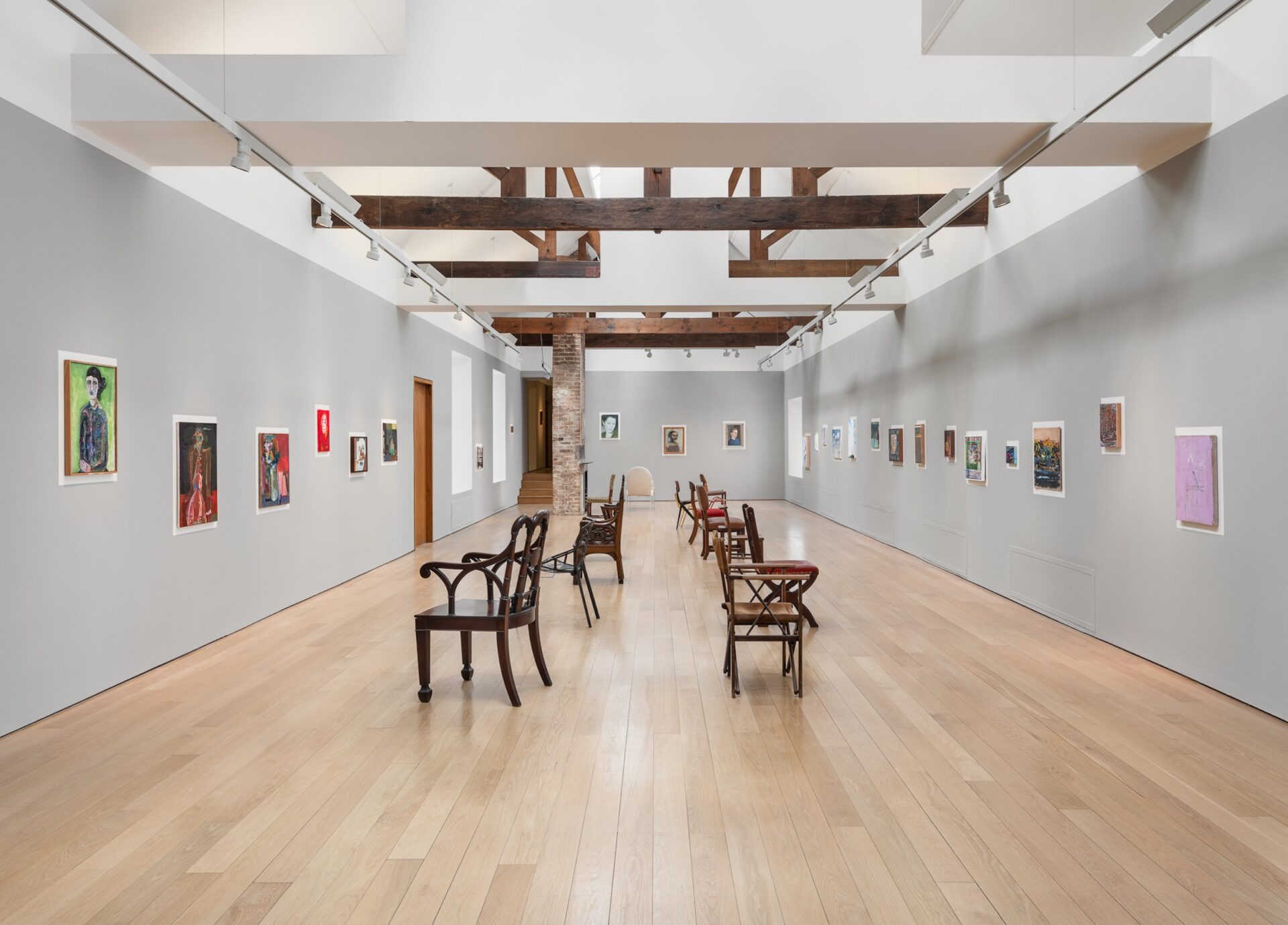
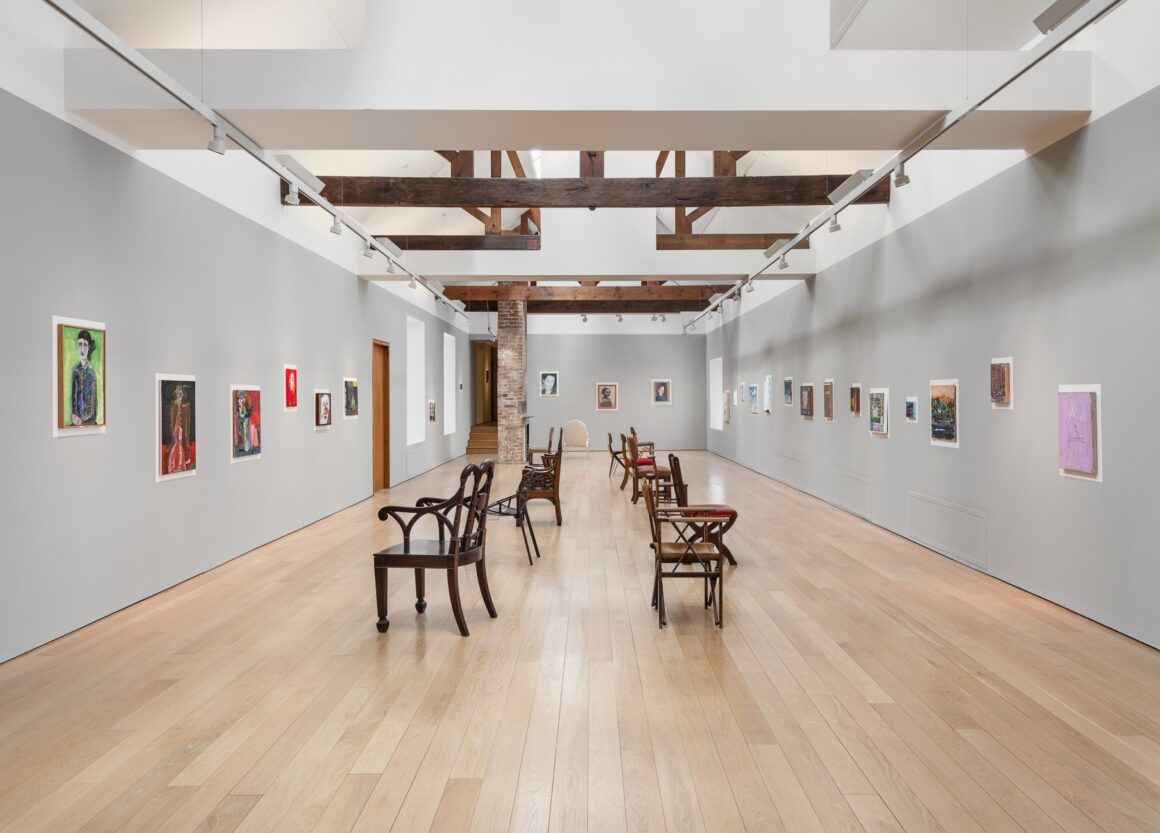
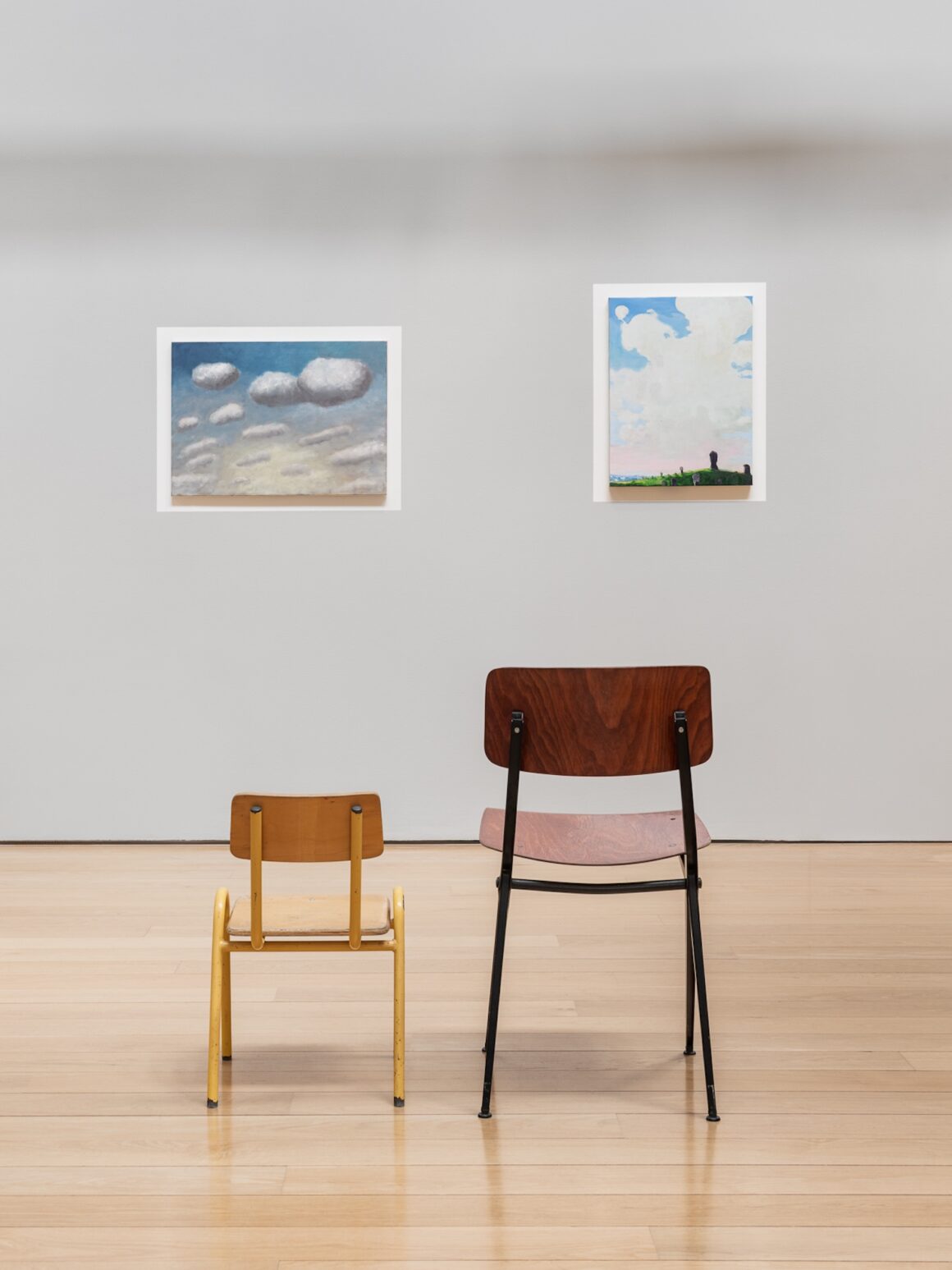
Despite the show’s title, the layout is only very loosely related to the classic salon hang; instead, the work follows a linear and well-spaced path around the gallery. It is more the conversation between each painting, enabled by their similar size and presentation and the many portraits, which summons the creative exchange of ideas that was the salon. An invitation to listen is extended to visitors by the provision of an informal collection of mismatched chairs, sourced from within the castle and placed throughout the gallery.
This is very much a painter’s show. Bill Lynch’s Yellow, Orange and Blue Little Flowers (c.1990–2005), daubs of paint on salvaged wood, hung next to John Maclean’s more formal and impressionistic Forest in Snow (2025), asks us to think not only about the history of painting, but what painting is. Across the room, a sequence – starting with Karen Barbour’s portrait, Daisy (2025), alongside her daughter-subject, Daisy Sheff’s cubist portrait, Kwitcherbellyachin (2021), Carole Gibbons’s still-life, Flowers in a Jar (c.1984), Margot Bergman’s Bait (2002), a landscape, portrait and concept, Merlin James’ abstract Bird House (2008), and Mike Silva’s realistic Studio Window (2026) – might be read as a garbled history of styles and subjects.
Other thoughts drift by. Jennifer J. Lees’ exquisitely and precisely painted Cowboy Hat (2026) – and on hessian, too – is bracketed by Na Kim’s Untitled (2026) cloudscape, the late Stephen McKenna’s Clouds (2014), and Verne Dawson’s Standing Stones in Brittany (2008), suggesting an absence, leading to thoughts of loss and the hereafter. On a facing pillar, Pádraig Timoney’s Broken Mirror for Glas 3 (2023) reflects nothing.
Some painters might seem to have been deliberately restrained by a selection of work at odds with their usual output. For example, Chantal Joffe, a practitioner typically working on a monumental scale, is represented by a tiny piece, as if to recalibrate, her impact, while Gillian Carnegie’s Section (2023), a stark, monochrome tree, belies the arresting detail of her wider painterly approach. However, with closer scrutiny, encouraged within this milieu, such artists tend to gain, rather than lose.
In the back room there’s a break in the egalitarian format. Alastair MacKinven’s large, Untitled (2019), featuring a black silhouette on red and purple, is roped off, creating a focal point. Out of context of MacKinven’s practice, this work, though big and buzzy, does not say much at all. The inclusion may be to underline the anti-elitism of the rest of the display or perhaps it is a personal nod to the work of an artist who died relatively young.
Nuggets of wit creep in – Joffe’s Self Portrait from Behind (2021) refuses to chat, while placing Couple from Dumbarton (2016–2017) by Andrew Cranston (known for painting on book covers) beside Paul Housley’s Rare Books (2026) is a sly wink – but for the most part, everything is on its best behaviour. Frayed canvases, rough frames, and raw supports are hemmed neatly into the white, painted rectangles upon which each work is placed. Though the impeccable presentation might serve to focus the discussion, it also transforms the chairs into museum exhibits, generating a certain restraint that might discourage some from sitting and taking the time needed to enjoy this show. However, most will appreciate curator Matthew Higgs for his willingness to allow the viewer space to ruminate. It would be interesting to see this sort of curation taking root in more accessible places – hospital waiting rooms or even city art centres – where the painterly magic might take effect on the disenfranchised cleaners of the world.
Clare Scott is an artist and writer based in County Waterford.