Ormston House
20 November 2025 – 21 February 2026
From 1916 to 1920, an engineering lecturer, William J. Crawford, regularly visited Kathleen Goligher’s Belfast home, conducting elaborate experiments to investigate her apparent psychic powers. As Goligher and her siblings sat hand-in-hand in a circle, the table between them levitated and tilted. Rapping was heard and footprints were found in bowls of damp clay that Crawford had placed on the floor. Clay appeared on Goligher’s stockings, even when her feet had been encased in tight boots. Emanations ‒ ectoplasm? muslin? ‒ were photographed appearing from under her skirt. Crawford concluded that these were physical traces of what he called ‘psychic rods’. He theorised that, when acting in concert with her circle and with her spirit ‘operators’ these projected from Goligher’s body, manipulating the table, touching the participants, and dabbling in the clay.
Three of Crawford’s books are included in Susan MacWilliam’s exhibition of new work, ‘Table Turning’, at Ormston House in Limerick. MacWilliam’s work in a range of different media emanates from her own fascination with late nineteenth-century and early twentieth-century mediums and the men who probed their powers. Addressing “phenomena contested by orthodox science such as clairvoyance, telepathy, and precognition,” MacWilliam reminds us of the “gendered relations of mediumship” in that “in many cases, the mediums were female, while those ‘investigating’ them were men,” who attempted either to reconcile science and the supernatural or to debunk the powers of those claiming psychic talent. (ormstonhouse.com)
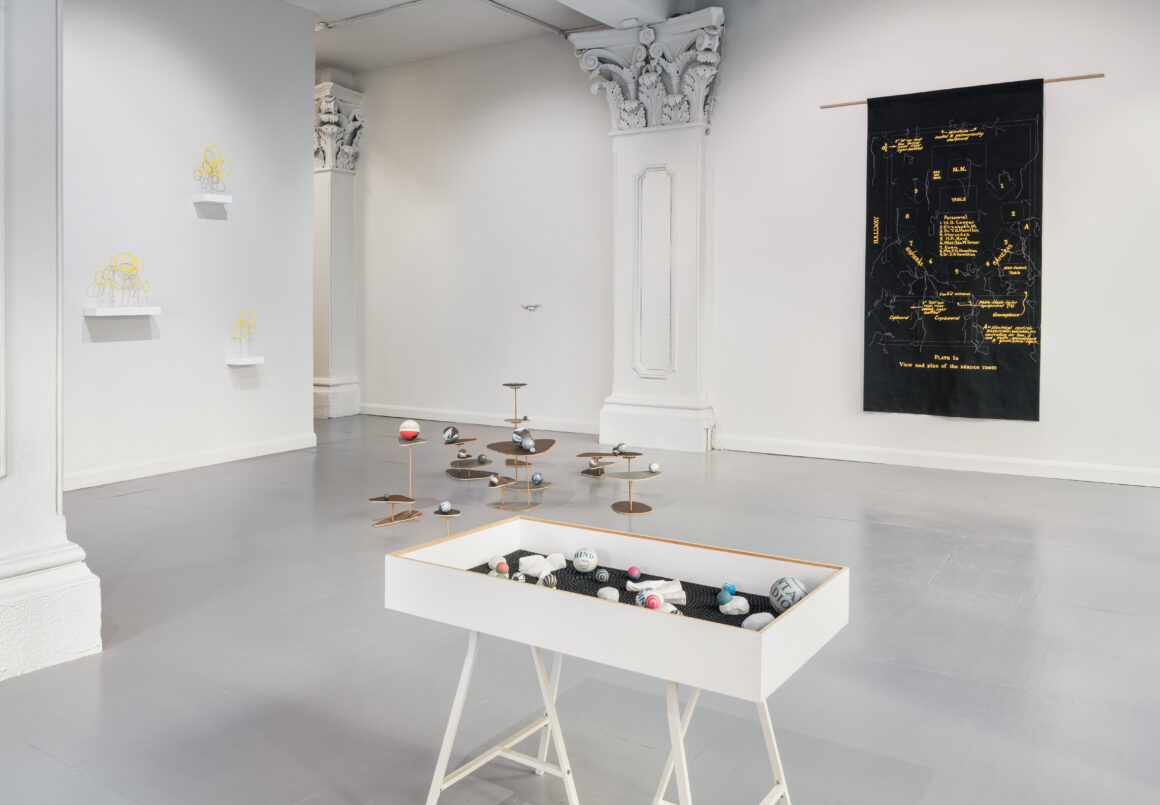
The vitrines forming part of several exhibits are sturdily and simply built (by the artist) and recall the tables of the table-turners. The first contains photos of the mediums and works of psychical literature, open to pertinent passages. In The Three Arts Clubs with Fifty-six Telepaths (2025), images of the female telepaths (imprinted on table-tennis balls) hover over an enlarged photograph of women reading in the comfortable library of the London Three Arts Club, which provided accommodation and facilities to women engaged in art, music, and drama and literature. From the start, MacWilliam suggests reading as a metaphor for telepathy, a means of intellectual exchange, and a force for female liberation. Art and sculpture can perform similar functions: for MacWilliam, “the realisation of ideas and objects in the studio” resembles “the manifestations and materialisations of the séance room.”
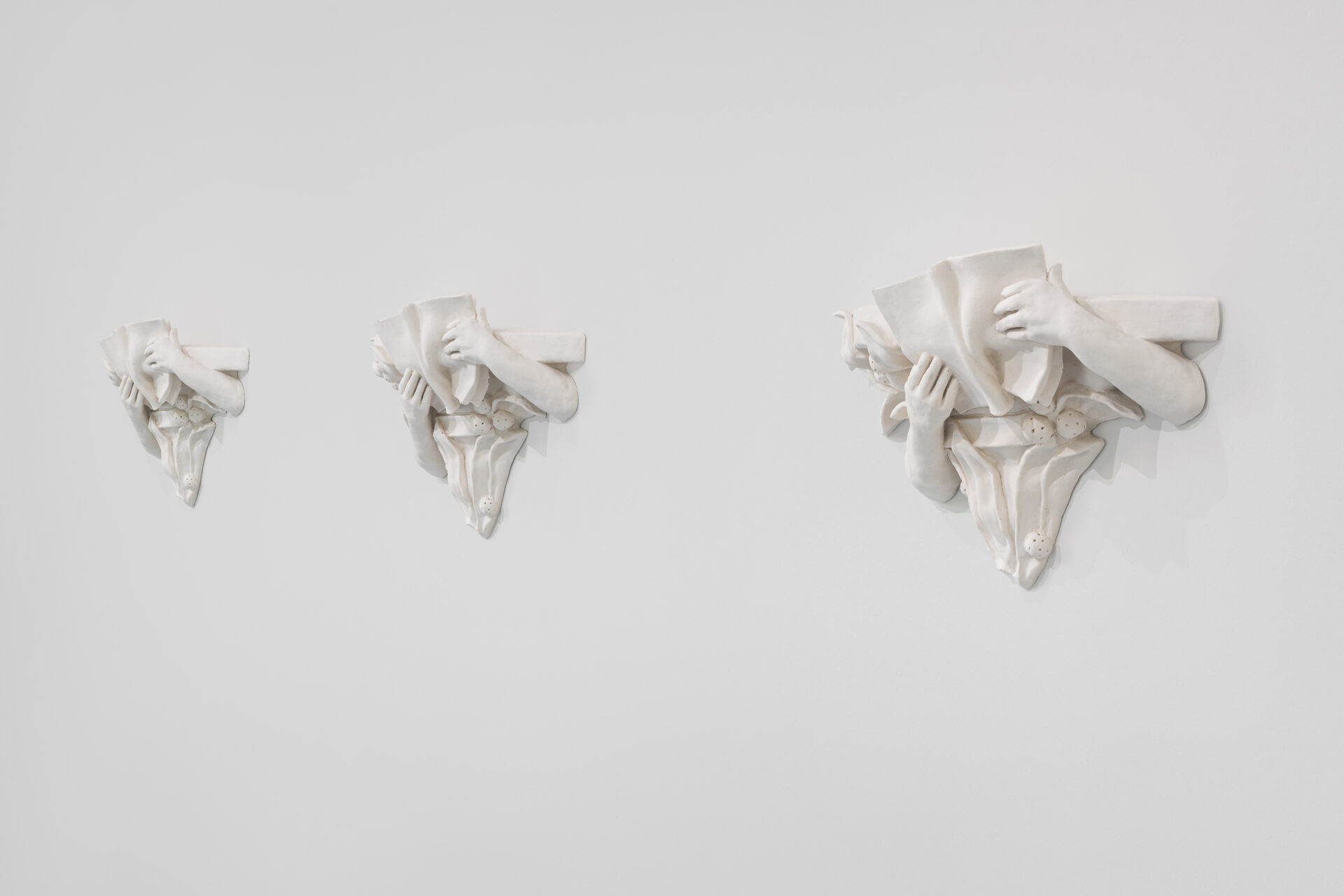
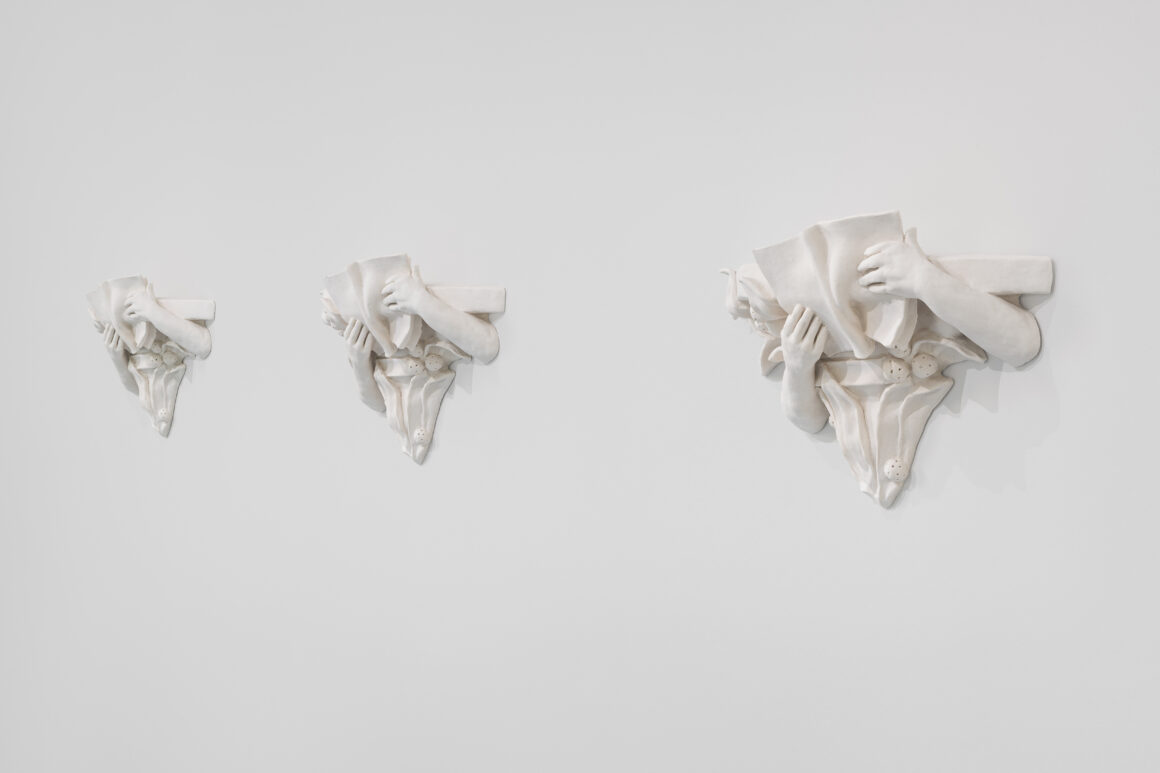
Ormston House is an ideal space for this work: ‘Table Turning’ responds to the gallery’s ornate columns, both in the ways the viewer’s movement is directed, and in some of the sculpted elements. Book Reader with Leaves (2025) – a series of wall plinths featuring books, hands, and spheres – echoes the building but also invokes funerary sculpture and the attention paid by investigators to the hands of their mediums.
A wall of different configurations in Telepathy Hoops (2025) prompts consideration about what or who those versed in scrying might find beyond. Nearby, in Apparatusphere (2014) fragments of surfaces, set at different heights, tilt, rise and subside. Spheres ‒ some marbled or clouded and others with glimpses of “images of experimental testing apparatus from the laboratory of parapsychologist Dr. J. B. Rhine” ‒ balance, seemingly precariously, like a model of an orbiting solar system. In Geraldine C: Rocks and Vortex (2025), the vortex is sewn into felt, as spheres, hands and sculpted ‘rocks’ merge, collide or, perhaps, fly apart. In her ‘automatic writing’ Geraldine Cummins, a Corkwoman, claimed conversations with historical figures and described alternate planes of existence. I found myself circling this piece several times, and the layout of the exhibition in general encourages the viewer to encircle both the room and the presented works.
Throughout, MacWilliam manipulates her materials to create impressions of both lightness and weight. Appropriately, the viewer finds themselves wondering at the sleight of hand involved. The table-tennis balls, from which the faces of the ‘fifty-six telepaths’ peer, as if from another dimension, aptly represent the interplay of materiality and immateriality that MacWilliam invokes so deftly. If so inclined, you could follow this exhibition with a visit to the ancient crystal ball / luck stone on display down the road in the Hunt Museum.
The most striking of MacWilliam’s works is Séance Room, 1931 (2025), a large felt wall hanging stitched with cotton thread, which (almost) faithfully renders a Canadian parapsychologist’s map of a séance, meticulously marking where the medium and the circle sat, the location of the table, and the cameras and ‘phonograph’ set to record. Loose threads, like tendrils of psychic ‘stuff’, wend across the surface, and between the sitters. Viewed alongside the rest of MacWilliam’s conjurings, it is as arresting an act of invoking other worlds as any of the 1931 circle might ever have hoped to experience.
Clodagh Tait lectures in History in Mary Immaculate College, Limerick.