CCA Derry~Londonderry
3 October – 19 December 2026
We think of the night as a loss of visibility: a time when we lose our points of visual and social reference, and instead, must orient ourselves on an internal, imaginative compass. ‘The Night Journal’ at CCA is a group show of four artists – Reuben Brown, Aisling O’Beirn, Wilhelmina Peace, and Michaela Razafima Nash – who are interested in the parallel realities that can emerge when we follow more intuitive modes of navigation.
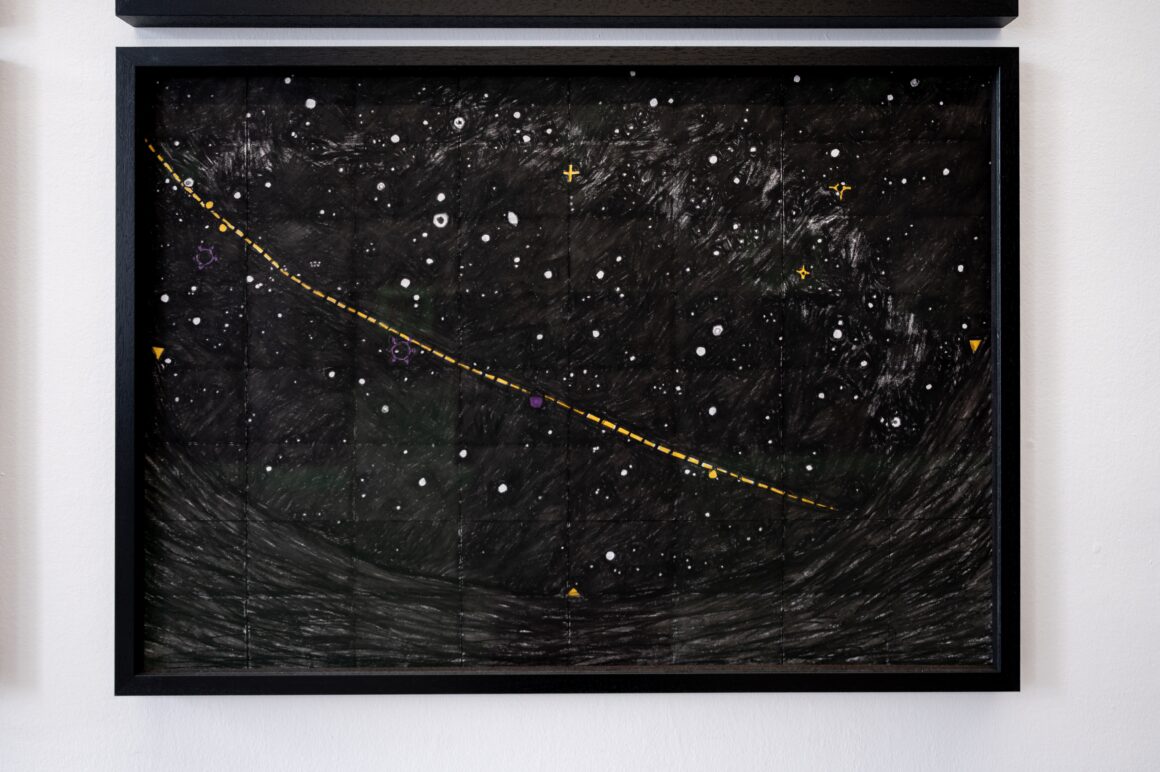
Secondhand Nightscapes (2024) by Aisling O’Beirn is a visual journal in 24 drawings of the Northern Hemisphere’s night sky over 12 months, drawn from an astronomical almanac – that’s the ‘secondhand’ part. The work suggests that this is what we should see in the night sky, without the interference of light pollution. The celestial bodies serve as a memetic canvas, in which we assign meaning and identity to individual stars and constellations, becoming malleable components of gestalt knowledge, like navigation, inspiration, or scientific enquiry. Light pollution doesn’t just blot out a nightly spectacle but also occludes shared bodies of knowledge. Secondhand Nightscapes, with charcoal textures of human labour, symbolically reclaims cultural knowledge.
Where O’Beirn draws her nightscapes ‘secondhand’, Michaela Razafima Nash’s text, The Night Journal, imagines a physical journey to seek them out. In this episodic journal, the narrator is an insomniac, nocturnal flâneur who travels urban streets towards a hill overlooking the city. They observe with foreboding, a sparsely populated otherworld of traffic, floodlights, and out-of-place humans. Entry 2 concludes with a recollection of an urban legend, a “creature that eats light”, which could be “a revolt against the constantly lit world humans have created.” This nod to folklore in Nash’s writing is mirrored in a series of 15 prints by Wilhelmina Peace, whose oeuvre is broadly concerned with metamorphic female representation in myth, folklore, and fairytales. The emotionless expressions and skewed proportions of the depicted figures are inspired by mythology in which characters become pedagogic vessels for meaning.
However, Peace’s figures aren’t vessels, but agents of transformation. Many of the prints, like Night Menagerie, Bat (2026) and Let Me Hold You (2025), feature Chimeric human-animal females that revel in dream-induced freedoms, as a foil to the figure in Longing for Fields and Feathers (2025), who is crouched and physically bounded by the very dimensions of the print. Morning (2025) features a woman with the face of a beast. Is she reverting from a lycanthropic reverie, or emerging to a new day, forever changed?
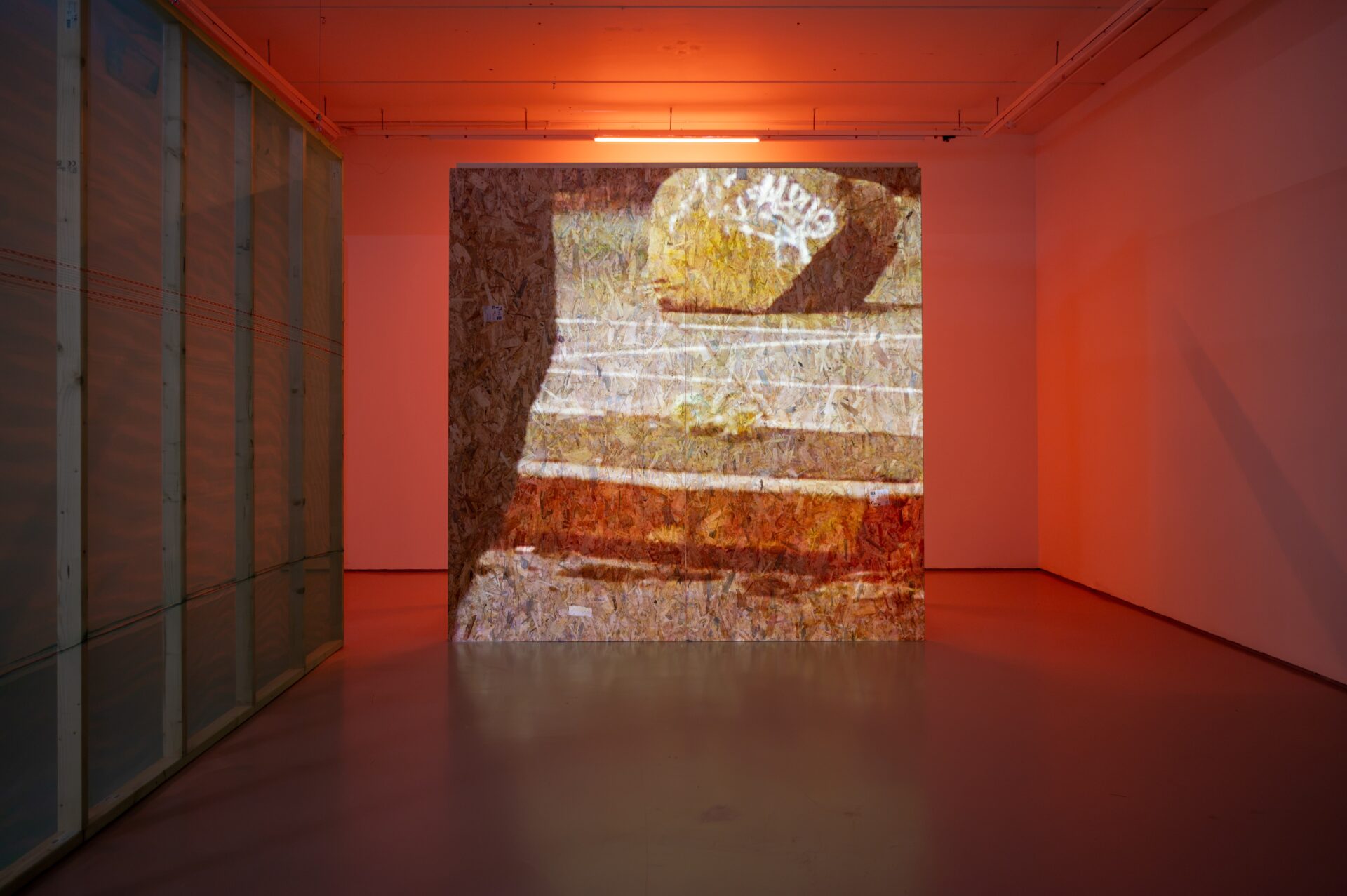
In Entry 3 of The Night Journal, the narrator stumbles across a queer, outdoor rave beneath a motorway bridge, complete with glow sticks and strobe lighting, offering “not the loneliness of insomnia, but the electricity of queer celebration.” Their eye is caught by someone with beautiful “top surgery scars glimmering in the lights.” On this night, scars aren’t concealed injuries, but proud physical testaments of identity. Reuben Brown’s installation and single-channel film, Brutal Discothèque (2026), depicts another guerrilla nocturnal culture: two anonymous men, improvising a dancefloor in neglected urban space under a motorway flyover. The presentation of the film is deliberately harsh: projected onto raw OSB board, it retains the visual grain of synthetic wood, while a distant, elevated recording angle suggests unsanctioned surveillance of a secret event.
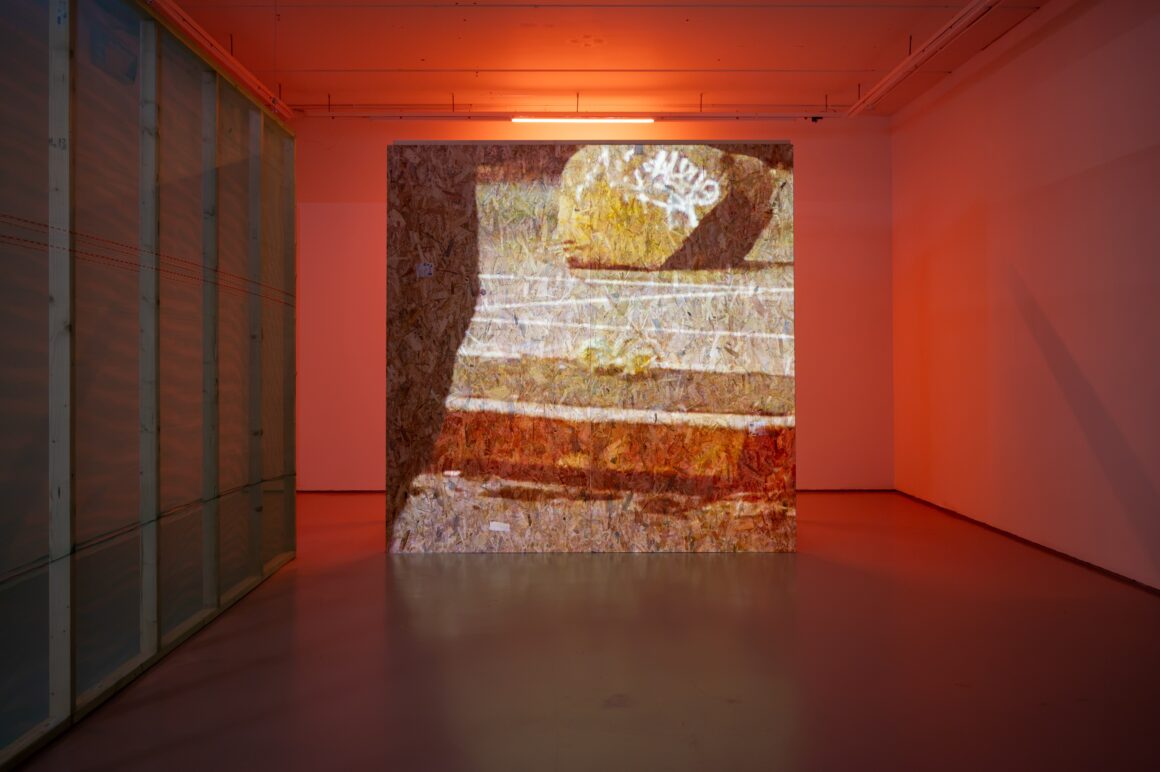
This work is framed as an insistence on presence without permission, in defiance of lacking infrastructure for queer communities in Ireland. However, it could also be read as a more transgressive facet of queer culture: anonymous, ad-hoc meeting spaces, evoking the parallel communities of ‘cruising’. The coarse grain of OSB board echoes the deliberately low-quality images of hook-up apps, compressed to save bandwidth and loading times on phones. Sometimes, people insist on invisibility and detachment.
Brutal Discothèque is distinguished from the other works by having no conceptual ‘end’: this night isn’t a cycle, but an intentional sociological construct. By contrast, O’Beirn’s Secondhand Nightscapes captures an ongoing cycle of change, while Peace’s Morning explicitly frames the freedoms of the night as fleeting. Entry 5 of The Night Journal ends as the narrator finally reaches their destination: the top of a hill overlooking the city, in time to watch light return to the waking world. I’m unsure whether this is a sad moment, or not.
Kevin Burns is an artist and writer based in Derry.