SARAH LONG REVIEWS THE CURRENT EXHIBITION AT THE GLUCKSMAN IN CORK.
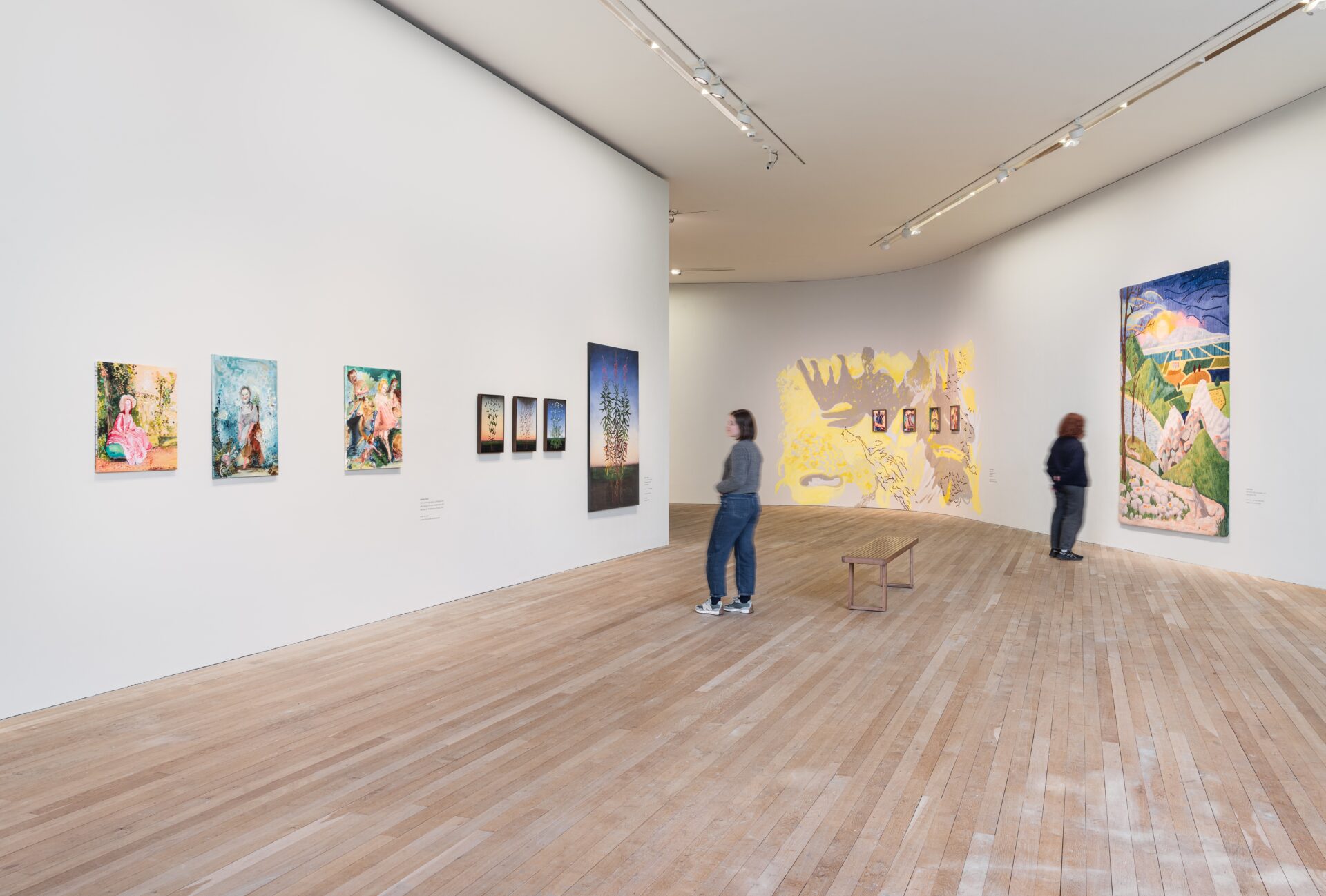
“Panorama Europa”, two words of Greek origin, form the title of the current group show at The Glucksman, curated by Katie O’Grady and Fiona Kearney. The Greco-Roman world, often invoked as the framework for Western civilization and certainly the foundational aesthetic and code of existing power dynamics, permeates our broader understandings of Europe. This exhibition, which continues until 1 November, features the work of ten Irish artists who variously draw on European painting traditions, namely: Ursula Burke, Michael Canning, Sian Costello, Genieve Figgis, Claire Halpin, David Eager Maher, Rachel Fallon, Eleanor McCaughey, Isabel Nolan, and Geraldine O’Neill.
The exhibition takes its title from a diptych by Claire Halpin, titled Panorama Europa (2024), which was originally commissioned by the Glucksman for the University College Cork art collection. The central motif of the painting is a Tower of Babel-like structure, altered to resemble an ancient Olympic stadium. Spread out from this central monument, which supports the large flag of the European Union, are several different narratives and timelines that pictorialise the shifting political landscapes of Europe. Within this typical Renaissance-style composition, Halpin balances multiple points of action, such as diggers extracting from deep within the earth, a series of dots and symmetrical lines that allude to the Nuremberg rallies, an assembly of Ukrainian refugees, and a more direct reference to Bruegel’s depiction of Babel, all happening within the one picture plain. The texture of the painting, with its thick impasto ground, evokes a scarred landscape, while the opaque application of paint, that renders flags, drones, and security cameras, is suggestive of layered stories and scenes, calcified underneath.
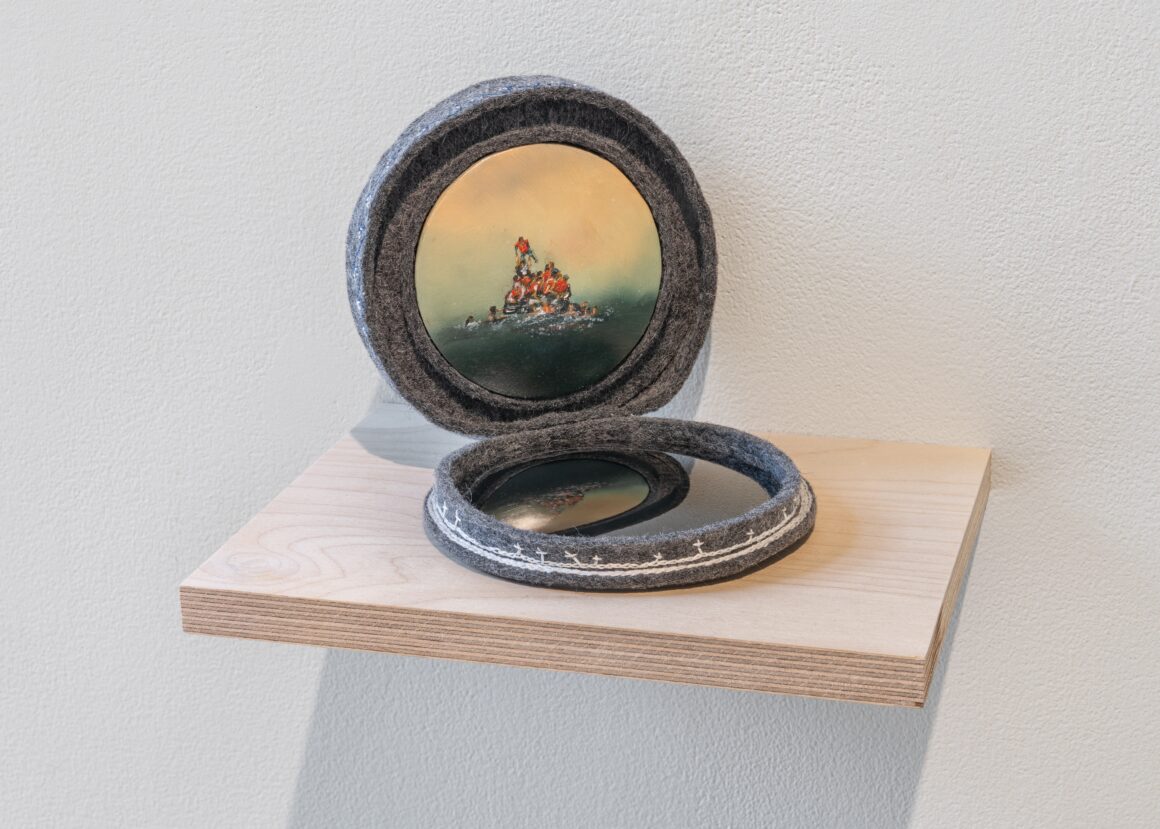
Halpin collaborated with Rachel Fallon on the sculptural work, To Never Look Away (2024), a round box holding a circular miniature painting, which calls to mind a devotional trinket. Indeed, the small object, fabricated from felt, black mirror and a gesso panel, is presented on a shelf that further imbues the materials with a talismanic quality. The exterior stitching decorates the box with small crosses. Buttery applications of Buff Titanium, Naples Yellow and Prussian Blue create the romantic looking oceanic horizon line of the painted scene held within. In the centre of the composition, however, are a mass of bodies in orange life jackets on a raft, with other bodies in the water surrounding it. The scene is terribly and inescapably familiar. Refugees continue to cross the Mediterranean, even, as the title condemns, when the eyes of the world look away. To borrow the words of Nuit Banai, and her criticism of ‘border identity’ and Eurocentricism, “It brings into relief the mostly unspoken ideological structures organising the relations between the capitalist First World and the rest of the planet: their uprootedness affirms our security; their deprivation guarantees our benefits; their death ratifies our life.” 1
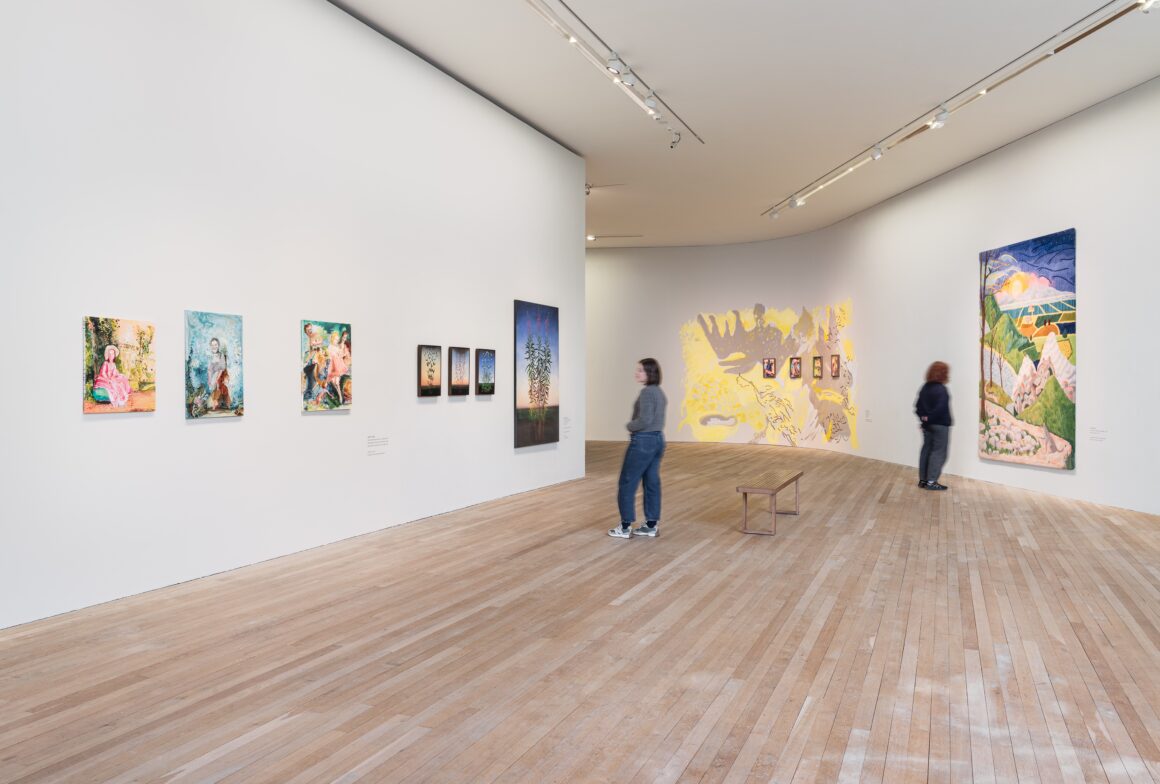
Sian Costello’s two large-scale self-portraits, The Model and The Mime (both 2025), operate within the conventions of the European painting tradition. Like John Singer Sargent, a leading figure of the Belle Époque, Costello uses the ‘sight-size’ method, translating the observed directly into the painting. Of course, Costello is depicting their own figure and so adapts the method through the use of photography, creating dynamic compositional poses. The result is extraordinarily striking; in The Model, the figure is rendered slightly larger than life, poised low on their haunches and drenched in a dramatic spotlight. The broad brushstrokes and luminescent palette create a kind of visual hum, causing the figure to appear in the midst of motion. A yellow fabric hangs as the backdrop for the figure and runs from the wall to underneath the feet. This allusion to the studio provokes a consideration of both the artist’s and viewer’s gaze, prompting questions of representation.
Elsewhere, artists engage in a more direct subversion and challenge of established practices. Across Ursula Burke’s series of three drawings, she cites traditional Arcadian landscapes by European artists and disrupts this harmony with scenes of protest and conflict in Northern Ireland. Genivive Figgis melts Rococo visions of loveliness into nightmarish figures through the slippery and loose application of paint, while Eleanor McCaughey combines religious iconography with personal motifs, and oil paint with glitter.
A panorama can be both a broad expansive view of a landscape and an extended series of pictures unrolled before the viewer. This exhibition, with its myriad of concerns, is both. Broadly, it is interesting to centre a European lens upon painting and to interrogate the medium’s continuing association with both historical and current power dynamics. The focus on Irish artists adds additional layers of consideration that mobilise art history to differing effects – observing and recreating, challenging and subverting.
Sarah Long is an artist and writer based in Cork.
1 Nuit Banai, Being a Border, edited by Francis Halsall and Declan Long (Dublin: Paper Visual Art, 2021) p.24.