MIGUEL AMADO REVIEWS THE LIVERPOOL BIENNIAL 2025.
The spectre of empire haunts Liverpool. Everywhere across the city, British colonialism’s exploitation of people and lands near and far, and the corresponding wealth extraction for the benefit of the British aristocracy, is summoned. The theme of this year’s Liverpool Biennial, BEDROCK, draws directly from the city’s geology, but a complementary understanding of the concept, anchored in a social perspective, makes the articulation between the city and its history more thoughtful, and helps explicate the intellectual edifice formulated by curator Marie-Anne McQuay. In BEDROCK, the sandstone that spans Liverpool is more than a geological quotation; it is a metaphorical lens by which a wound in today’s society might be reclaimed, even if the fractured relationship between Liverpool and its past is too profound to ever be entirely repaired.
Alice Rekab is one of the 30 artists featured in BEDROCK, and their contribution encapsulates the curatorial premise. Like Rekab, around half of them operate from European cities – from Amsterdam to Vienna, Oslo, and Dublin – yet have roots in diaspora, with the majority exploring topics of identity and representation informed by their lived experience. In advancing a selection that pays particular attention to demographics and politically driven content, McQuay points to cultural hybridity as the quintessential characteristic of the twenty-first century, suggesting that contemporary Liverpool, independently of its complex foundational principle, synthetises such attribute. In this regard, BEDROCK aligns with a myriad of recent European biennials, placing a globalist interpretation of art at the core of their reason for existence. Similarly to those other biennials, BEDROCK struggles with Liverpool’s ambiguous historical condition as a centre of power, as well as the mere fact that its curatorial vision necessarily departs from a position of privilege – whether financial, ethnic or other – granted by its European institutional and ideological apparatus.
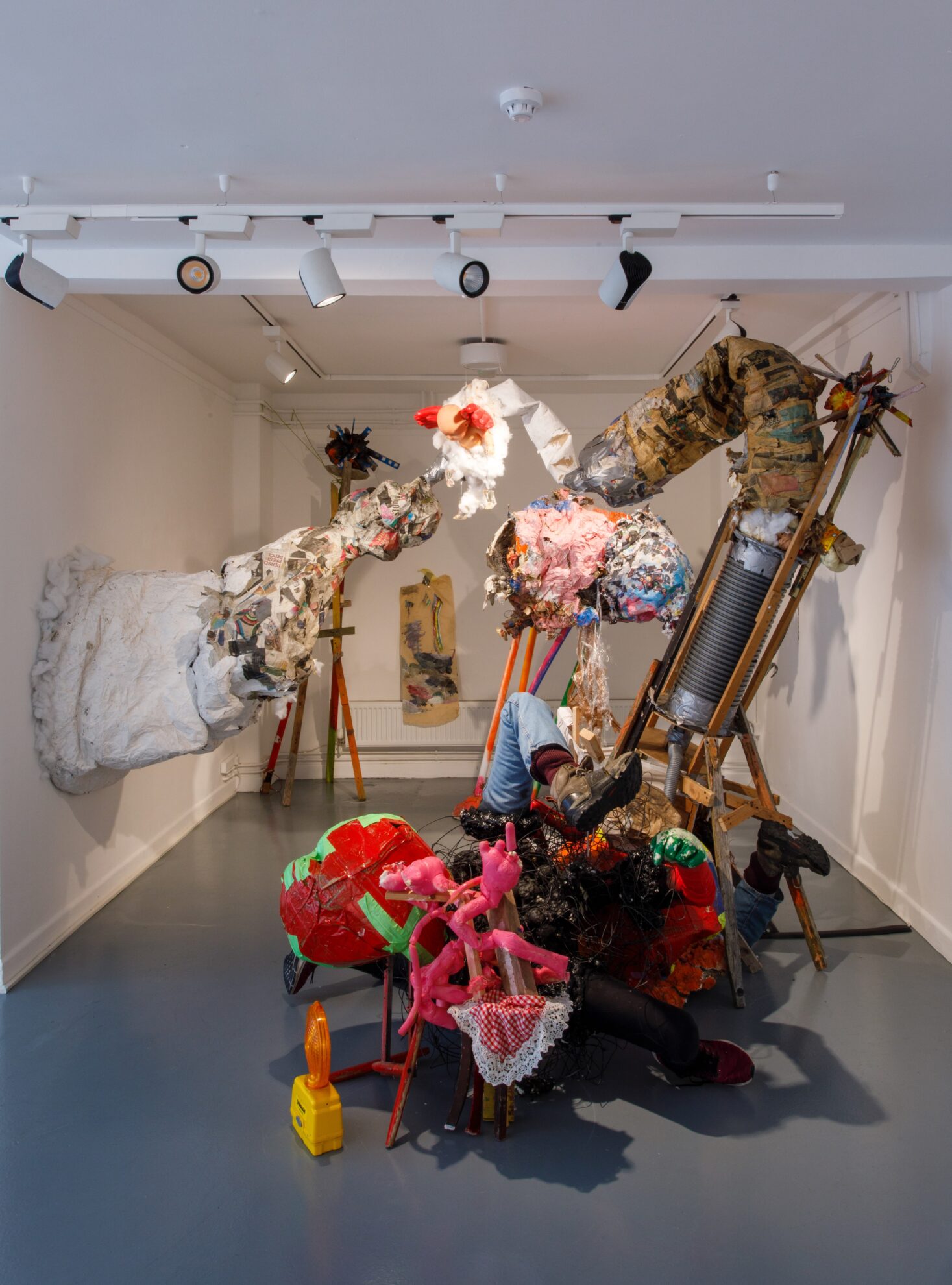
At The Bluecoat, Rekab presents an expansive, refined mix of works, both new and from recent years, that epitomise the questions posed in BEDROCK. The display consists of fragmented clay pieces that resemble body parts, African statuettes, miniature replicas of animals associated with wildness laying on found mirrors, and a salvaged cabinet holding archival items, from heirlooms to books. Furthermore, a wallpaper digitally blends old portraits of Rekab’s paternal grandmother and father, architectural details of The Bluecoat and other buildings where Rekab exhibited before, impressions of Rekab’s sculptures shown elsewhere, and fluid lines depicting transatlantic ship routes linking Liverpool, West Africa and the Caribbean, known as the ‘Blundell family’s slaving voyages’. Appropriately, the display is titled Bunchlann/Buncharraig (2019-25), linguistically relating ‘bedrock’ to notions of origin and family.
Rekab’s display speaks to their Irish and Sierra Leonean heritage. It combines the Irish language and elements of the white monoculture in which they grew up, with aspects of a multifaceted Black culture acquired via interactions with their Sierra Leonean progenitors. At stake here are issues of racial memory, generational trauma in marginalised communities, and senses of displacement and belonging, all entangled with inherited and chosen lineage. The same theoretical framework guides another artist showcased at The Bluecoat, Amber Akaunu, whose film, Dear Othermother (2025), takes Black Liverpudlians as a subject in a fitting crossover of fact and self-reflection, typical of the regional stories the artist documents. The work is an emotional chronicle of kinship, pride, and resilience among single mothers from Toxteth, illuminating a matriarchal care network derived from need and solidarity.
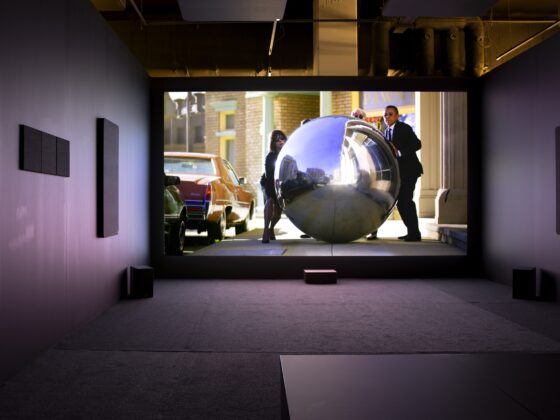
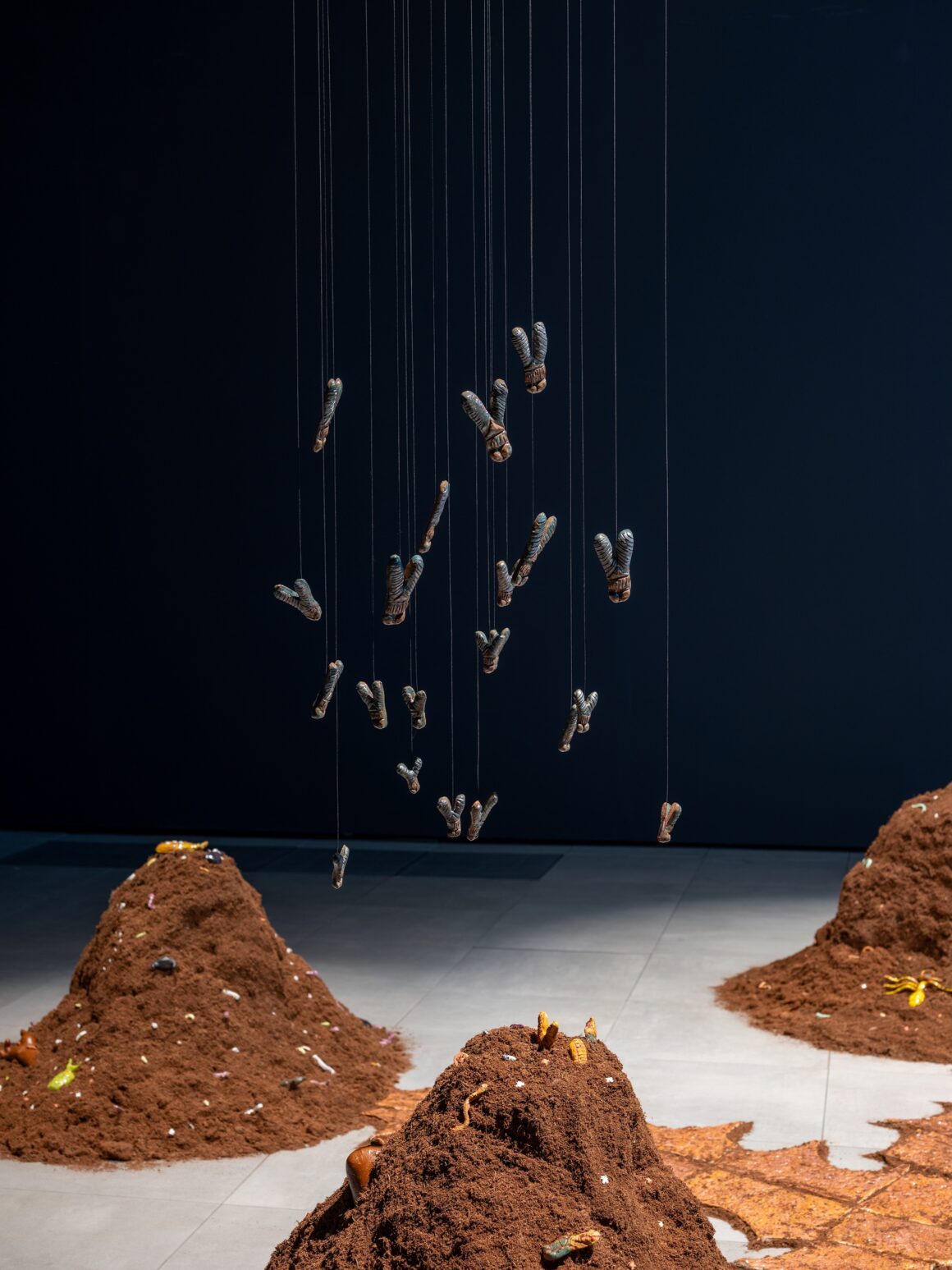
Another interesting pairing of artists is that of DARCH (composed of Umulkhayr Mohamed and Radha Patel) and Linda Lamignan at FACT. Lamignan’s three-channel video, We Are Touched by the Trees in a Forest of Eyes (2025), is a grandiose description of Liverpool’s commercial ties with the Nigerian state of Delta, predicated on palm oil and petroleum. In a captivating sequence of scenes, it demonstrates the antagonistic interests of Western corporations and the earth-oriented belief system of the region’s inhabitants. To create their installation, Heaven in the Ground (2025), DARCH collaborated with residents of Sefton, a village in Merseyside, to compile accounts of their worldview – which integrates humanity, nature, and spirituality in equal terms – focusing on death and grief. DARCH render them in audio, accompanied by four interconnected soil mounds, above and within which are animals, fabricated in ceramic.
A rich layering of narratives with the exhibition’s theme appears outdoors and in unconventional locations. Along Barry Street is Kara Chin’s installation Mapping the Wasteland (2025), a group of tiles inserted into the concrete paving stone that poignantly address the impact of overconsumption. At a warehouse in Jordan Street, Imayna Caceres’s installation, Underground Flourishings (2025), comprises countless intricate clay pieces uniting the artist’s Peruvian ancestry with matter and water sourced from the Mersey and Danube Rivers to elegantly consider primeval ways of life.
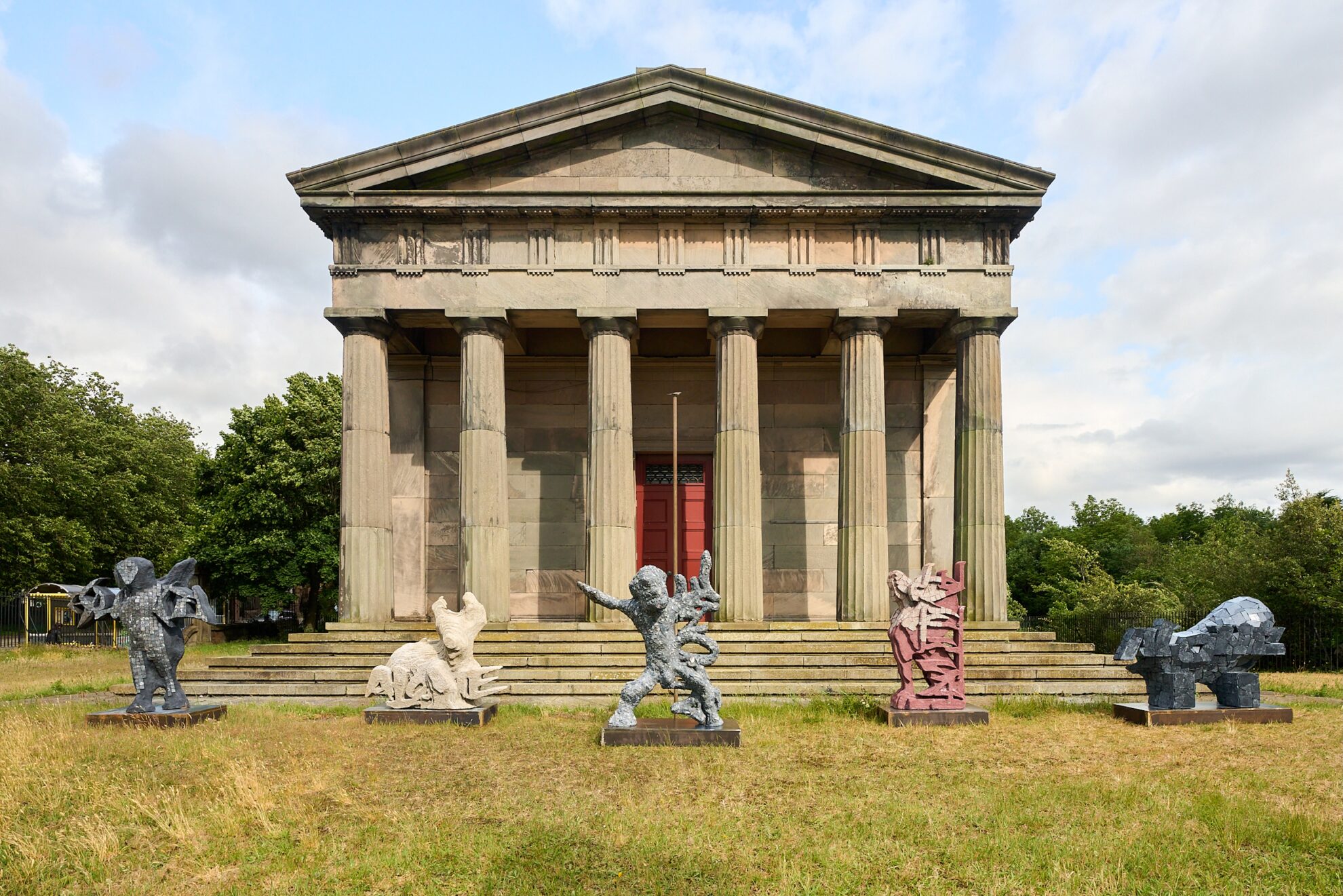
Also of note is Isabel Nolan’s sculpture Where You Are, What We Are, with Others (2025), set against the Liverpool Metropolitan Cathedral. The work is inspired by interior design plans for the Lutyens Crypt, part of this site, and the demolished St Nicholas Pro-Cathedral. The forms are infused with ecclesiastical sensibility, smartly resonating with the construction: Arched window frames unfold in a concertina motif, whether in colourful and delicate or austere and brutalist lines. They are barely held together, conveying a state of imminent collapse. The work examines the role of religion – including sectarianism and inter-faith encounter – in defining Liverpool’s civic mindset, and expands Nolan’s enduring interest in the intersections of architecture, myth, iconography, and abstraction.
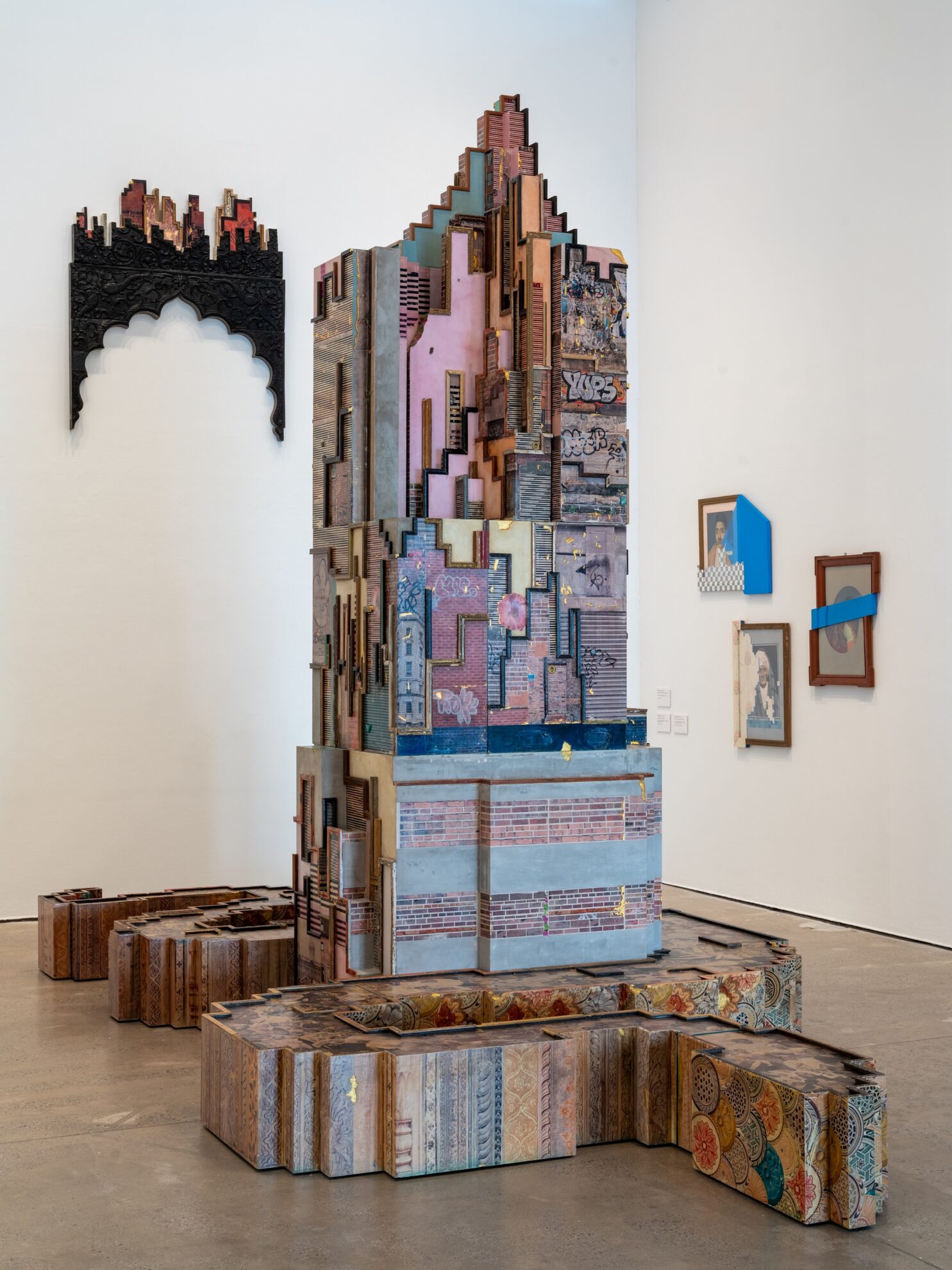
Arguably, BEDROCK’s highlight is at Walker Art Gallery. In dialogue with a collection developed during Liverpool’s economic heyday – and still a symbol of the city’s engagement with art – Antonio José Guzmán and Iva Janković present Concrete Roots/Griots Epic Stories from the Black Atlantic (2025), a potent iteration in their series of large-scale modular structures that serve as backdrops for textile banners and soundscapes, as well as scenarios for performances. In all works by the duo, the textile banners are dyed in the unique indigo of a workshop in India that employs artisanal methods. This substance, once known as ‘blue gold’, was a highly prized commodity in Europe, and rapidly acquired the status of cash crop across the colonised world, from India to South Carolina, mostly relying on slave labour.
The textile banners bear abstract patterns influenced by DNA sequences that evoke the forced resettlement of enslaved West Africans in the Americas. The music is affiliated with dub, a style that emerged in Jamaica. In conjunction, they express a wider, distinctive Black culture formed through the exchange, and later fusion, of artefacts and knowledge from West Africa, the Caribbean, the Americas and England – what has been designated the Black Atlantic. Here, a more contextual output is illustrated by allusions to urban unrest using printed textual graphics – a nod to Liverpool’s so-called race riot in Toxteth in 1981 (which actually involved members of the working class from diverse backgrounds), which is explicitly referenced in the soundtrack.
It is precisely this commitment to the locale that upholds the ideas and materials amalgamated in BEDROCK, so eloquently elucidated in Guzmán and Janković’s work by addressing legacies of dissidence in Liverpool. In addition, because Guzmán and Janković are surrounded by the paintings and sculptures of the Walker Art Gallery – assembled in the context of the institution’s embedment with Liverpool’s mercantile elite of British colonialism – they are able to establish a parallel between the titular Black Atlantic and processes of capital accumulation that provoked, and continue to shape, inequality and segregation, whether dividing the West from the rest of the world or, within the West, the working versus the ruling classes.
Miguel Amado is a curator and critic, and Director of Sirius Arts Centre.