ANNA MACLEOD DISCUSSES HER PREVIOUS PRODUCTION RESIDENCIES AT EDINBURGH SCULPTURE WORKSHOP.
The Uisce / Floraperformative community river walks is the latest phase of my ‘Water Conversations’ series that explores water and land through historical, cultural, and ecological lenses. Water is central to all human and more-than-human life on earth. Historically, water has been critical to the development of towns and cities; however, the positioning of dwellings and industry beside water bodies brought gross pollution and biodiversity loss. It is now known that, globally, freshwater life is facing alarming species loss at rates more severe than on land or in the oceans.
In my home city of Edinburgh, the Water of Leith has been rejuvenated over the past 40 years through multi-agency community trust work.1 In witnessing the return of life and biodiversity of the water and riparian corridor of this iconic silver thread running through the city, Edinburgh seemed like the ideal spot to develop a transferable model for performative community walking, to celebrate water’s embodied animacy.
The two-year process of research and development for Uisce / Flora was made possible through two residencies at the Edinburgh Sculpture Workshop (ESW) in the summers of 2023 and 2024 respectively. The Reach Scotland Residency Programme, organised by Edinburgh Sculpture Workshop, is designed for artists working on funded projects that require either the production of final work, or a focused period of research and development (see edinburghsculpture.org). The heavily subsidised residency costs were funded through an Agility Award from the Arts Council of Ireland.
Founded in 1986 by a group of sculpture graduates from Edinburgh College of Art, ESW was an artist-run organisation for many years, before capital funding was secured to build the Bill Scott Sculpture Centre in Newhaven, which opened in 2012. The Reach Scotland programme at ESW is an excellent living, researching and making environment in the heart of the city, where artists are offered curatorial and technical support, an apartment, a dedicated 24-hour access studio, and access to workshop facilities. The facilities in the state-of-the-art building are supported by a dedicated staff and technical support team; artists working in the workshops have specialist technicians on hand to guide them through multiple sculptural processes in the creation of new work.
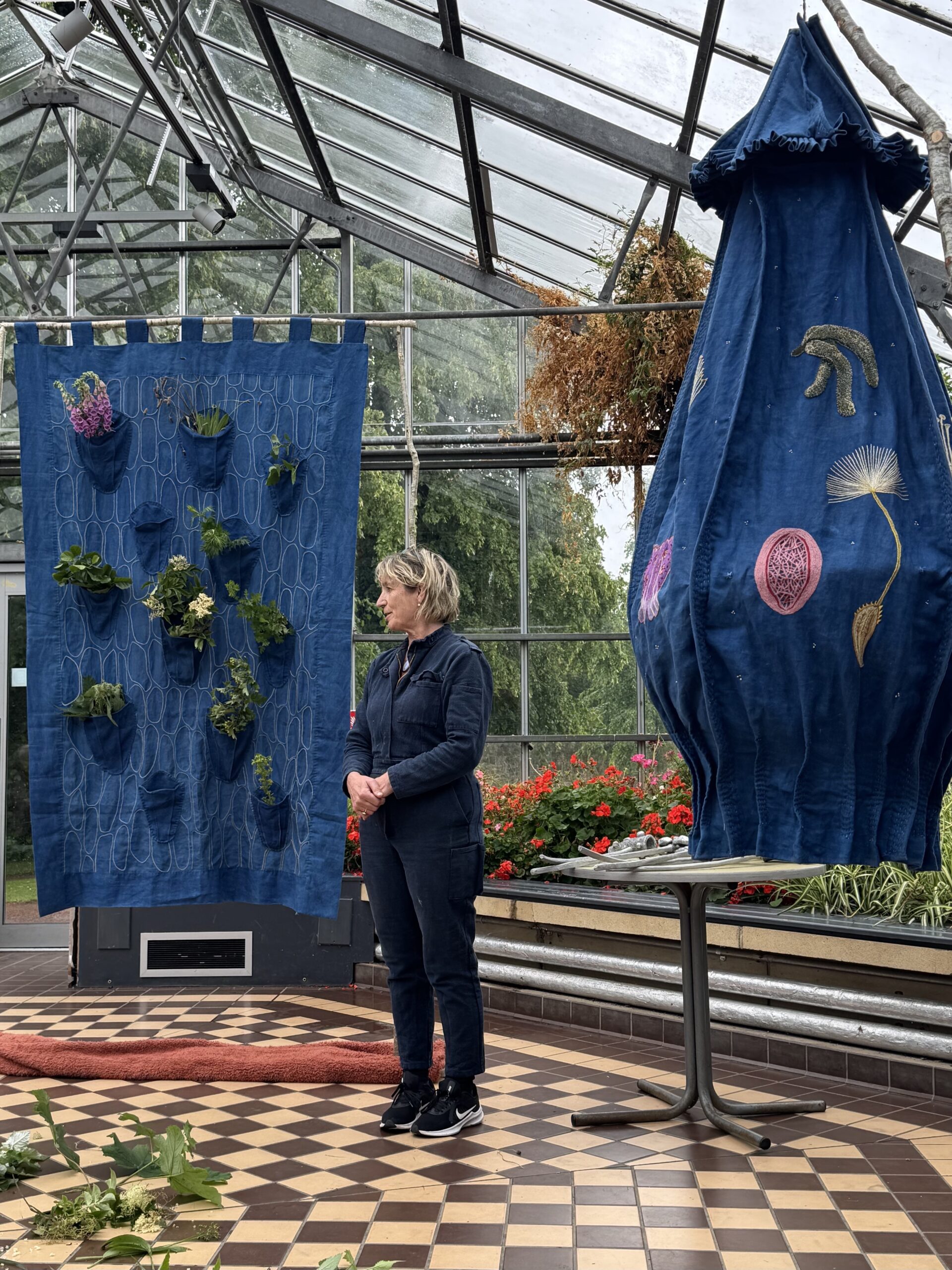
Uisce / Flora was conceived as a ceremonial procession along waterways and riverine paths (with embroidered textile sculptures and cast recycled aluminium staffs), as performative healing of human perceptions towards water, and as an act of interspecies empathy.
Research for the project involved input from multiple individuals and organisations. At the Wemyss School of Needlework in Fife, I learned crewel embroidery and was introduced to textile designer, Katie May Anderson, who was instrumental in the form of the fabric works, generously sharing her knowledge of plant-based dyeing, pattern cutting, and assembly.2 The design of the embroidered riverine plants was drawn from two collections at the Royal Botanic Garden Edinburgh: the extensive Herbarium collection of more than three million preserved specimens; and the Library and Archives collection, where the nineteenth-century John Hutton Balfour teaching diagrams and Brendel teaching models are held.
At ESW, I was helped by the excellent technical staff through the long and complex processes of ceramic shell, sand casting, and finishing, involved in making the seven cast aluminium staffs, based on Caddisfly cases. Caddisflies (order Trichoptera) are freshwater aquatic invertebrates and indicators of good water quality; they are best known for the portable cases created by their larvae and, as such, are sometimes referred to as ‘underwater architects’.
Uisce Lite / Flora Edinensis was held in Edinburgh during June 2025 at two venues along the route of the Water of Leith – The Physics Garden at Saughton Park and St Bernard’s Well in Stockbridge. Invited speakers contributed to the walks on health-related subjects including ethnobotany, folklore and mythology, herbalism, and river regeneration.
A river walk, titled Uisce Sionainn / Flora Liatromensis, was recently performed on 16 May along the River Shannon, as part of my exhibition ‘Tír Breac / Speckled Land’ at The Dock in Carrick-on-Shannon. I was joined by Katie May Anderson, and a talk was delivered by Niall Mac Coitir, author of Ireland’s Wild Plants: Myths, Legends and Folklore (The Collins Press, 2010). A limited edition zine, designed by Padraig Cunningham of Pure Designs Studio, with an illustrated essay by Dr Phillina Sun, was launched at the event.
Anna Macleod is a Scottish / Irish artist, researcher and educator based in Manorhamilton, County Leitrim.
annamacleod.com
1 See: The Water of Leith Conservation Trust (waterofleith.org.uk)
2 Katie May Anderson is a textile maker, researcher, and educator based in Glasgow (@kmacostume)