When I was eight, I summoned a group of friends to my house for a ‘Cluedo dinner’. We had apple juice in champagne flutes, silver cloches over our dishes, and were served by ‘waiters’ – friends of my parents. Then, in the middle of dessert, there was a scream. We followed it into the kitchen, where my mother informed us that one of the waiters had been murdered. Our new quest was to be detectives; we needed to find the killer. It was thrilling. And even though I knew that everything was staged, when I followed a trail of ketchup-blood into the basement, on some level I believed that a murderer was lurking in the shadows. I screamed for my father; I clung to his legs. Children are particularly good at inhabiting the space in between fantasy and reality. Immersive theatre, at its best, promises to reopen this space in adults: to provoke the uncanny sensation of straddling two realms.
It is this kind of experience I am hoping for when I go to see Asylum Productions’ The Alice Project at the Kilkenny Arts Festival. The Alice Project (6 – 16 August 2026) is an immersive theatre event, split into five ‘episodes’ that unfold across several days and multiple spaces across Kilkenny that involves 150 performers, mostly drawn from community theatre, but with some professional actors. Billed as an “epic reimagining of the Kilkenny Witch Trials”, it is based on the story of Alice Kyteler, a wealthy Kilkenny moneylender who became the first woman in Ireland to be accused of witchcraft by Bishop Richard de Ledrede in 1325. Whilst Kyteler escaped, her maidservant, Petronella de Meath, was burned in her place. It is a complex story of class, wealth, gender and persecution: rich material, then, for a project of this ambition.
Alice Kyteler, or rather, the Alice Kyteler brand is all over Kilkenny. I pass Kyteler’s Inn, a pub that sells ‘Witches Brew’ and a restaurant on the Butterslip called ‘Petronella’. I find myself in an art exhibition that attempts to connect the artist’s recent house fire and Petronella’s burning. It strikes me that the Kilkenny witch trials would look good on a funding application: repackaged to suit even a vaguely tangential contemporary narrative. I wonder how The Alice Project will contend with this impulse. The Alice on the posters wears a red pantsuit, a headscarf and sunglasses. Perhaps because I am thinking of the modern ‘witch-hunt’, she reminds me of Amber Heard.
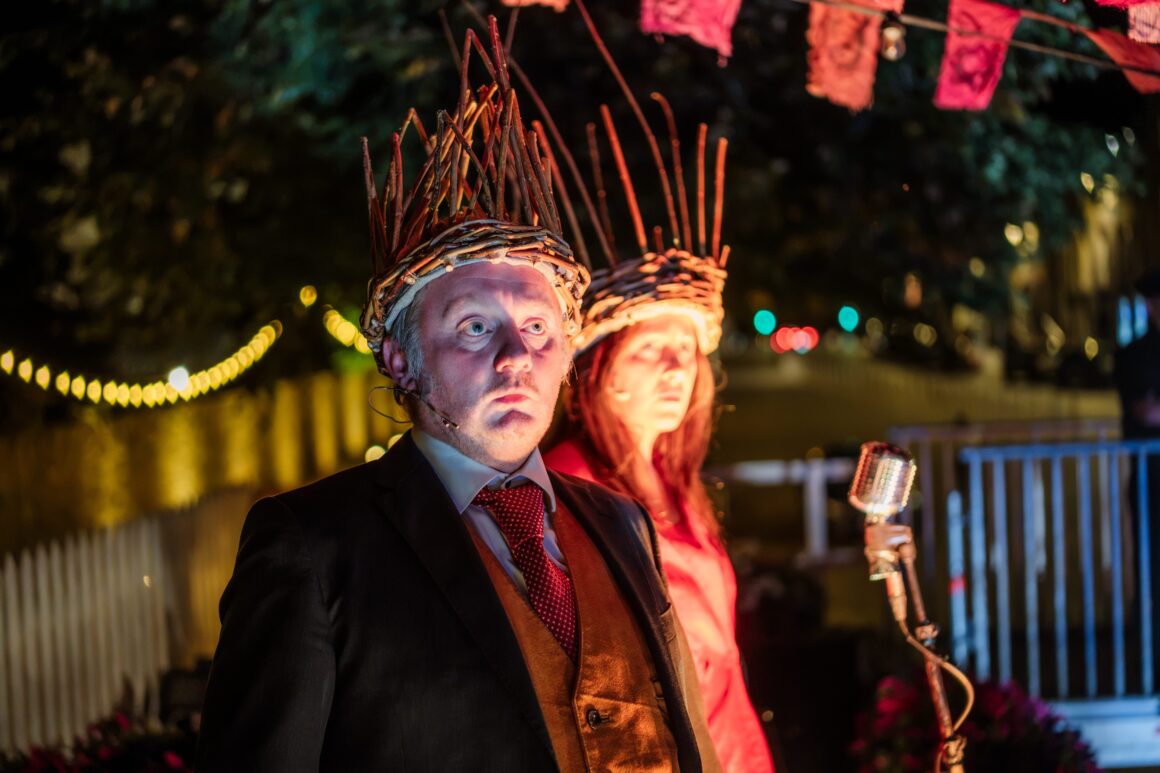
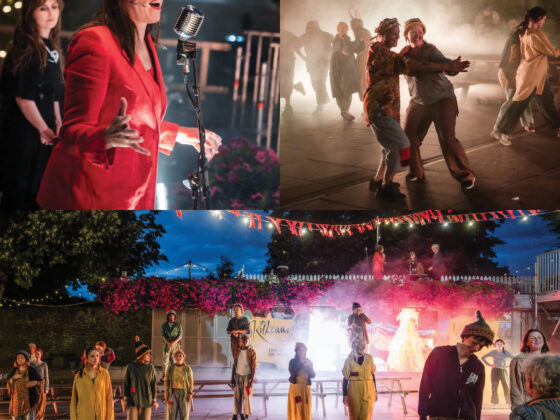
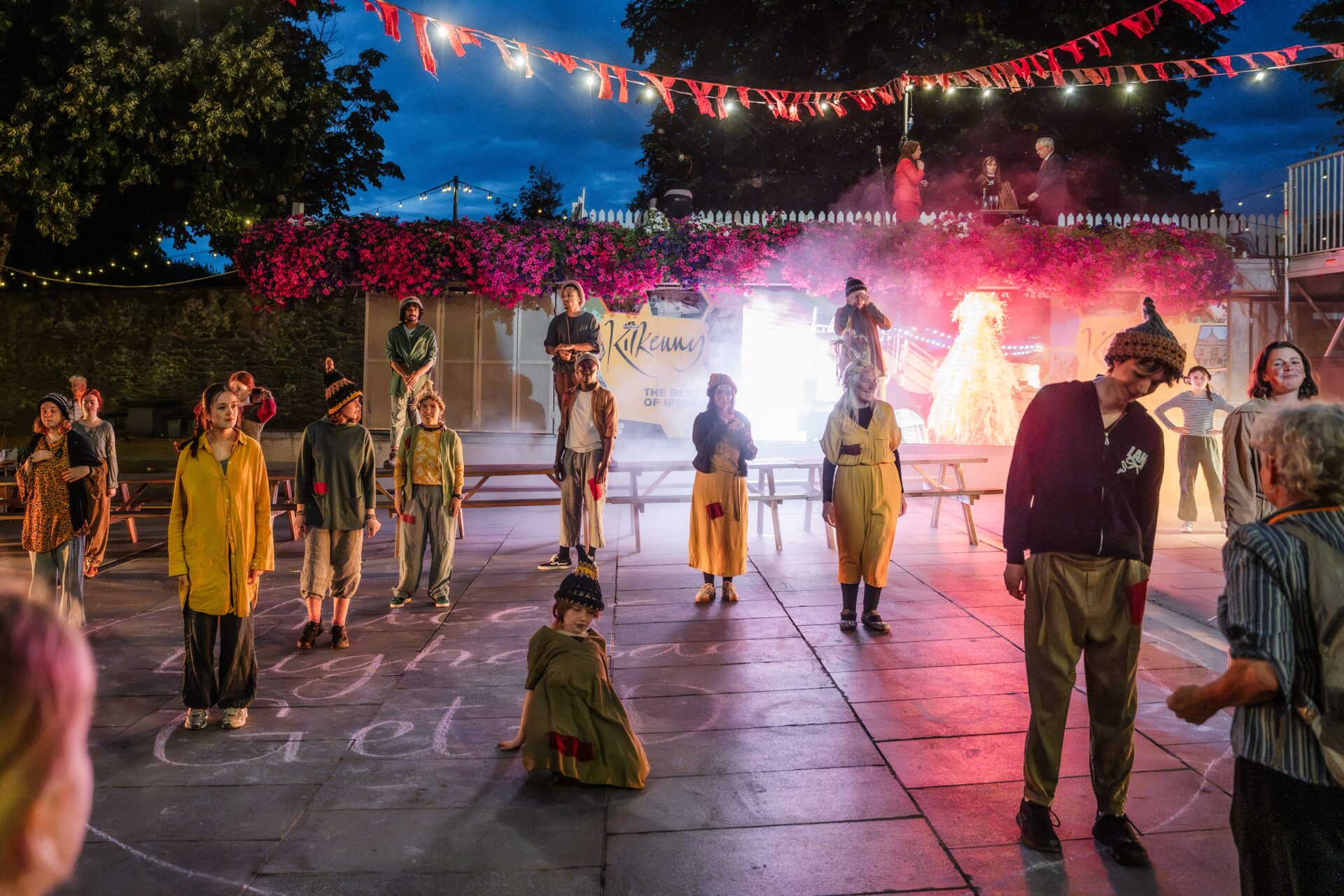
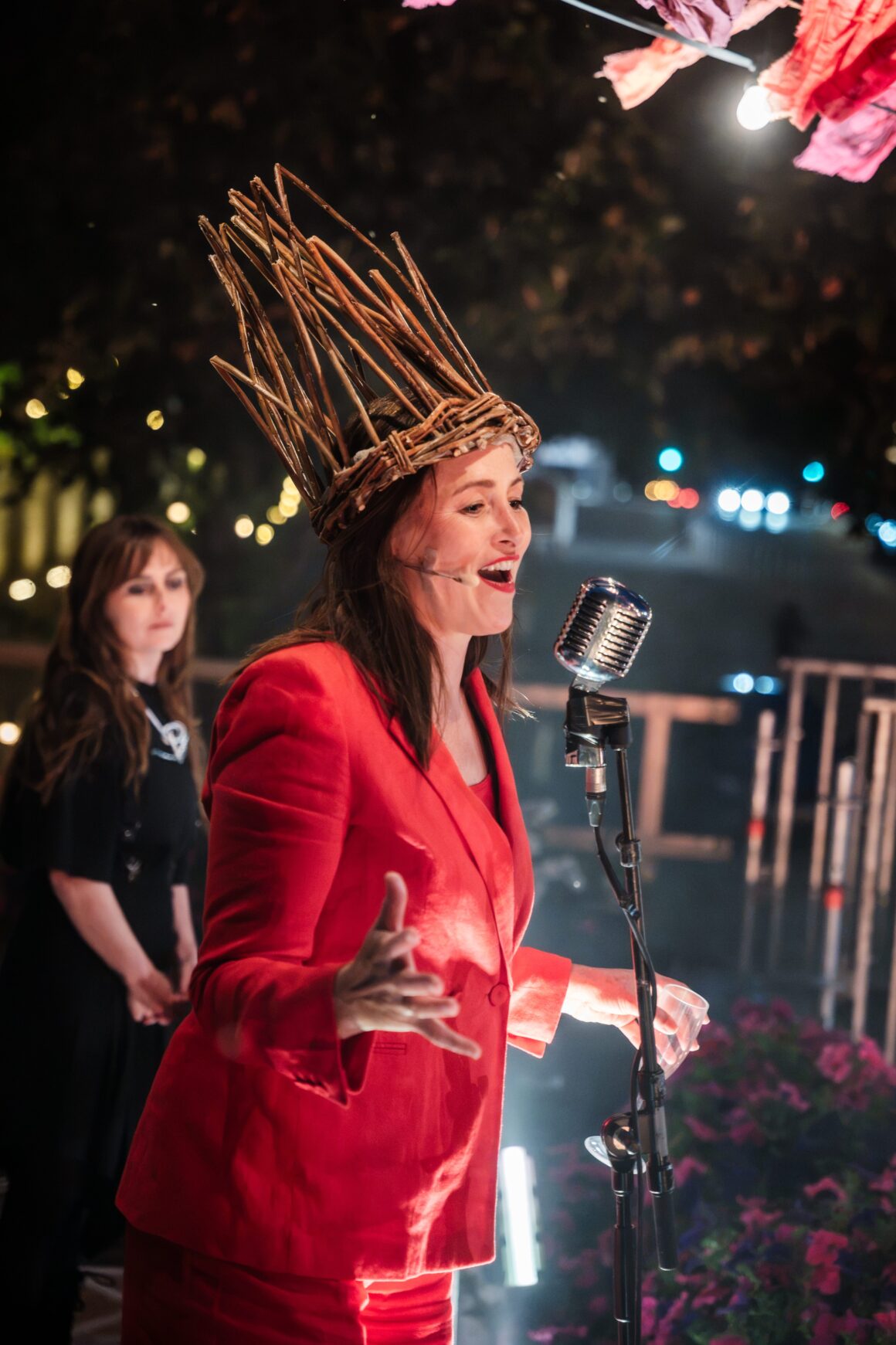
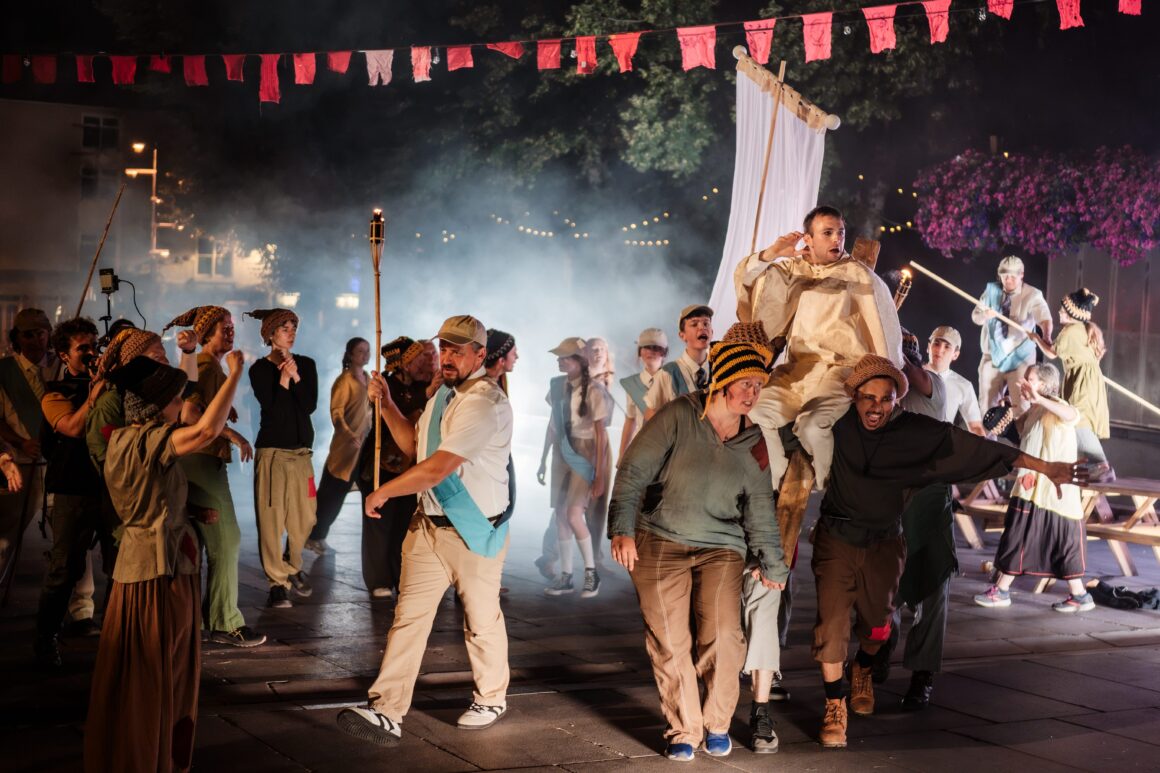
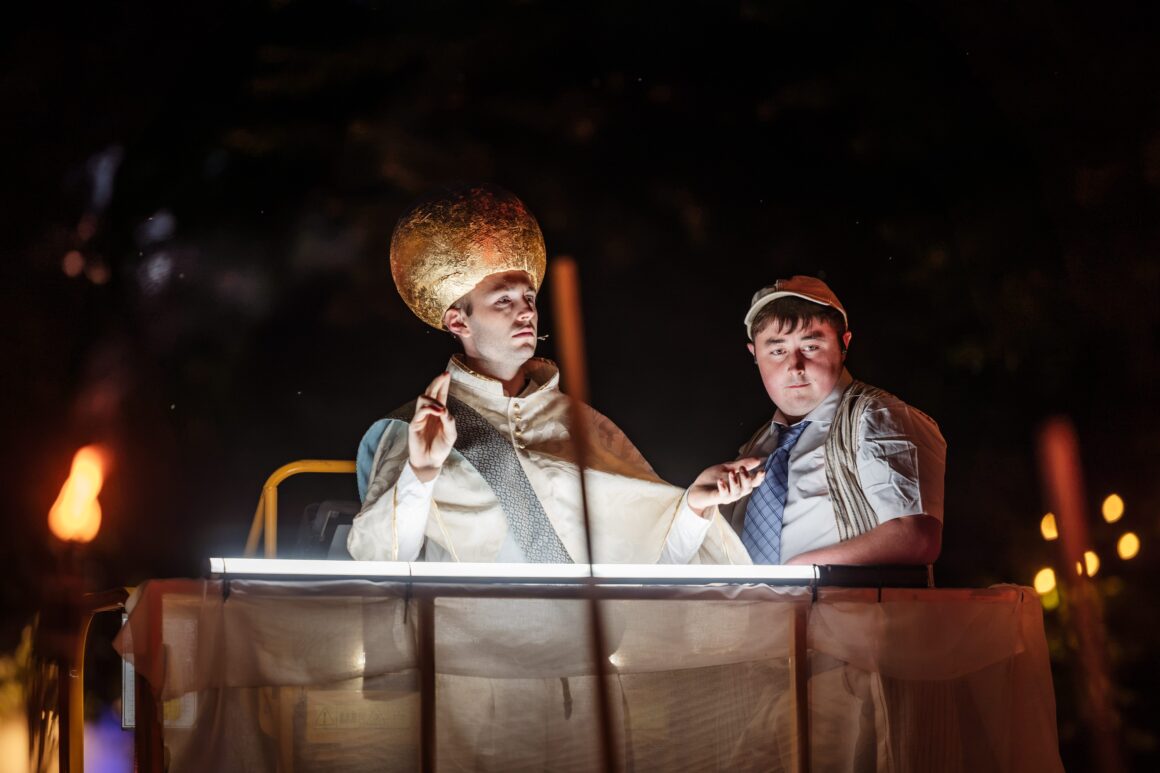
The first episode, ‘The Demon Dance’, is the preliminary showdown between Alice and Bishop Richard de Ledrede. I gather as part of a large crowd on The Parade, where we are welcomed to Alice’s ‘Lughnasa Ball’ by ‘John Clynn, roving reporter’, played by Kevin Mooney. Clynn acts as our narrator/MC, introducing the principal characters and telling us what to think of them. There is the fey William Outlaw, Alice’s stepson and mummy’s-boy (Ryan Costelloe); Arnold Le Poer (Michael Somers), the seneschal of Kilkenny who has attached himself to Alice and her money; a skittish Petronella (Mary Whitty); and the ebullient Alice, (Muireann Ryan), crowned with a wicker headdress who, like a tabloid queen, bats away suspicions that she may have had something to do with the death of her four husbands. It is an efficient pantomime sequence, but the commentary can feel overpowering Because Clynn repeatedly warns us that the bishop intends to shut down the ball, his eventual arrival is less intimidating than it might have been. The pleasure of the confrontation is instead in its slapstick humour. The bishop appears in a transparent box atop a crane, like a makeshift popemobile. When, after a battle of insults, Le Poer calls for the bishop’s arrest and he is slowly lowered to cries of “lift me up!”, it is a hilarious vision of hubris.
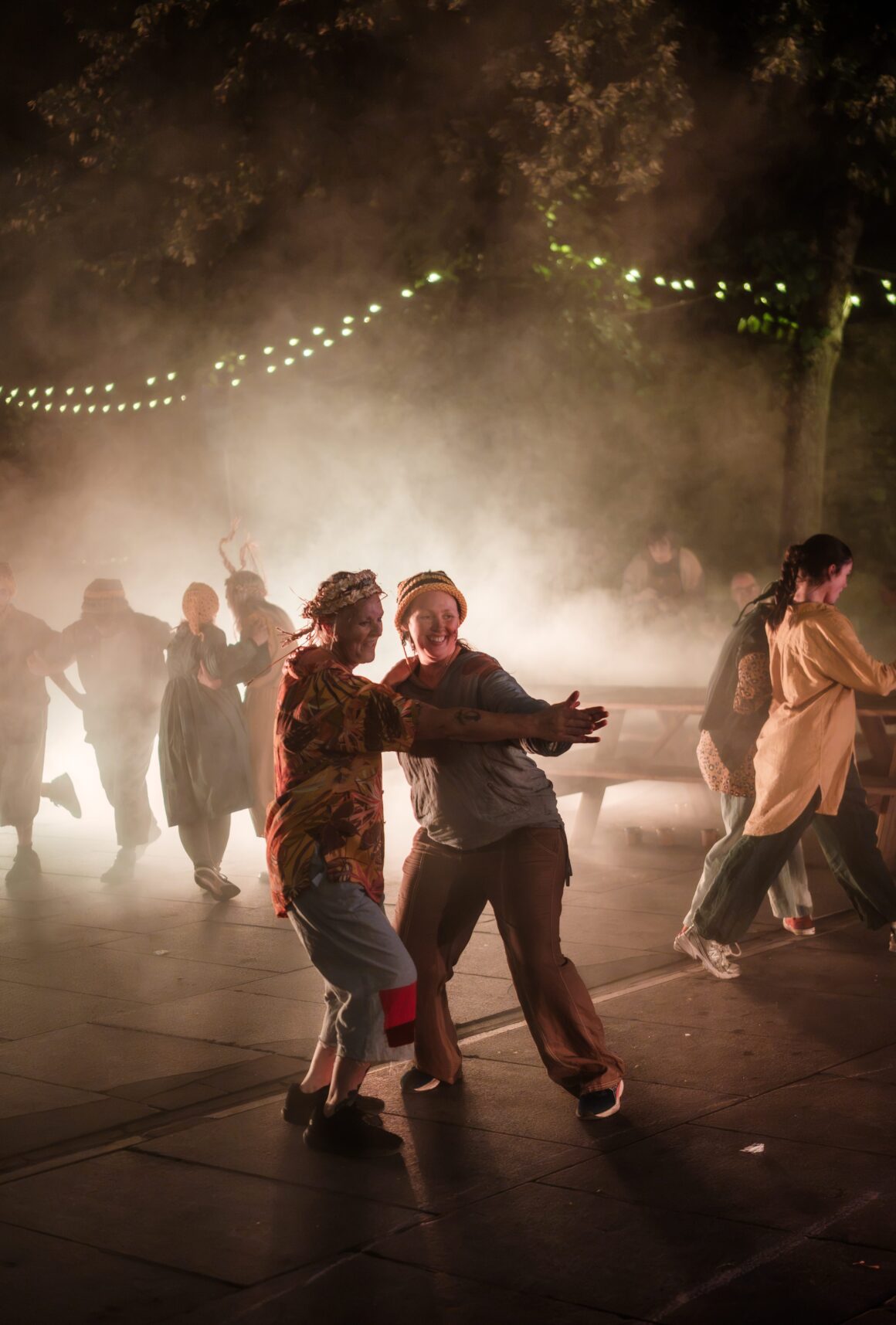
The episode’s strength lies in its visual sequences. The major action is a magnificent ensemble dance, choreographed by Cindy Cummings, which blends traditional sequences with modern inflections, such as tabletop vogueing. This ‘demon dance’ was advertised as ‘participatory’, the steps posted on social media. While the audience is, in fact, stuck behind a railing, the atmosphere is still infectious, and as people point out friends and family in the cast, the boundary between actors and audience begins to blur. There is also a bit of technical witchcraft. A camera broadcasts a live feed onto a large screen at centre stage, and I find myself straining to catch my own face, reflected as part of the party. At the end of the episode, flames appear on the screen. The camera cuts between the flames, the audience, and Petronella, who stands alone on a raised platform. It is a beautiful, prophetic sequence, more powerful for being left unexplained.
Episode One introduces many competing ideas – pagan traditions, religious influence, political corruption, modern media culture, queerness and ‘the witch’ archetype – but none are yet developed enough to fully bring us into the world. I wonder about this presentation of Alice as a vital Kilkenny It Girl – and hope it will be complicated.
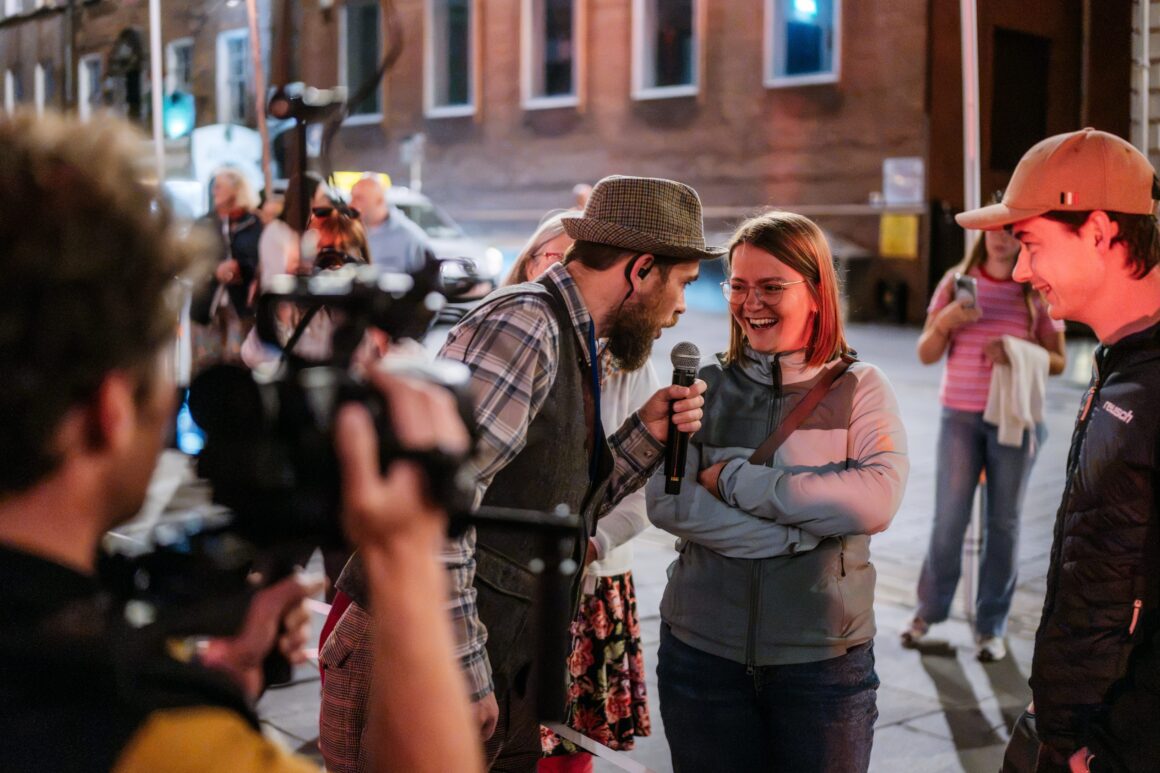
Episode Two, The Words of Dred’, is written by Clare Monnelly and set within the Parade Tower at Kilkenny Castle. We, the audience, are reporters, summoned to a press conference, in which the imprisoned bishop (a standout John Rice) lays out his case in the form of a brilliantly leery sermon, shifting between fierce severity and a slippery, camp appeal to the audience. At a press conference given by someone this narcissistic and tyrannical – Rice’s de Ledrede is like a more eloquent Trump – genuine interaction would hardly be welcome. As such, when audience members are invited to ask questions but instead read from planted question cards, it is an effective commentary on the role of the press and the audience throughout the production: our affective power is illusory.
Episode Three, ‘The Words of Alice’, written by Medb Lambert and directed by Dónal Gallagher, is only ten minutes long and delivered to a single audience member in the graveyard at the Medieval Mile Museum. I am told that I am a reporter from The Daily Words, here to interview Alice, but that I cannot actually ask questions. I am given a notebook, which I can write in but will not be allowed to keep – an amusing riff on who does and doesn’t get to author history. I am ushered into the graveyard and Alice (Delia Lowry), strides out from behind a headstone and launches into a defensive monologue at lightning speed. Two narrative strands emerge: Alice and the bishop’s contest to dominate Kilkenny, and the more interesting unpicking of Alice’s self-mythology. She tells us that she was married very young to a man her father’s age; that she is forever defined by the societal obsession with her “four dead husbands.” In Lowry’s hands, Alice’s vanity is painfully self-destructive, her deeper trauma is masked by a determination to control how she is seen.
What interests me is how much I dislike Alice. This is a welcome advancement on her initial portrayal as a vibrant heroine. Regardless, even if she did murder her husbands – The Alice Project skirts around this question – what must it have been like to be married to them, or to discover that the young girls she had employed were being sexually abused by them? I think again of Amber Heard, and of the difficulty in getting an audience to care about the stories of women it finds ‘unlikeable’. I am, however, moved by Sarah, Petronella’s daughter who leads me out at end of the episode as Alice rushes off. When she insists that I write her name down and that I remember her, I have the urge to speak – and am frustrated at not being allowed to. Although I compliantly hand my notebook in at the end, I note Sarah’s name down in my phone.
I have a week before Episode 4 and the finale, which allows me to reflect on what I have seen. Perhaps I had been approaching The Alice Project in the wrong spirit. I was looking for a slick, solid construction of Alice Kyteler’s Kilkenny, but what was being offered instead was the world of a local community that had spent three years developing, inhabiting and personalising a period of its history. Some of what I had read as failures – such as competing dramatic visions – might instead be understood as the marks of a collective act of invention.
Episode Four, ‘The Words of the Accused’, written by Fern Kealy and produced in collaboration with Barnstorm Youth Theatre, plunges the audience into the panic of the ten ‘accused’ by the bishop: Alice’s ‘coven’. I am ushered into a pub in the Home Rule Club, which we are told is run by Mrs Kyteler. The youth performers are committed and compelling, and perhaps because of their age, their desire for the infuriatingly selfish Alice (an excellent Muireann Ryan) to guide them, is heartbreaking. Particularly good is Emily Green’s Eve, a nervous client of Alice’s who is late with a payment. Through Eve, we understand that the defining factor in who is condemned here is money, class. When Alice flees, barking instructions about when to wash the sheets, we arrive at an unexpected and prescient conclusion: there is no overarching female solidarity here. This is a narrative of the rich versus the poor.
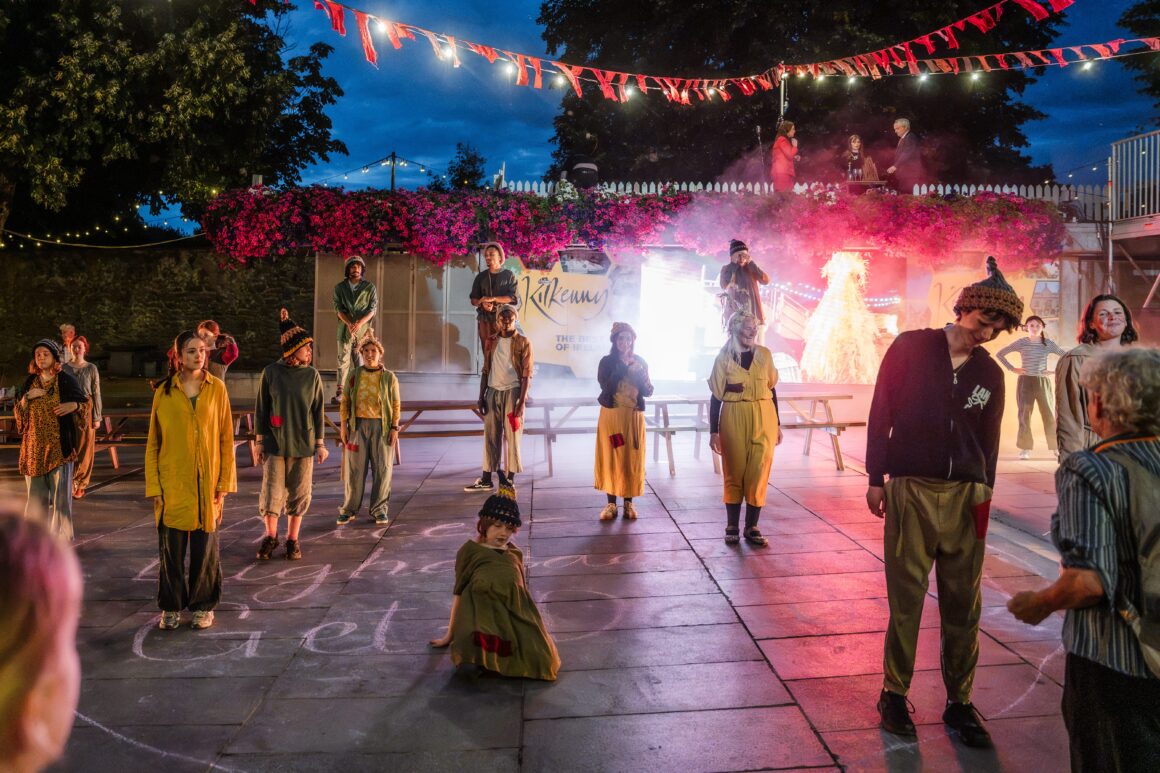
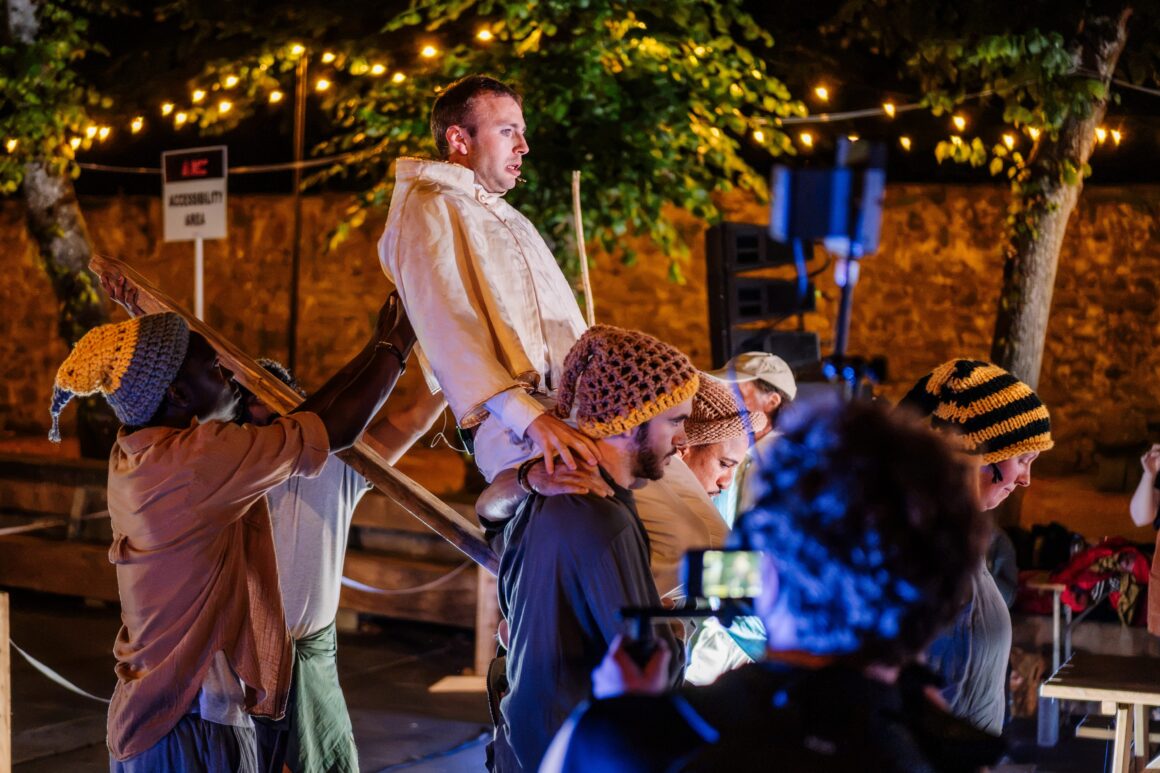
Petronella (Violet Butler) is the episode’s emotional centre. In a surreal twist, she speaks to the fire in a mechanical voice, and it ignites. Is this witchcraft, or is Petronella glimpsing her own future? The question of ‘magic’ is underexplored across The Alice Project, which makes the appearance of a wounded man, whom Petronella heals with a peacock feather, particularly intriguing: traditional healing practices often gave rise to accusations of witchcraft. It is in moments like these, which encourage us to look closely at the scenes unfolding around us, that The Alice Project is most immersive. When the bishop’s henchmen, the ‘doves’, pull up in a grey van and arrest everyone, it is stressful and intimidating. A girl screams as they drag her away from underneath my feet, and I am troubled by my passivity – by my not stopping them.
Set in the grounds of St Kieran’s College, the final episode, ‘The Burning of Petronella’, is a magnificent spectacle. We are welcomed by a now-sombre John Clynn into the ultimate, twisted form of entertainment: a public execution. Visually, it is stunning. The bishop is illuminated in a Gothic window; the seneschal and William Outlaw gather on the steps of the college, while a large, local choir stands in the arches, singing.
I had wondered how Petronella’s death would be handled, whether The Alice Project would shirk its brutality in favour of something more abstract. I am pleased to find myself part of something that feels genuinely horrific: Petronella’s screams, when she is dragged in and tied to a pyre-structure, are terrifying. There is also a meta play-within-the-play, in which children, monitored by the doves, perform a strictly controlled version of Alice Kyteler’s story: the story of Alice as an evil witch. The scene evokes both state censorship and indoctrination, as well as widespread social inaction in the face of violence and injustice. “Are you just going to watch her burn?” someone screams at us. And yes – we are.
There are hopeful moments too. An aerial acrobat twirls defiantly up the pyre, like a form of Petronella’s escaped spirit. All the Alices and all the Petronellas gather together, and although The Alice Project never quite tackles the complexity of the Alice character, it is a compelling meditation on storytelling: these histories will live on in whoever tells them. When the whole cast assembles at the end, many of them emotional, it is a poignant tribute to Petronella, a woman failed by Kilkenny and now resurrected by it. I could argue that it is all too neat. Why should a story of brutality and division end with a note of false solidarity? But what strikes me instead is how unifying it must have been to be part of this project: to act alongside people from your community whom you might not otherwise have known, to take ownership of and insert yourself into the history of your home.
Out in the town afterwards, almost everyone I meet has been involved in the project. They tell me excitedly about Alice Kyteler, the false narratives they heard growing up, and how much The Alice Project has enhanced their understanding of not just the witch trials but the place they are from. I feel I have been part of that moving, thrilling discovery – even though I have never been to Kilkenny before.
The next day, before my train, I go to mass in St Canice’s Cathedral. I am not religious, but I am with a friend who is, and feel the service might be interesting. When we sit down, we realise that we have accidentally become part of a baptism. Too late to leave, we stay and keep quiet. The priest makes a joke about the small congregation, how close he is standing to all of us. “Could you come and help?” he asks a little girl in the front row, who does. And when we leave, I do not feel like an imposter; I am just happy to have been a part of it all.
Maya Kulukundis is a fiction writer and critic whose work has appeared in outlets including Banshee, The Irish Times, The Lilliput Press, Books Ireland and The Irish Examiner. She is the assistant curator at the Festival of Writing and Ideas.