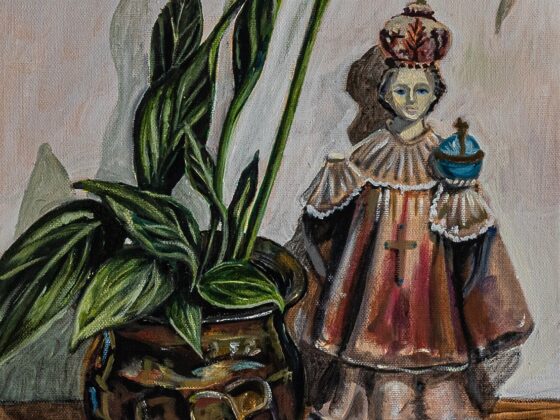
Lavit Gallery
4 – 27 September 2025
Thematic group shows are always an ambitious endeavour, while an exhibition that seeks to survey the ‘Irish art scene’ is an equally admirable but daunting venture. To capture and reflect a given time may seem futile, but shows like these are necessary and serve an important critical function. They are a call and response; an invitation, a mark, a pause, or rupture, that initiate a welcome review of the current terrain, before we hurtle into the future. The inaugural ‘New Irish Art’ exhibition at the Lavit Gallery in Cork City, curated by Brian Mac Domhnaill, is one such provocation.
Through this curatorial lens, we can examine and debate what constitutes ‘new’, both formally and temporally. A timeline and narrative are proposed; the exhibition features works spanning painting, sculpture and printmaking by artists John Behan, Tom Climent, Cecilia Danell, Nuala O’Donovan, Deirdre Frost, Kaye Maahs, Samir Mahmood, Louise Neiland, Martha Quinn, Jennifer Trouton, Dominic Turner, Amna Walayat, and Conor Walton.

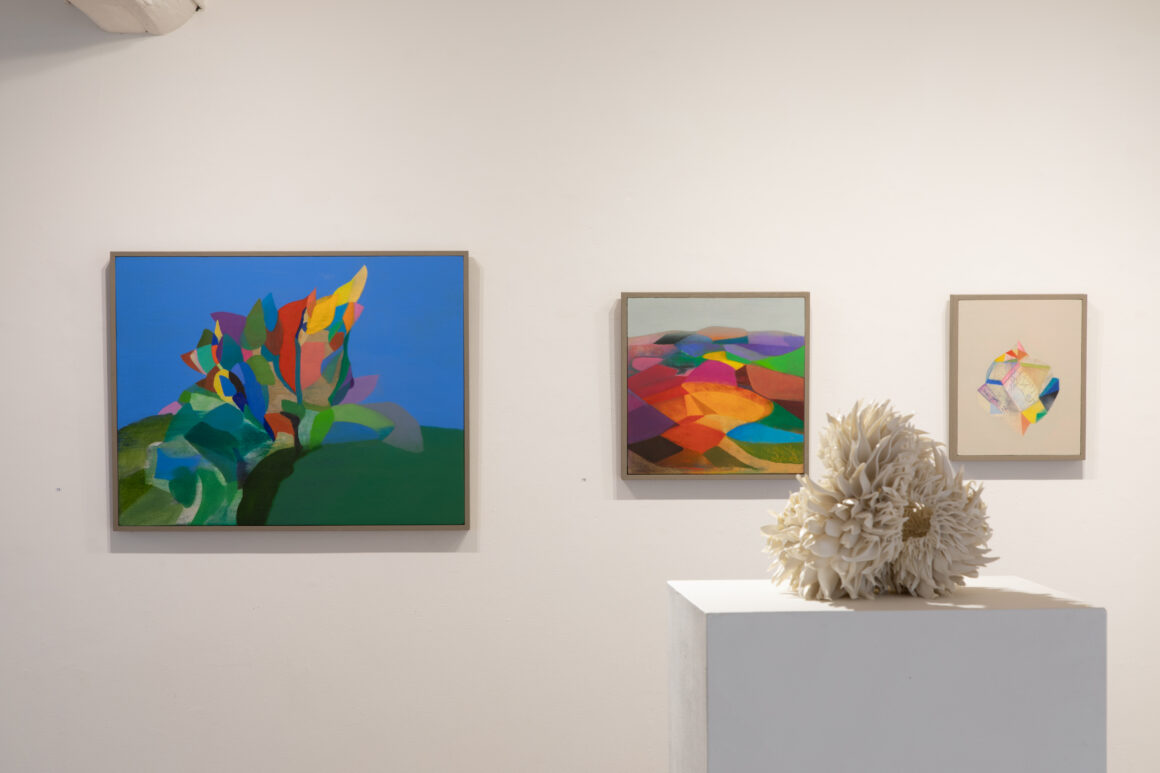
Tom Climent’s abstract paintings are amongst the most prominent and immediately recognisable contemporary Irish landscapes. His geometric, colourful, and jagged planes are composed into three small-scale works. Land of Poems (2025) is particularly playful: a Crayola-esque rainbow of half-moon shapes slip and slide against one another, simultaneously evoking Brigid’s mythological patchwork cloak, roving hills, or geological depictions of the earth’s strata. The work’s title further alludes to Ireland’s magnified literary history, often extolled in connection to the rugged majesty of our topography. Climent’s palette, however, offers a fresh outlook that eschews the nostalgic, bog-standard, 40 shades of green.
This energised engagement with the natural world is mirrored in the large-scale paintings of Cecilia Danell. Her hallmark Swedish woodland scenes are particularly impressive in the abundant natural light of the gallery. Thick, lush, broad strokes are arranged into the fluid drooping leaves of pine trees. The stylised patterns of natural forms combine with heightened colours to create a psychedelic experience. Soft Rain Will Fall (2023) perpetuates an intense psychological state; the strange mound of leaves rising to meet the canopy conjures a realm of fiction.
The ‘newness’ of the show’s mission is exemplified in Deirdre Frost’s novel approach to her medium. In Red Earth (2024), Frost manipulates the natural grain of her wooden surface to create background impressions of sky, and details of collapsing architecture in the painting’s foreground. She presents an unusual laser-cut surface in the smaller-scale work, Faoi Ghriain (2025) – a strange kaleidoscopic shape that contains both geometric hard edges and the blooming swirl of foliage.
Part of the curatorial framework aims to consider the term ‘new Irish’ in relation to parochialism and themes of national identity. Amna Walayat’s self-portrait series, originally commissioned for EVA International in 2023, grapples with the nuances of this discourse most explicitly. Walayat employs traditional and neo-Indo-Persian techniques along with her own personal visual language and symbolism to reflect her cultural hybridity. In Self-portrait (Untitled) (2023), Walayat presents a twin image of herself. One of her representations is wearing a life vest, and the other is wearing a suicide bomber jacket. The symbolism is a powerful commentary on how Muslim bodies are outwardly perceived during times of crisis in the West.
Jennifer Trouton also presents a twist on historical traditions in her politically charged oil painting, Bring Down the Flowers III (2025). The title is a Victorian euphemism for inducing a woman’s period and the meticulously rendered still life arrangement is made exclusively from abortifacient flowers. Another fastidious display of labour is evident in the work of Nuala O’Donovan. Three of her handmade porcelain sculptures, displayed on plinths, carefully study the patterns of natural forms. Moments of manual aberration in Teasel – Enclosing Eden (2024) echo the organic irregularities that can occur in the plant’s structure.
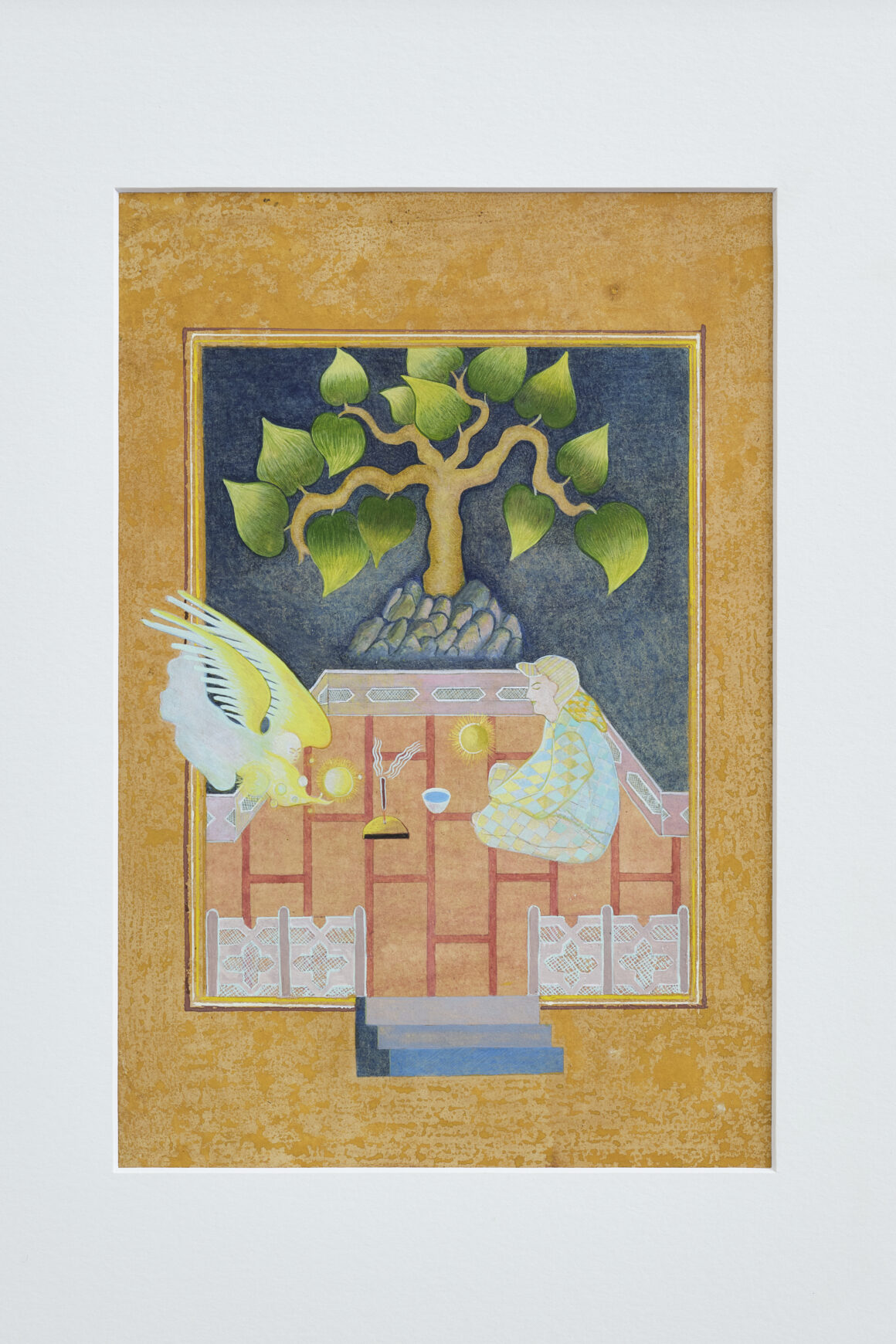
Ideas of fluctuation and divergence resonate in three works by Samir Mahmood. Engaging with traditional miniature painting from the Indian subcontinent, Mahmood’s bodies often extend and expand beyond the borders that typify the style. In The Exam (2021), a figure is levitating above a balcony while a ‘shadow self’ lies below, suggesting transcendence. A hazy cloud emerges either side of the enlightened body and continues upward, beyond the internal framing, visually referencing the wings of an angel. Engaging with the margins in this way, Mahmood subverts standardised grammar in an act that can be understood as ‘queering’ – a challenge to, or disruption of, heteronormative power codes.
The experience of the exhibition allows connections between artists to percolate. This serves to amplify shared and persisting interests, such as the landscape or portraiture, while also highlighting the idiosyncrasies of their individual practices.
Sarah Long is an artist and writer based in Cork.