BRENDA MOORE-MCCANN DISCUSSES A RECENT EVENT BY NA CAILLEACHA IN ROME FOR ST BRIGID’S DAY.
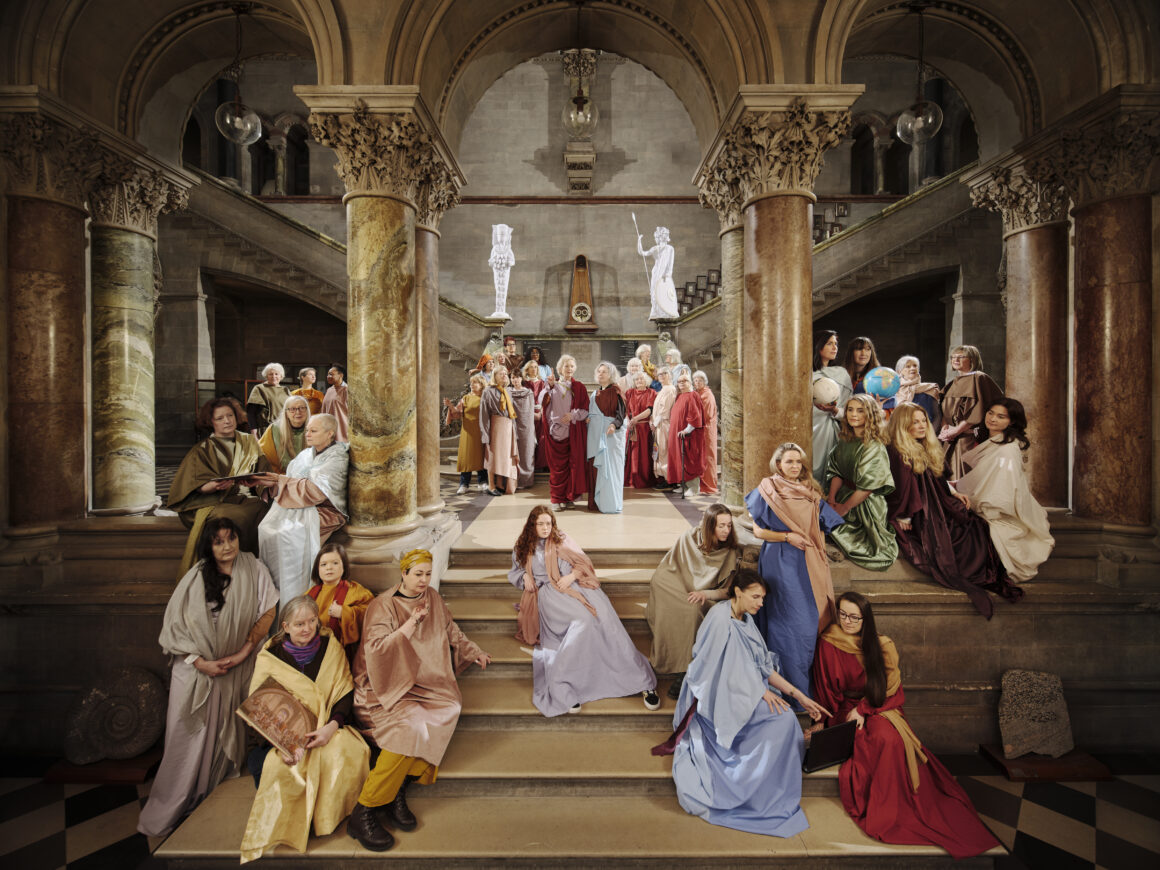
Two schools, two different times and sensibilities: The School of Athens (1509–11) by Raphael and The School of Hibernia (After Raphael) (2024) by the Irish art collective, Na Cailleacha. Ireland-Italy Projects was founded by Jane Adams and I in 2024 to promote cultural exchange. We saw Na Cailleacha’s project as an exciting, innovative and provocative artwork to bring to Rome, the site of Raphael’s famous fresco in the Vatican.1 While The School of Hibernia attracted much international and Irish media attention in 2024, there has been little written about its recent iteration in Rome.
The appropriation of well-known art from a different age is a well-established practice in contemporary art since the 1970s. While not as common in Irish art, there are some precedents, such as Robert Ballagh’s The Third of May (After Goya) (1970) and John Byrne’s Last Supper, Dublin (2004). The School of Hibernia follows Ballagh’s lead in using historical artworks to make a political statement – in this case, a feminist challenge to the patriarchy underpinning Western art and its history.
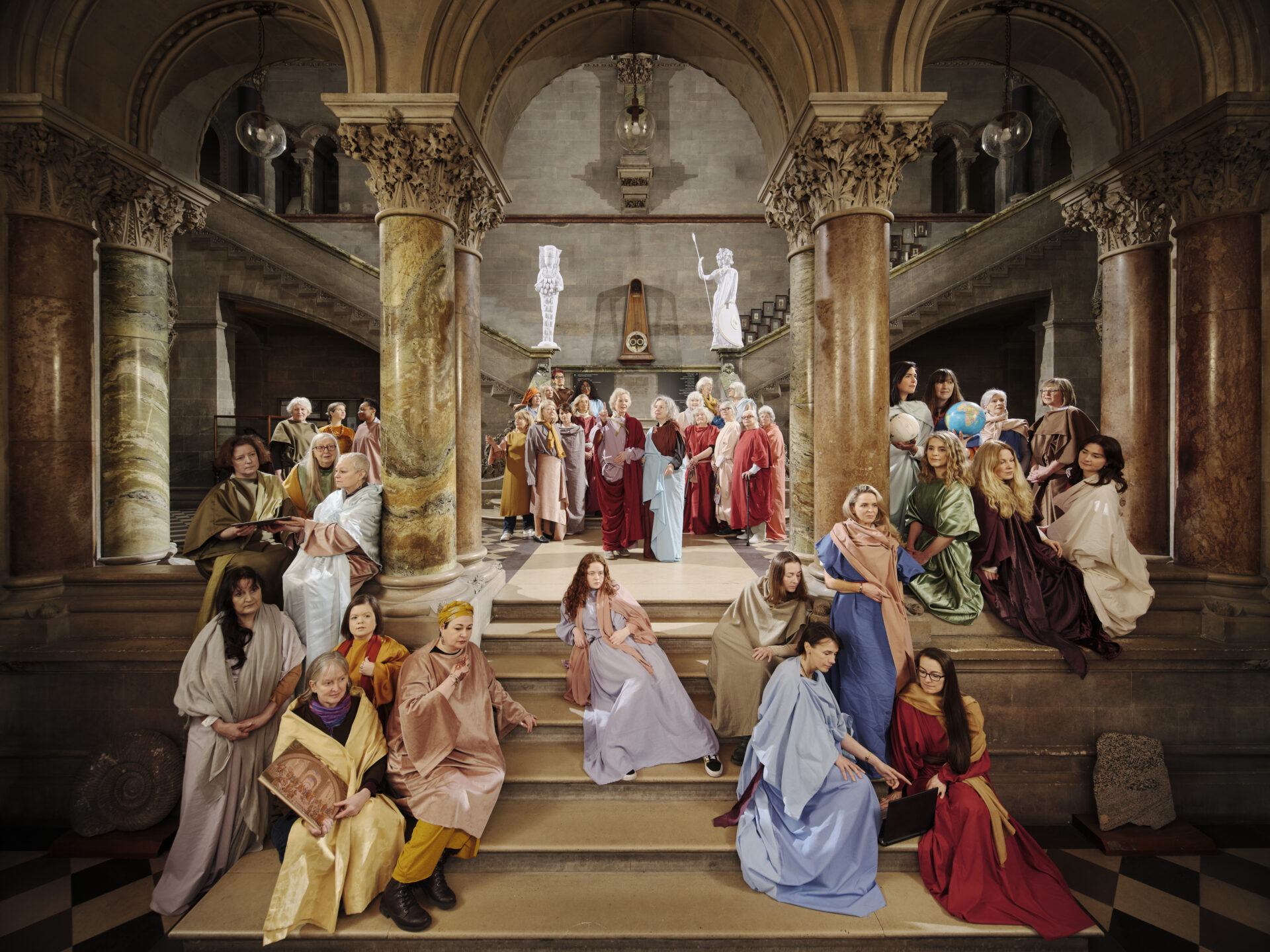
The original tableau vivant was staged in the Museum Building at Trinity College Dublin, with 41 women from all walks of Irish life, including art, music, medicine, art history, poetry, science, theatre, sport, politics, dance, film, and activism. The work exists now as a photographic print, brilliantly captured by Ros Kavanagh, that is simultaneously an image rooted in art history, and a group portrait of contemporary women of significance. They include Mary Robinson, Linda Doyle, and Caroline Campbell, respectively, the first woman President of Ireland, Provost of Trinity College Dublin, and Director of the National Gallery of Ireland. The print has since entered the collections of Dublin City Council, the Office of Public Works, the Royal Irish Academy, the Arts Council of Ireland, Trinity College Dublin, University College Dublin, University of Limerick, and the Contemporary Irish Arts Society.
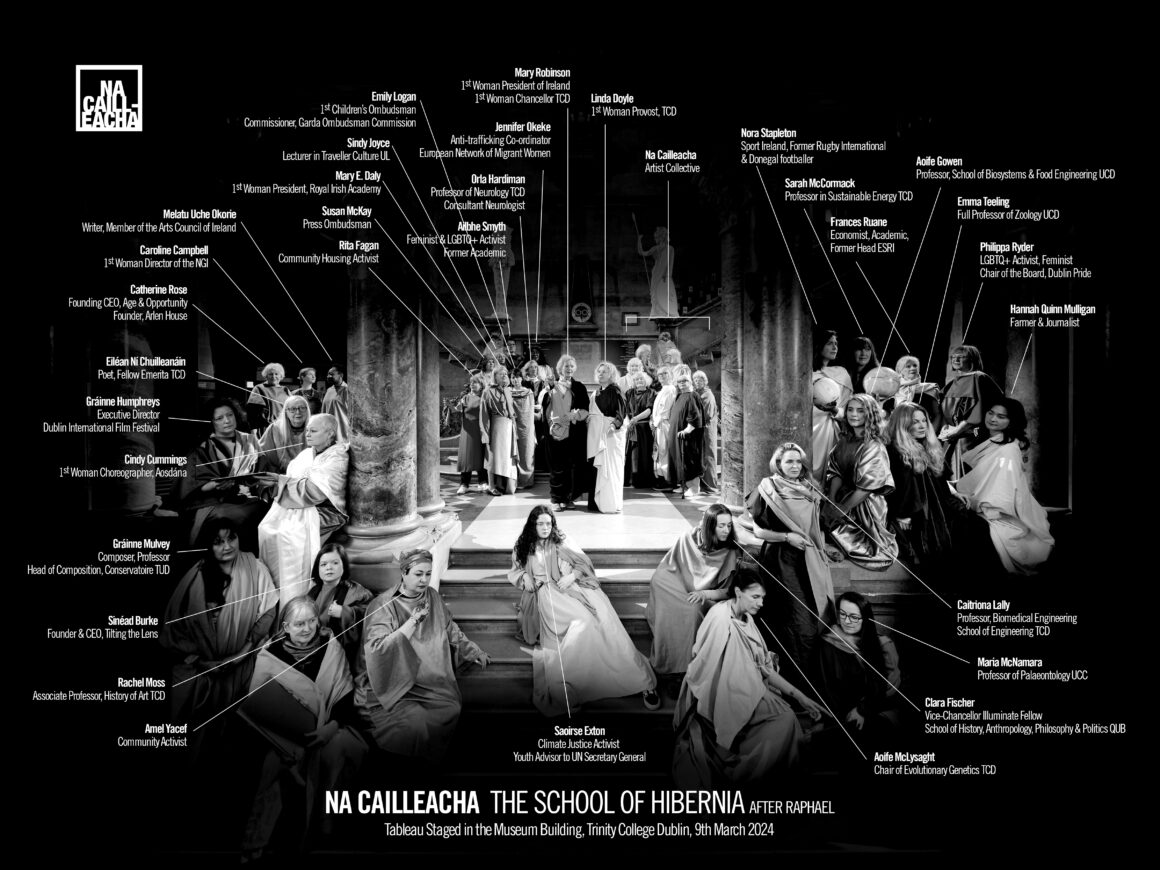
Never intended as an exact replication of The School of Athens, in relation to the number of participants, The School of Hibernia referenced the original fresco in terms of colour palette, architecture, and antique costume, in order to point out an overarching difference – that all of the participants are high-achieving women. Their toga-like outfits were recycled curtains bought in charity shops. Modern references included the substitution of Euclid’s geometrical instruments with a portable computer in the foreground, and trainers worn by the young woman sprawling on the front steps, the place occupied by the barefoot Diogenes in the original fresco.
In Rome, the work was presented through an eclectic range of events to mark Ireland’s female patron saint, St. Brigid. A symposium was held on 2 February in the beautiful crypt of the Chiesa Santa Brigida, located in the spectacular Piazza Farnese. It was organised by Ireland-Italy Projects and supported by Culture Ireland, the Embassy of Ireland in Rome, and Trinity College Foundation. The event included such distinguished speakers as Professor Arnold Nesselrath, former deputy director of the Vatican Collections; Catherine Marshall, art historian, Na Cailleacha member, and curator of The School of Hibernia; Professor Rachel Moss, Trinity College Department of Art History; Professor Emma Teeling, Zoologist and Director, Centre for Irish Bat Research, University College Dublin; and Caroline Campbell of the National Gallery of Ireland – all participants in The School of Hibernia.
The talks were delightfully diverse, ranging from a revision of art history education to a comparison between The School of Athens and The School of Hibernia, and the various contexts for the creation of the latter. The symposium finished with a talk on women, science and bats – extraordinary ecological research furthering an understanding of human aging.
The second part of the event took place a short walk away in the Cinema Farnese Arthouse on Campo de’ Fiori. Here, the Irish-Italian connection was emphasised with a bilingual presentation of extracts from Articoli per Signore /Articles for Women, a one-woman theatrical show written, devised, and performed by actress and feminist Elisa Pistis, which wittily critiqued traditionally discriminatory accounts of women’s achievements by the Italian press. Prior to this, a wine reception, sponsored by Ireland’s Dunne & Crescenzi, was accompanied by background jazz music by Na Cailleacha member, Carole Nelson. An interview with director and Na Cailleacha member, Therry Rudin, by Irish-Italian filmmaker, Vittoria Colonna (a descendant of the eponymous muse of Michelangelo), was followed by the première of Rudin’s charming film, Rootstock (2024), a documentary charting the evolution of the School of Hibernia through participant discussions, interviews, fun and laughter.
Brenda Moore-McCann is a medical doctor, art
historian and founder, with Jane Adams, of Ireland-Italy Projects.
1 Ireland-Italy Projects’ first event in 2024 presented research on the work of long-neglected Renaissance painter, Suor Plautilla Nelli, at a symposium in Trinity College Dublin.