Kevin Kavanagh Gallery
11 September – 11 October 2025
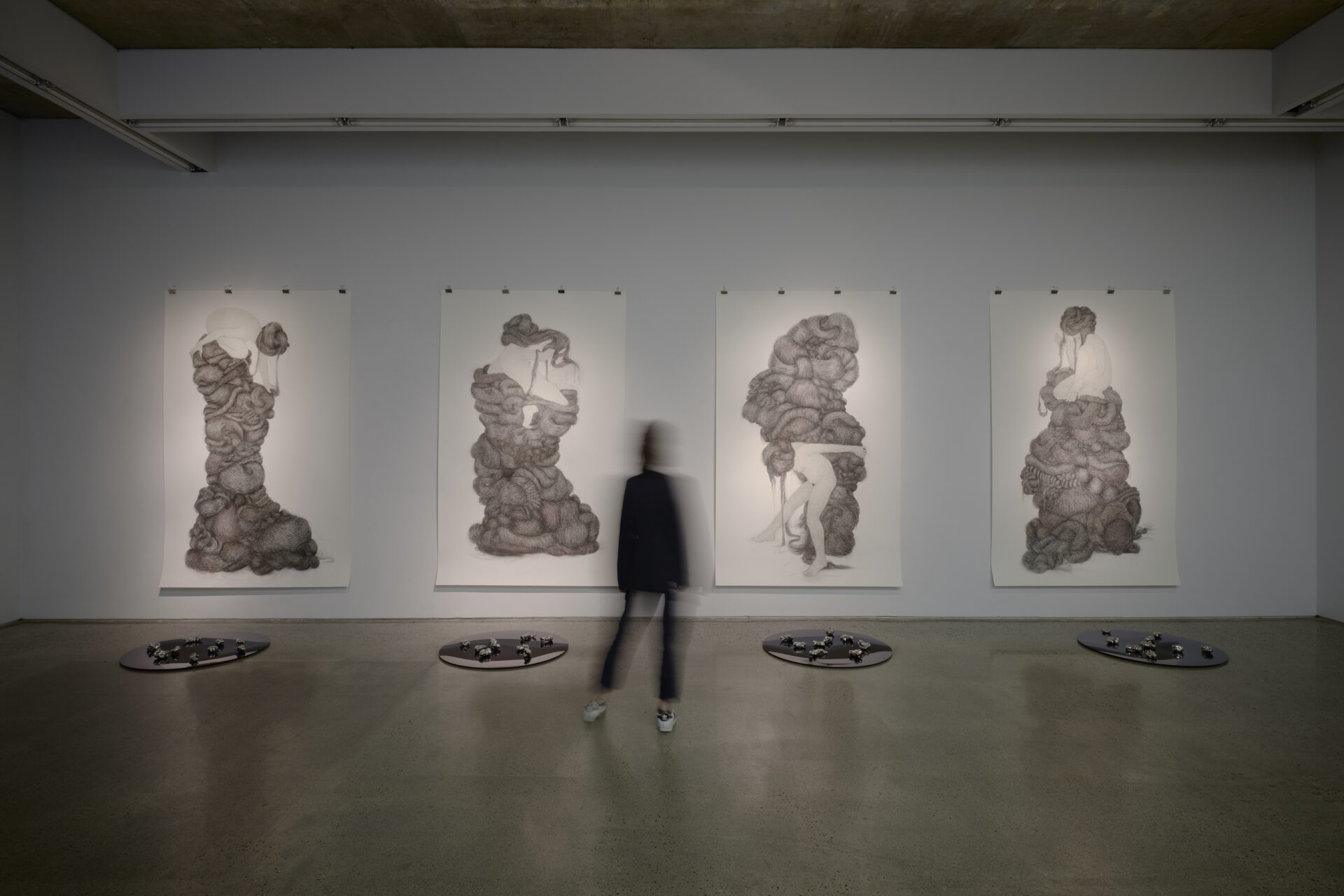
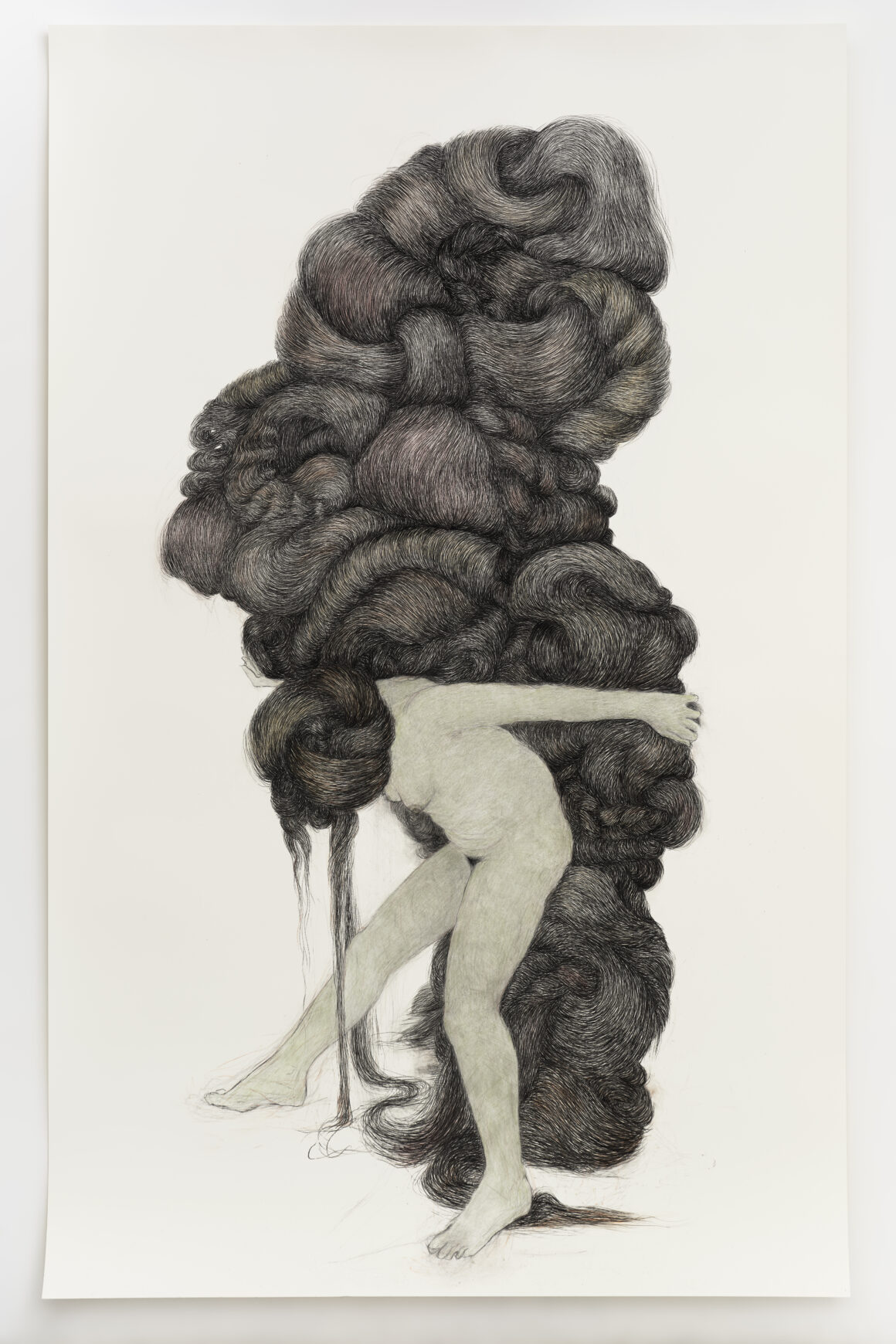
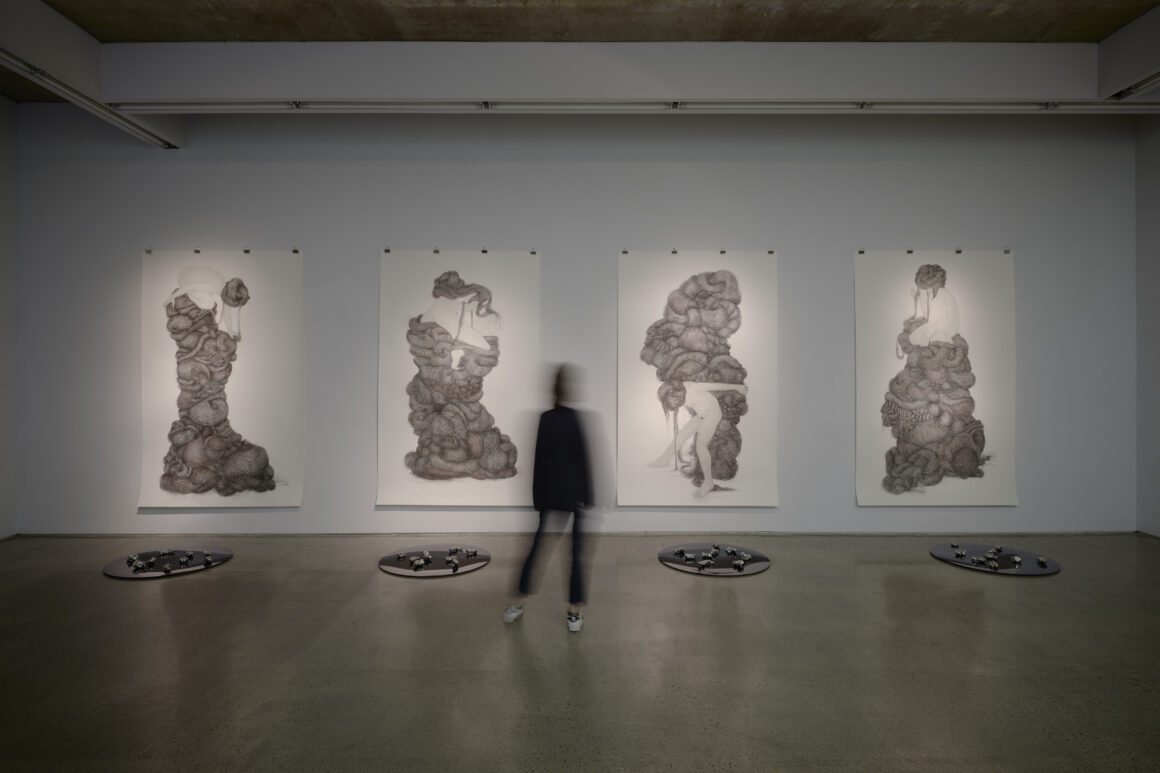
Kevin Kavanagh recently presented ‘The Sibyls’ by Alice Maher, comprising a series of five large-scale drawings in charcoal, graphite and chalk. Four works, Sibyl I-IV (2025), hang unframed, side by side as a series with impressive scale (at 245 x 152cm each). The subject of each drawing is a female nude or Sibyl, who is engrossed in spewing and tending to a vast skein of her own black hair that falls into untidy rolls, forming misshapen, dense columns.
The Sibyls are drawn in simple outline, with minimal rendering of anatomical form, while the hair is deeply etched with trompe l’oeil definition, bursting with movement and energy. The incongruity of weight and form is both dynamic and devotional. Maher’s drawing skills pack considerable force, most notably in the strange light that leaks through the rolls of hair like stained glass. The overall hanging arrangement and subdued gallery lighting further create an oratory atmosphere.
On the floor in front of each Sibyl are four separate sculpture pieces, Vox Sibyllae I-IV, comprising circular black mirrors, upon which Maher has placed hand-sized, nickel-plated, cast bronze ‘gobs’ of amorphous material, like squished plasticine that a child might discard.
The Sibyls were prophetesses in Greek civilisation who, during the Renaissance, provided scandal-free cover for the depiction of beautiful women, subjected to the male gaze. Maher invests her Sibyls with composed agency and enigmatic self-absorption that refuses the gaze of the viewer. They are entirely focussed on themselves as they tend to their mounds of hair that either obscure their faces or distract them away from view. They casually hold their precarious positions on pillars of hair that oscillate dramatically.
Narrative drawing forms part of Maher’s oeuvre, which has consciously and effectively borrowed from and paid homage to centuries of art history. Sibyl II reclines sensually as Marie-Louise O’Murphy did in Boucher’s La Blond Odalisque (1751); Sibyl IV could be enjoying Le Déjeuner sur l’herbe (1863) by Manet; while Sibyl I, in a casual display of strength and balance, brings to mind Artemisia Gentileschi’s Judith, as she slays Holofernes. Sibyl III is a familiar and recurring character of Maher’s own creation – a sturdy young girl, grounded in a deep connection to the land and spirit world, capable and persistent under the weight of her ungainly burden.
On the opposite wall, sadly, The Supplicant (160 x 110 cm) has fallen under the weight of her hair; she is submerged with only her foot and outstretched arms visible, her palms pressed together, and fingers entwined, as if pleading or praying. No circular mirror sits on the floor below her.
The juxtaposition of Vox Sibyllae I-IV directly in front of each of the Sibyls I-IV results in an upside-down reflection of each drawing in the mirror below. These dark pools in the terrazzo floor have a strange black patina that reflects the drawings perfectly, while creating the illusion of bottomless depth, causing a moment of sensory disorientation for the viewer that even the silvery forms on their surfaces cannot break.
On the pristine white paper, the Sibyls are graceful, metaphysical characters; however, in the mirrors, they are inverted and distorted in a darkened underworld. This duality is familiar within Maher’s broader practice, conceptually fuelled by dichotomies, borderlines and transgressions. The “gobs of misunderstood language”1 transgress the grand mythical narratives of the Sibyls, while providing a grounding in the bogs and fields, playgrounds and encyclopaedias of our childhoods. ‘The Sibyls’ is a visually and intellectually compelling exhibition that also serves as a sanctuary of contemplation.
Carissa Farrell is a curator based in Dublin.
1 Quote from a public conversation between Alice Maher and Jesse Jones on 11 September at Kevin Kavanagh, Dublin.