Ormston House
29 August – 26 October 2025
I, like so many, was very sad to hear of the recent passing of Manchán Magan. He showed us the Irish language as otherworldly and rooted in the land – a living thing, full of poetry, weather, and innate wisdom. A far cry from the dull, punishing version of Irish that many of us were taught in school. In remembering him, what lingers is his lightness, humour, and humility. Buíochas ó chroí, a Mhanchán.
I think Manchán would have loved ‘Bíodh Orm Anocht’ – a group exhibition, developed by Ormston House in collaboration with EVA International. The sound, poetry, and temperature of the title alone, which loosely translates as “be with me tonight,” holds an entire story of longing and presence that feels profoundly aligned with his gentle ways of communicating. Like Manchán’s work, the exhibition felt quietly revolutionary; an intimate space of tenderness and kinship with all species, stories, and unseen forces, highlighting the world’s quieter correspondences.
The exhibition opened with Seán Hannan’s LUCK (2022/2025), a short video paired with a single egg, encased in a flight case on a plinth. The work draws on the Irish folk tradition of piseóga (curses), with the video offering context, while the object itself anchored the installation with minimalist simplicity. The curatorial decision to place the screen on the floor was quietly brilliant, allowing the ominous egg to dominate the space. This gesture signalled the exhibition’s broader engagement with modes of knowing that precede and exceed our techno-rational era, leaning instead towards older, more mystical registers. The all-caps title, LUCK, functions as a catch-all incantation: a good or bad word that gives shape to the shapeless.
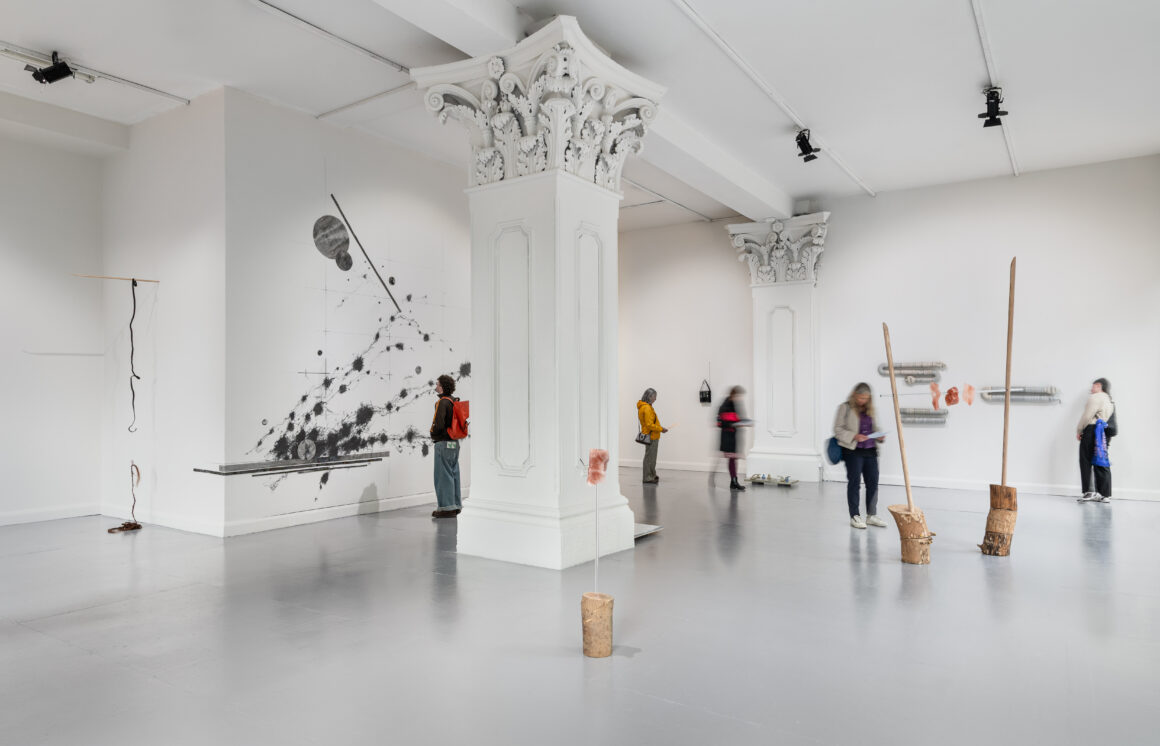
Laura Ní Fhlaibhín’s wonderfully titled Extendable comb for giant ghost ponies (2025) sits horizontally, like a railing. Carved from the softness of ash, its delicacy is offset by a grounded, tactile weight. At its tip, a small equine comb gestures toward care and grooming. Beside it, Spirited Rein (2025) comprises horsehair and burnt reins, suspended from a bent ash dowel. The reins fall and sweep like a calligraphic mark. Highly sensitive and barely there, the piece somehow holds a monumental and elegant sorcery.
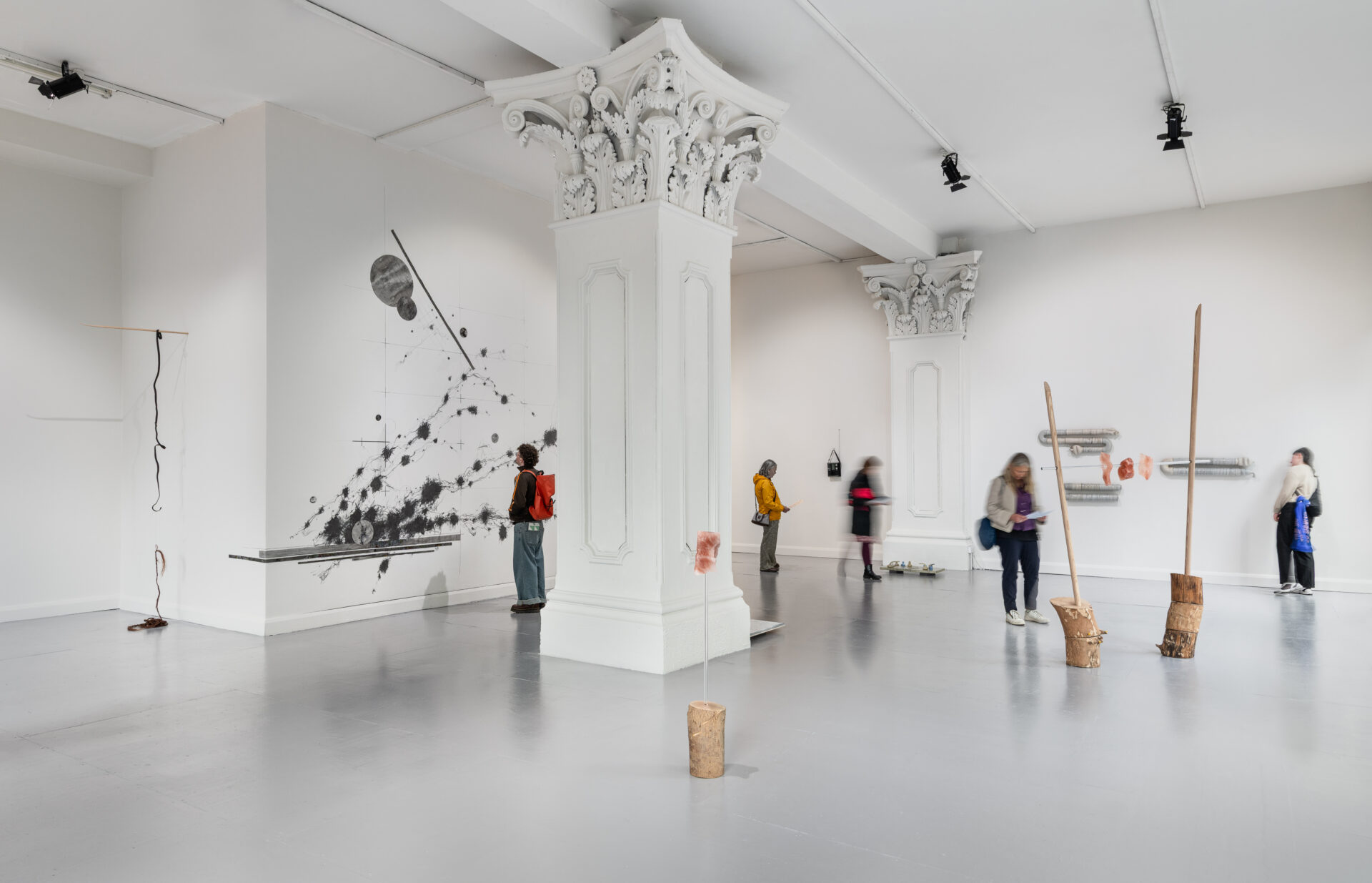
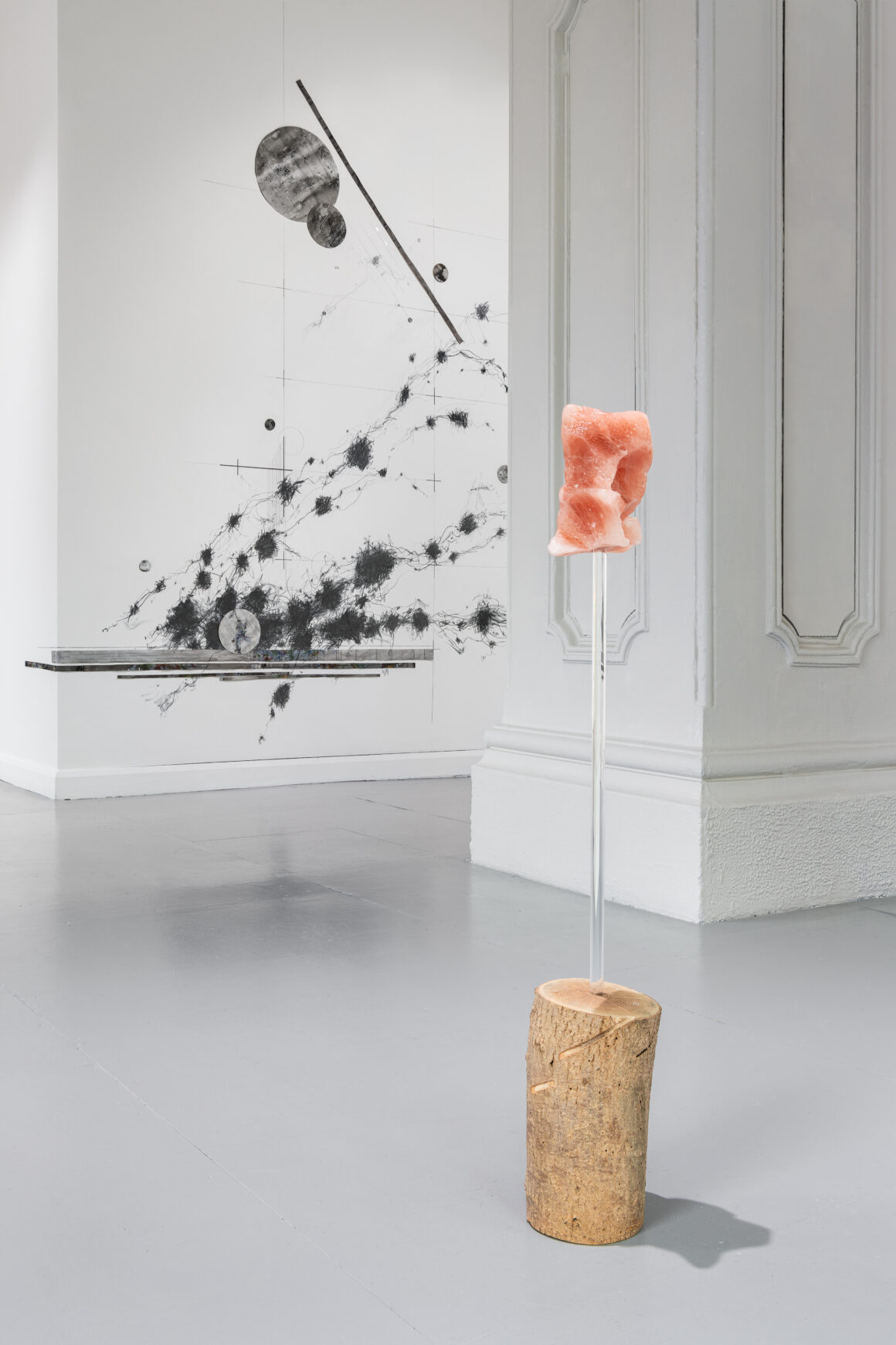
In Ní Fhlaibhín’s Bob Shíafra Alannah Seán (2025), Himalayan rock salt licks – provided for ponies to access essential minerals – stand on glass rods, embedded in logs of ash, ravaged by dieback. A sacred tree bridging earth and sky, Ireland’s native ash is disappearing. This piece invites us to remain attuned, even as the world grows quieter. Ní Fhlaibhín’s practice suggests an epistemic shift – a turning toward knowledge rooted in feeling, a kinder way of knowing the world.
In a related rhythm, Kiera O’Toole’s Affective Cartography: Limerick (2025) translates this sensibility into drawing. Her vast, on-site wall work unfolds as collaged circles that cluster and expand across a constellation of graphite lines, moving through the city’s geometry. Up close, it pools and dissolves into tremulous lines, scribbles, and knots – intimate gestures that scatter, bleed, and pulse with life and messiness. An embodied record of how place is felt.
A stacked edition of digital drawings by Ciarán Ó Dochartaigh in collaboration with Alex Feldmann, entitled An Loch Fada Thoir (2025), chart the collapse of the rare Arctic Char. The work does not shy from naming the forces at play: human intervention causing ecological imbalance, and long histories of exploitation. Through a depth of detail and supposition, the work bears witness, connecting our actions to the silence of a lost species, framing ecological decline as inseparable from historical ignorance and violence.
Other powerful works by Ó Dochartaigh include Caoimhín (2022/2025), a glazed ceramic rendering of the artist’s late father’s intestines, meticulously hung on the wall. The work feels alive and dead at the same time, its sickly glaze unsettling, its worm movements near vile. Here, the gut is gut-wrenching – a tunnel of instinct, agony, memory, and grief. Grief lives here not symbolically but physically, drawing the viewer into the lonely, ungainly, terrible meat and foul of mourning.
Seán Hannan’s Received at the Graveyard (2025) traces how forgotten voices and rituals might ripple forward in time. A custom AI, trained on archival recordings of Caoineadh – the near-extinct Irish keening tradition – wails out through an old transistor radio, its aerial stretched skyward, an antenna to the past. The collision of machine learning and obsolete technology collapses the centuries, allowing ancestral sound to emerge through the static. Strange, frail, and obviously ghostly, the work gives free passage into the laments of a not-so-distant past. It opens a mode of listening attuned to the echoes, absences, and the subtle stirrings within us.
Ormston House and EVA International always cultivate an ecology of support and inclusivity through their programming, which deserves the highest praise. Their provision, for example, of accessible, plain-English exhibition texts, alongside a rich series of talks, workshops and offsite happenings, creates an inviting framework for engagement.
In this light, ‘Bíodh Orm Anocht’ felt both enchanting and essential. It reclaimed Irishness not as a fixed identity but as a realm of openness, poetry, and welcome. Here, folklore and ritual, landscape and language are not emblems of belonging, but channels of connection. This commitment resonates profoundly at a moment where Irish flags are being wielded for xenophobic ends. If Manchán showed us that speaking Irish could be an act of love, ‘Bíodh Orm Anocht’ demonstrates that making art in this spirit can keep that love alive – luminous, fragile, and shared.
Sheenagh Geoghegan is an artist and writer from Tipperary.
sheenaghbgeoghegan.com