Hillsboro Fine Art
3 – 26 September 2026
Claire Halpin is a Dublin-based visual artist who studied painting at Dublin Institute of Technology and Gray’s School of Art in Aberdeen in the 1990s. Halpin frequently describes her paintings as ‘political landscapes’ that reflect the contested nature of geopolitical territory, focusing on contemporary and historic narratives of global conflict. Her latest solo exhibition at Hillsboro Fine Art continues to explore these themes.
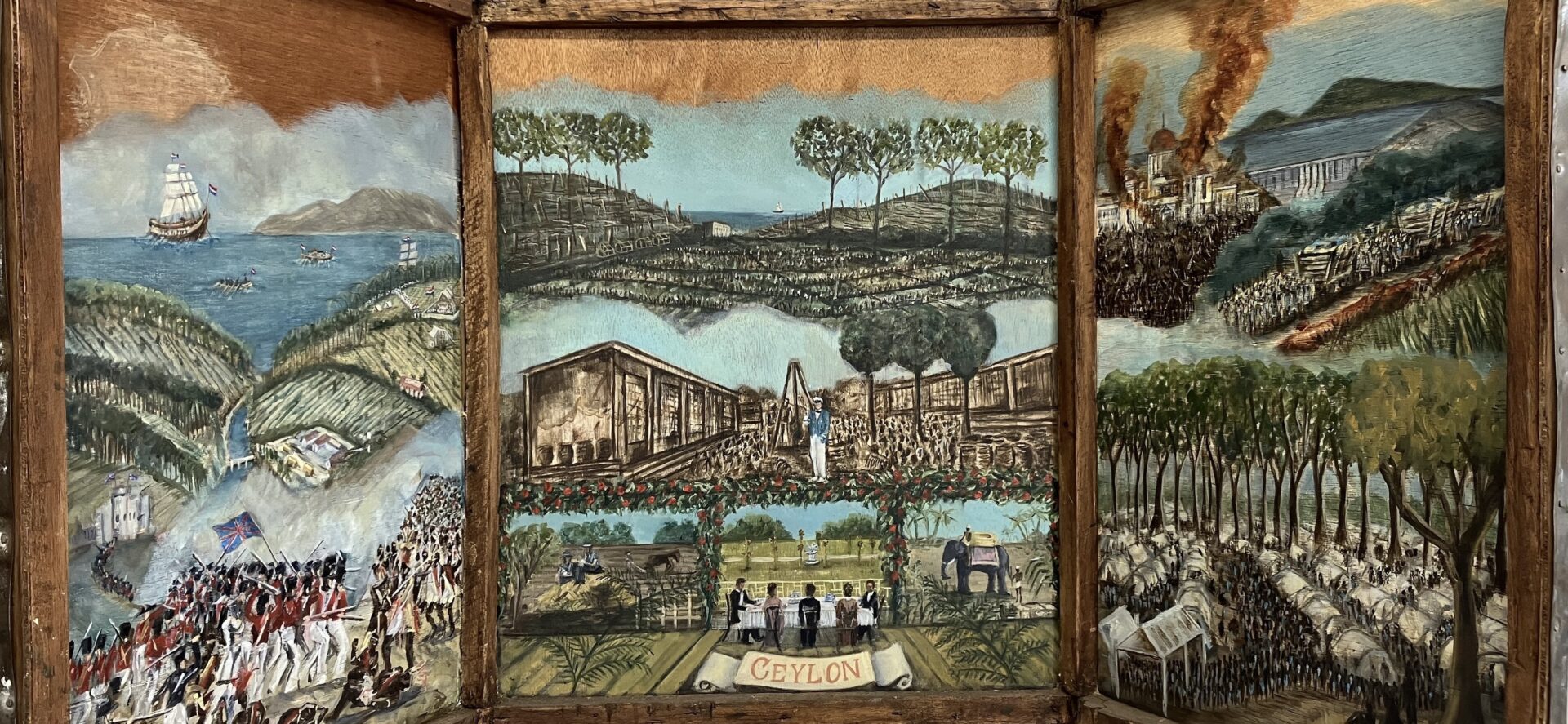
Stacks of old wooden crates occupy the main exhibition space. Their sides are marked by dilapidated lettering, which identifies the goods they once contained, and their provenance. Most belong to a company called Maskeliya Plantations Ltd., and several reference “produce of Sri Lanka,” “produce of Rwanda,” and so on. In each instance, the topmost crate has been turned and split open, to form three connected panels. By painting the interiors of these deconstructed boxes, the artist has created triptychs – an art historical device associated with religious iconology of the medieval and renaissance eras, producing three-part works exploring unified themes. Importantly, the triptych structure had hinged panels, to be opened for display or folded shut, which allowed ease of transport.
According to the exhibition statement, these are historic tea crates, used by Halpin as painting supports in order to evoke the spectre of imperial industry. The crates are both symbols and vehicles of empire – items of colonial extraction via trade and commerce. The meticulous painted panels themselves contain a mélange of colonial-era imagery, touching on particular historical territories of empire: Rwanda and Sri Lanka, for instance, and Ireland too. The artist’s imagery is at once dreamlike and cinematic, with fragmentary vignettes producing a sweeping montage of imperial brutality, war, starvation, subjugation, and forced labour.
Halpin’s works are uncompromisingly nightmarish, staging episodes of power and privilege alongside devastating oppression. Take the first crate installation, Outpost – India (2026): the central panel contains several jubilant scenes of empire, referencing the Great Exhibition of 1851, an international fair that celebrated industrial Britain’s achievements, including the ill-fated Crystal Palace, built to host the fair. Above is an enormous parade ground, its white bandstands decked in British regalia, with red-garbed cavalry, riding resplendent white horses before a sea of black faces.
At the bottom of the left panel are early nineteenth-century harbours. Wooden sailing ships dock beside bustling crowds of workers, preparing timber and other commercial goods for transport. One imagines the spectacle of London for those first encountering it during this era: Heinrich Heine, arriving in 1827, was overwhelmed by the city’s “machine-like movement” and “colossal uniformity,”1 while Dostoevsky, 35 years later, marvelled uneasily at a city “so vast and so harsh in its originality.”2
Halpin spells out the cost of these marvels with blunt antipathy. At the far left, a couple, perhaps Irish Famine victims, cower in starvation, while above, a battle rages across a war-ravaged landscape, black bodies made evanescent as mortar fire and buckshot rip through them. In the right-hand panel, dancers in saris and elegant Indian formal wear mingle with English bureaucrats in long-tailed coats and top hats. Beneath them, a family slowly dies, their skeletons burning brightly beneath the surface of their skin.
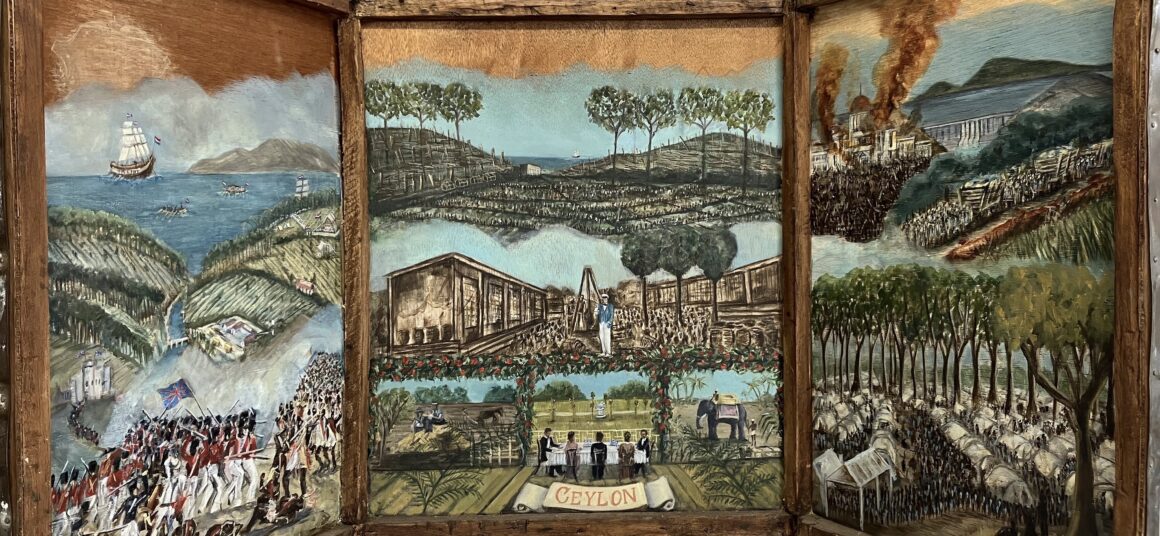
Claire Halpin, Outpost: Ceylon, 2026, oil on tea chest; images courtesy of the artist and Hillsboro Fine Art.
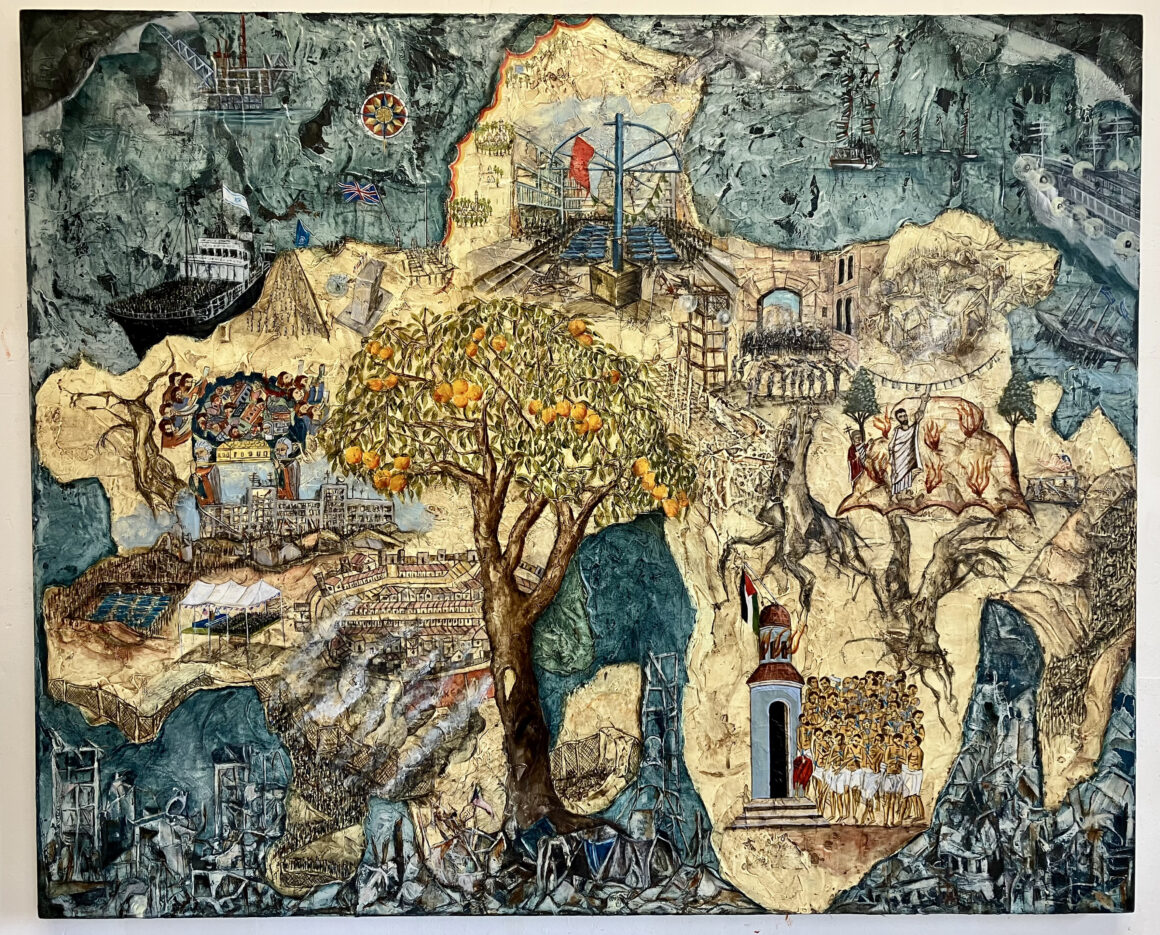
Besides being a historical meditation on the horrors of colonialism, ‘Empirical Outposts’ is particularly timely due to the ongoing Israeli campaign of genocide against the people of Palestine. Adorno once wrote, in a now-famous line, that to write poetry after Auschwitz was barbaric, and certainly any attempt to address Israeli war crimes is an endeavour fraught with peril, since the current reality is so abject that any artistic representation risks feeling facile.
However, Halpin is a sensitive, accomplished artist in this domain. Having led us through historical imperialism to underline the persistence of such modes of state violence today, from the tactics of contemporary warfare to the rise of far-right politics, she refuses to frame the people of Palestine as subaltern victims. In Topographia Palestina, amid a sea of destruction, among the burnt embers of a society, an orange tree grows and thrives. Surrounded by symbols of violent oppression – a British oil rig, an Israeli warship, a burning minaret – the tree bears Jaffa oranges, so closely associated with Palestinian culture. Thrusting upwards, its fruit glowing in the light of burning Palestinian flags, the tree becomes a defiant emblem of survival.
Tom Lordan is a writer and critic based in Dublin.
tomlordan.com
1 Heinrich Heine, ‘London’, in Havelock Ellis (ed.), The Prose Writings of Heinrich Heine (London: Walter Scott, 1887) p. 48.
2 Fyodor Dostoyevsky, Winter Notes on Summer Impressions, trans. Kyril FitzLyon (London: Quartet Books, 1985) p. 43.