The MAC, Belfast
31 July – 18 October
A long-held quandary for performance artists, and the arts spaces in which their work is shown, is how to endow a temporary happening with a permanence that allows legacy, further exhibition, and marketability. For this, photography and video are, of course, the favoured media. American artist Mike Kelley (1954–2012) rarely allowed filmic documentation, believing that performance should, according to his frequent collaborator Tony Oursler, “exist only in the moment.”
If photographs are images of death – moments that have passed beyond experience and interaction – then such photographic documentation provides portraits of art corpses. Thus, video evidence, to paraphrase film theorist Laura Mulvey, kills the work 24 times a second. A third option, one which redefines its material qualities as museum display, is to exhibit the detritus left behind by the completed work. For ‘Reconstructions: A Room for Mike Kelley’, Mary McIntyre and Robert Anderson have produced facsimiles of such evidence, using images from publications as direct bases for their installation of responses to Kelley’s sculptures and of photographs which recorded his performances. Many of the latter are direct copies from the books, but with the artist and audience removed, their presence gone but their ghosts remaining, like that of Van Gogh, sitting in his empty chair.
McIntyre and Anderson’s ten-year fascination with the documentation of Mike Kelley’s work – in galleries and in his studio – has resulted in this collaborative body of work that aims to extrapolate a semblance of the physical reality of works made between 1977 and 1980. If the cloning of a lost loved one, however, is carried out using damaged or insufficient DNA, the results can be genetically distorted, with resemblance to the deceased subject limited to familial approximation.
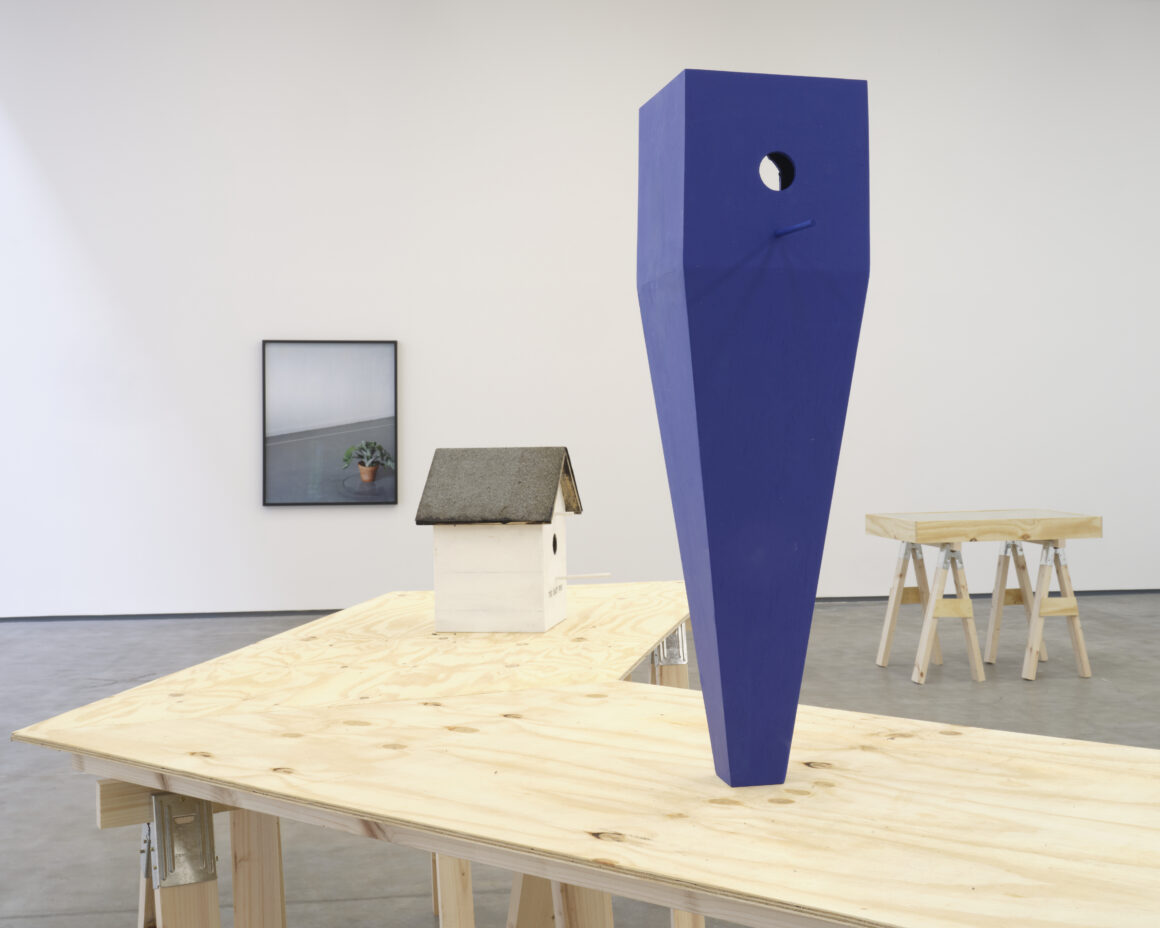
In a glass display case sits a number of publications with photographs of Kelley’s sculptures, installations, and performances made over this period. The black-and-white image of a moment in the performance, My Space (1979), shows the artist standing stationary, but with his upper body motion-blurred. He looks down at a potted plant placed within a circle drawn on the floor. Two members of his audience are seen to one side. On the same page is a diagram of interlocking circles or spheres – like a complex Venn diagram – with a description of the volume he occupies, including the phrase, “In my space my body cannot be affected by other life forms, such as plants.” McIntyre’s photograph is a precise copy of the original, but in colour, with the plant and the circle, along with details such as skirting board, occupying this new proportionately accurate rectangle. The artist and the spectators are gone.
Kelley’s The Monitor and the Merrimac (1979), referencing the American Civil War ‘Battle of Hampton Roads’ between two iron ships, is given similar treatment. The performance consisted of numerous elements (including sound) which appear to have an air of chaos about them, objects scattered apparently haphazardly, but resulting from the narrative of the work, with models of the two ships taking centre stage. The precision of the facsimile (again, artist and audience are removed), with the same objects accurately arranged, produces a strange perceptual disorientation, as we are faced with a visual near-congruence, resulting from two very different aesthetic procedures.
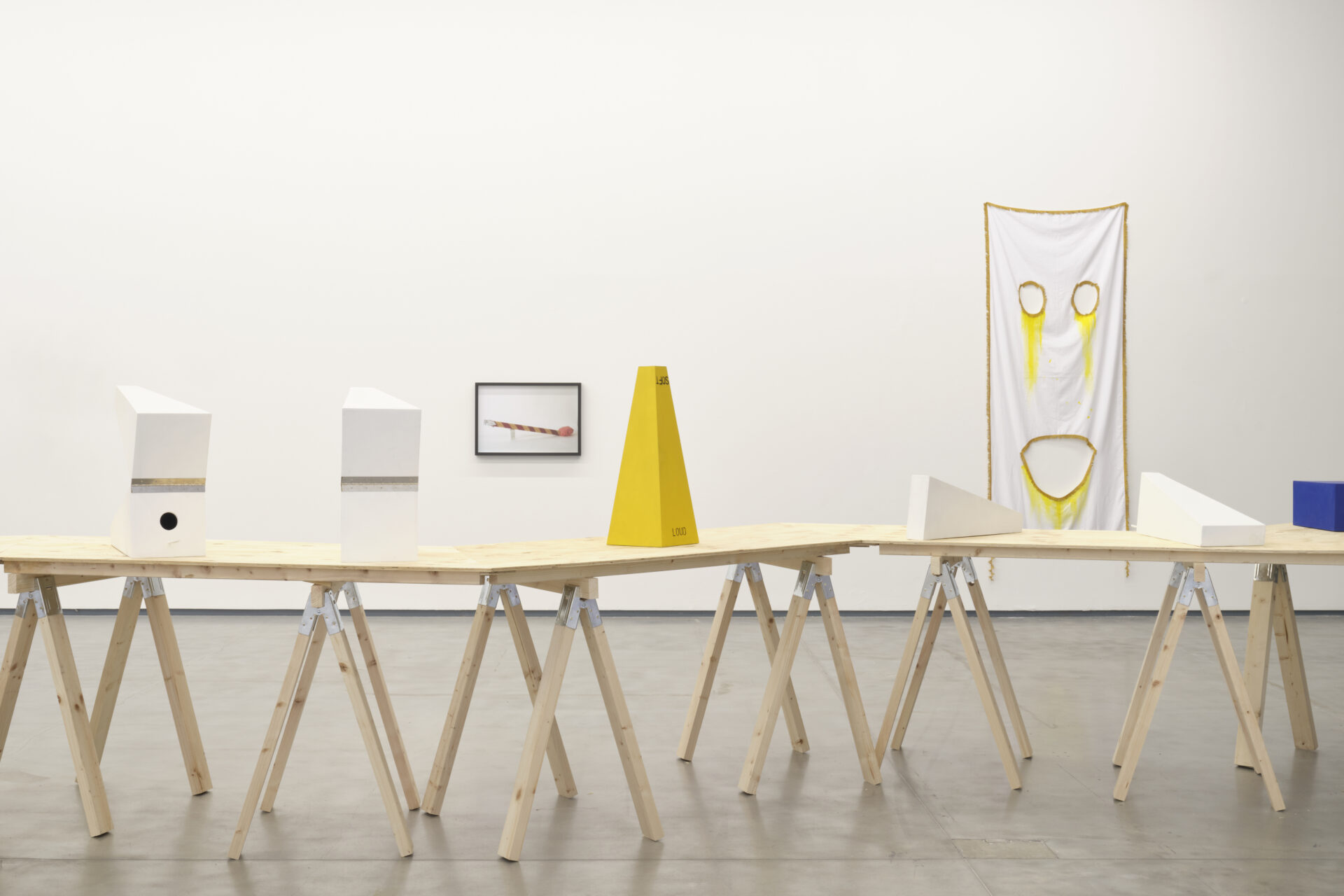
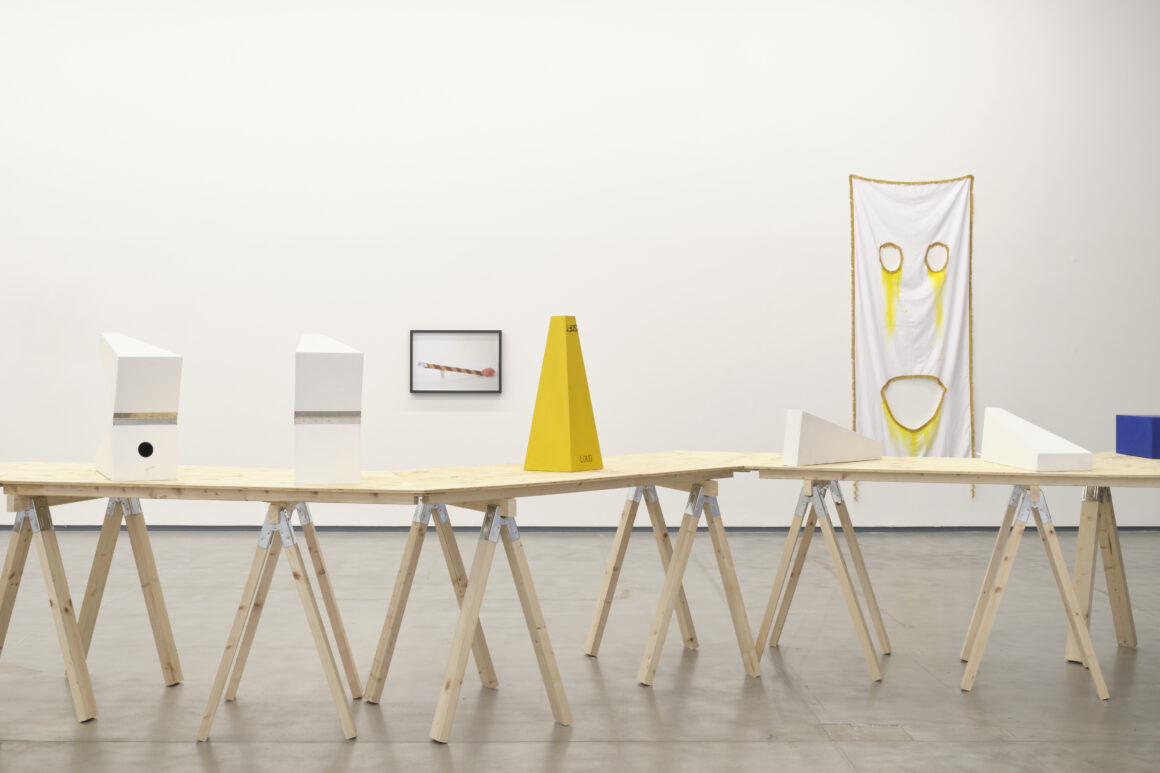
For the sculptural elements of the show, a long zigzagging tabletop sits on trestles, upon which are placed a number of reconstructed objects, again using documentary photographs from publications to inform their fabrication.
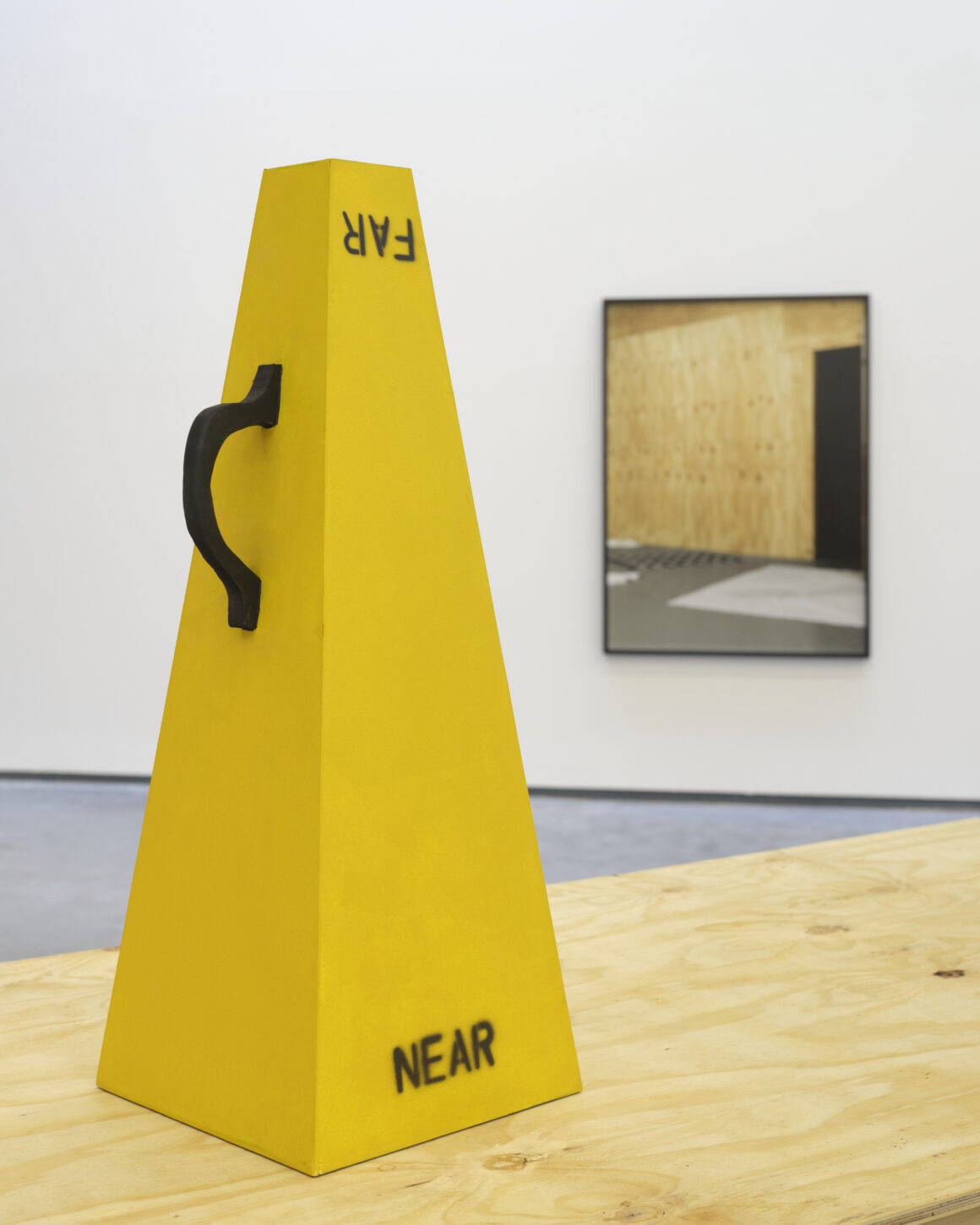
For his performance, Perspectaphone (1978), Kelley made a wooden megaphone, square at both ends, with SOFT and LOUD written on one side and NEAR and FAR on the other, thus equating physical perspective with levels of sound. He soon after made comparable objects, now adapted whimsically as birdhouses, again emulating perspective, bringing to mind Renaissance polymath Alberti’s visual pyramid. These include Birdhouse for a Bird that is Near and a Bird that is Far (1979).
Anderson has made precise copies of these objects. Those which relate to performances of the past sit in the museum silence that comes when faced with artifacts of which we have limited reliable knowledge. The unseen truths inform the show as a whole, leaving the audience with the conflict between the pleasure gained from the images and objects and the frustration that comes with their indistinct historical testimony.
Colin Darke is an artist based in Belfast.