Solomon Fine Art
23 October – 15 November 2025
In 1967 the sculptor Richard Serra set down on paper, in his own hand, a list of what he described as “actions to relate to oneself, material, place and process.” Entitled Verb List, it comprised 107 possessives and infinitives, such as to fold, to bend, of refraction, to scatter, to join, to gather, to continue. In the context of the weighty muscular works of torqued steel he would go on to make, this single piece of paper with four columns of crabby handwriting might seem almost comically slight. But what is so wonderful about Verb List is the way in which it serves to animate even his most monumental and imposing works with a sense of their matter-of-fact history as contingent things, existing in time like ourselves, subject to procedures and activities that can shape, twist or break metal and the human body alike.
Corban Walker, with a practice now spanning four decades has, like Serra, developed a remarkably consistent sculptural vocabulary, albeit one more varied, and equally at ease with glass, ceramic, wood and aluminium as well as steel and paper. Walker, too, has paid meticulous attention to the artwork not simply as a self-contained object but as something situated: in the gallery, in public space, in time – in a lifeworld. However, this kind of exploration of the relationship between the artwork and the lifeworld – the experiential, opening/closing, turning space that we navigate with our distinctive bodies and needs – has in fact been significantly expanded and enriched by Walker’s concern with the question of normativity.
His work has consistently asked us to consider exactly whose lifeworld gets to determine the physical structures of our everyday existence. Walker’s many effective strategies for achieving this include attention to scale and carefully utilising material fragility. To move through an exhibition of Walker’s work is to be rendered awkward and physically self-consciousness; the viewer senses that one’s lumbering presence among stacked ‘corbanscale’ constructions of glass, plywood or ceramic poses a danger to such carefully balanced, borderline-precarious assemblages. In this way, the viewer is invited to rethink how the world is moulded around presumed bodily norms, and how it may be moulded otherwise.
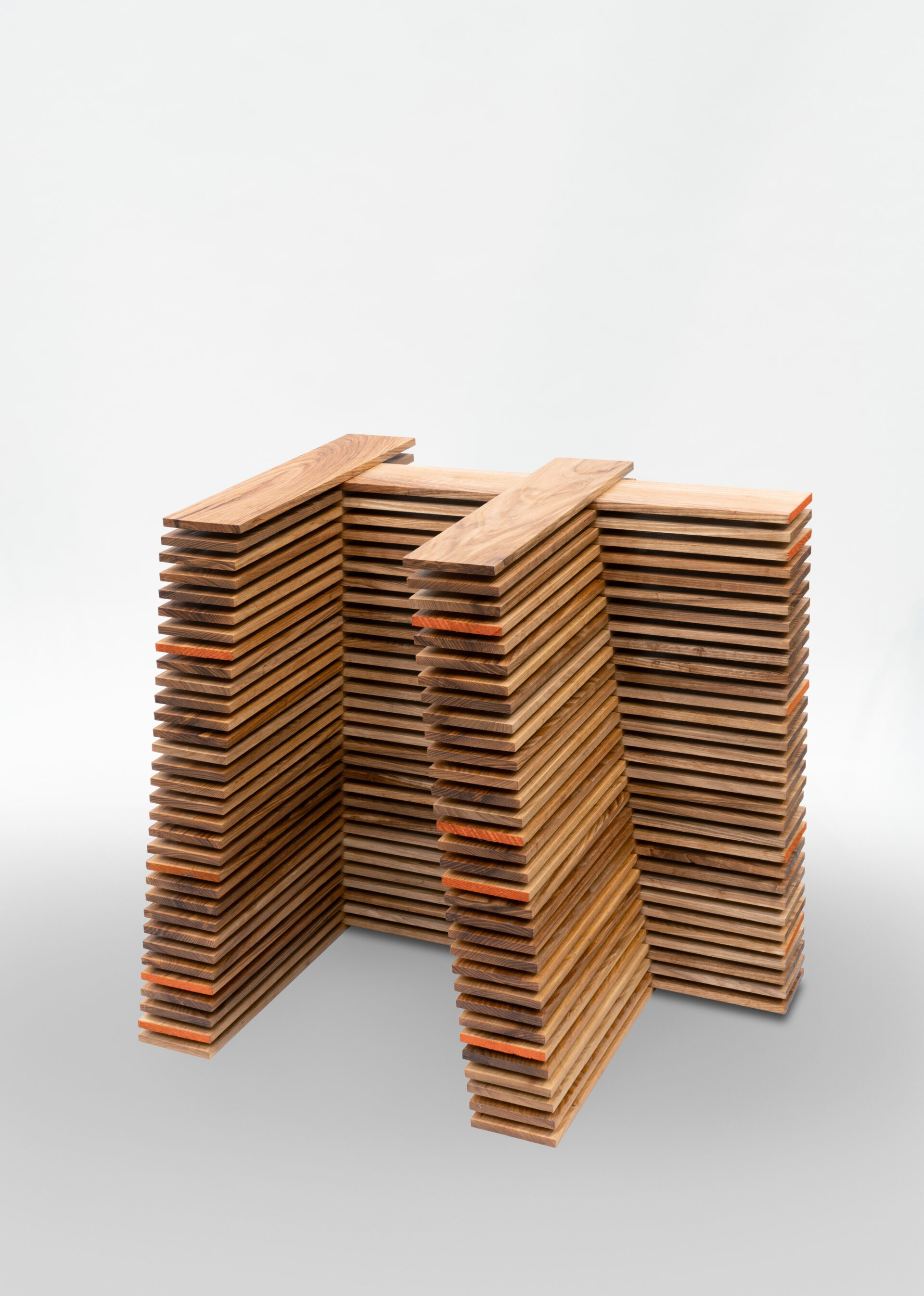
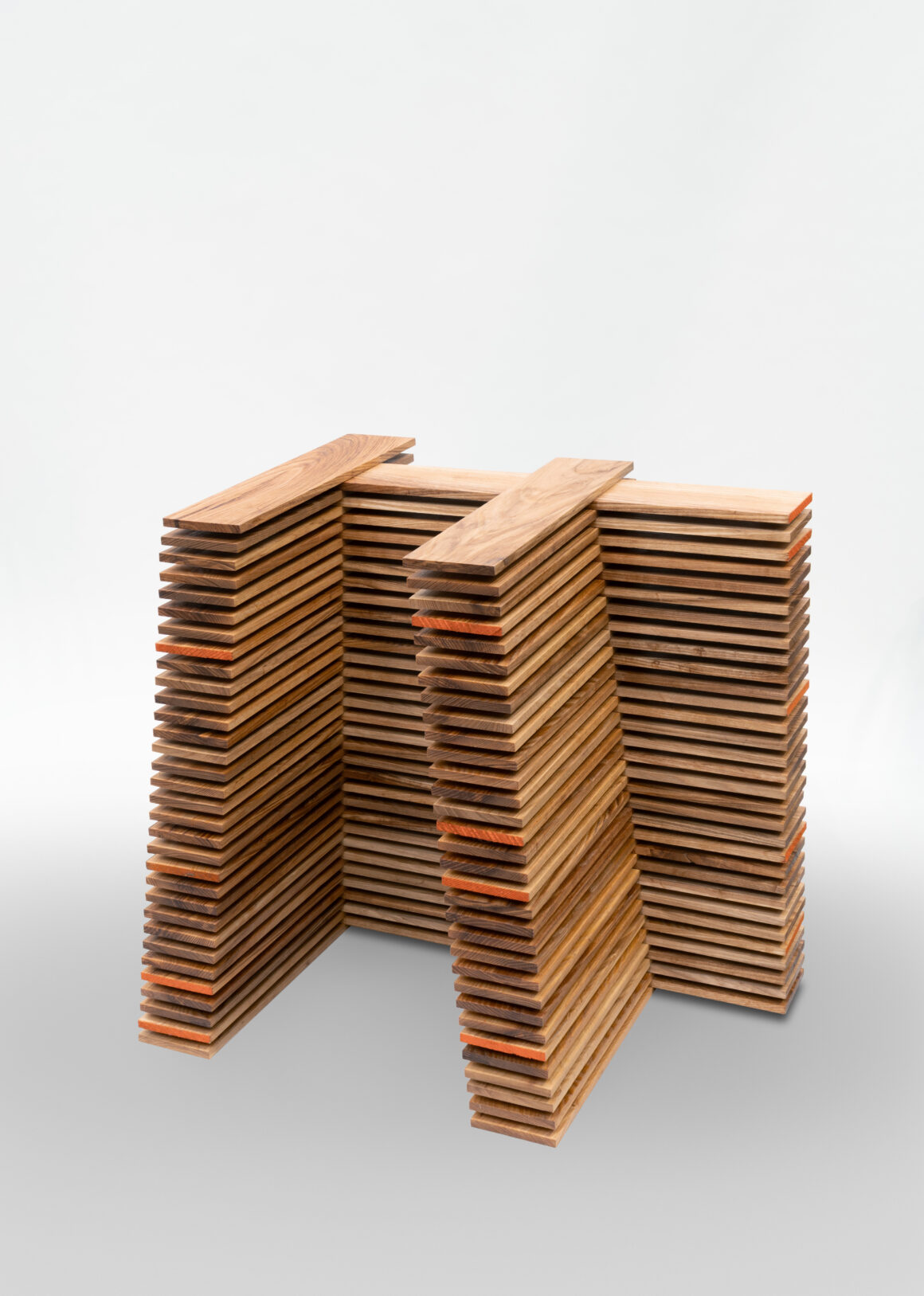
At first glance, it might seem that ‘RESIST’, Walker’s recent solo presentation at Solomon Fine Art, is simply a continuation of such preoccupations and strategies. The familiar forms and materials are there. Upon entering, we see Untitled (116 Stack @ 5°) (2024), birch plywood stacked in a sideways listing form, like a geometric Tower of Pisa. Other architecturally infused works, such as Untitled (RESIST) (2025) in oiled ash wood and Untitled (Gen Joe) (2025), a set of three interconnected aluminium stacks, stand nearby offering the satisfactions of a minimalism meticulously achieved.
However, in the company of works like Untitled (Obliterated) (2000-25), in which a bronze form wrapped in muslin resembling a multiple amputee lies on a notched ashwood plinth, or Untitled (Healing, will it come?) (2025), two porcelain cast-like objects glazed with ink-black handprints, it’s clear that Walker’s preoccupations here have broadened to encompass the kinds of existential precariousness that come with political turmoil. In Untitled (Reuse It Again) (2010-25), blown glass forms are wedged between chunks of I-beam steel, like eggs ready to be cracked. Likewise in Untitled (Baby Annihilation) (2025), flat pieces of dried porcelain clay rest between two columns of aluminium, while nearby, Untitled (Annihilation Stream) (2025) has a similar form, but substitutes fired porcelain between the aluminium columns. These contrasting material densities and strengths bring the viewer right through the looking glass of fragility, all the way to its determining factor: the limit of any material’s ability to precisely resist pressure and maintain its integrity. It’s a question, in other words, of how to survive.
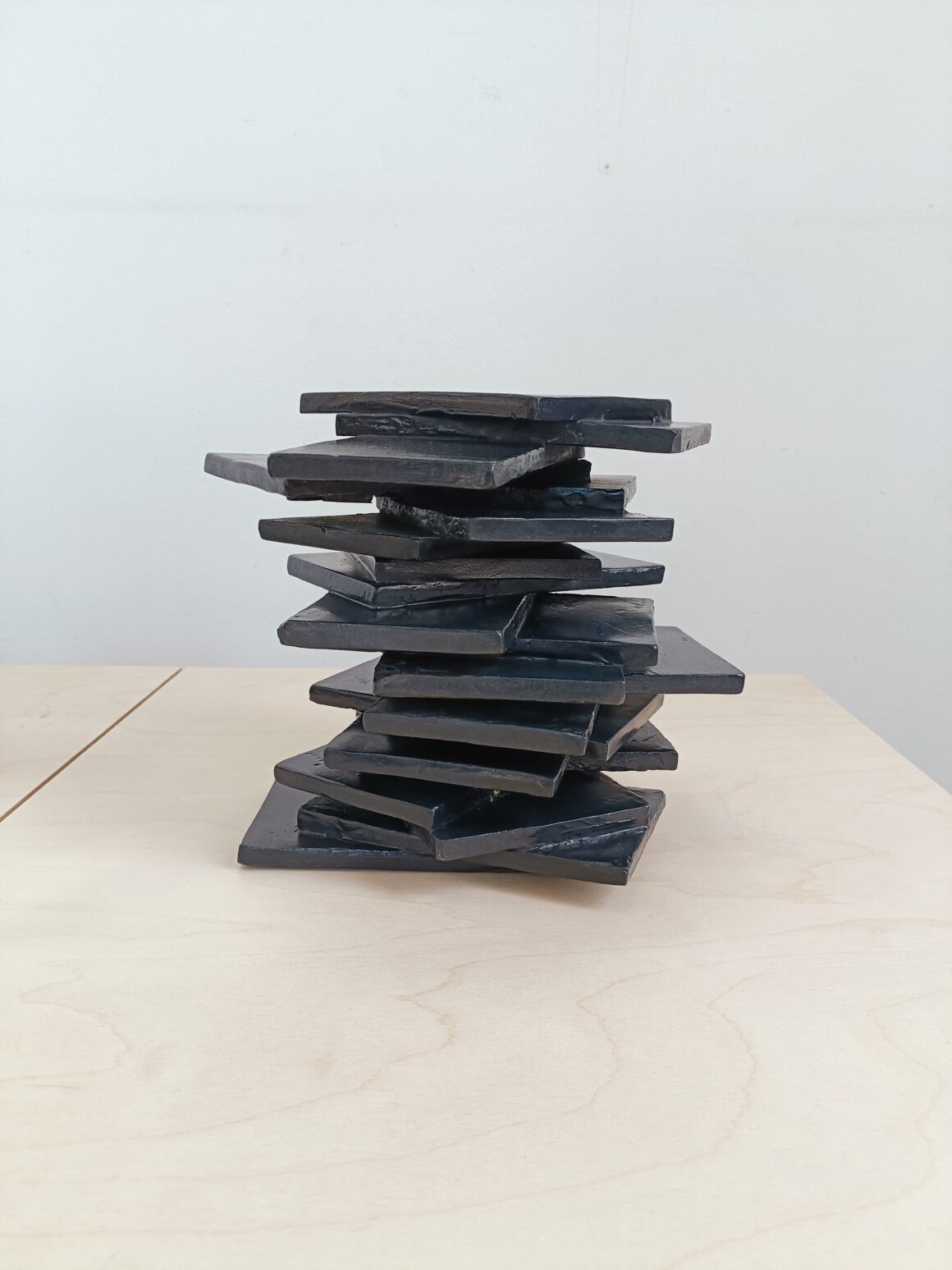
This is not to say that we have not seen intimations of mortality in Walker’s work before. His 2023 collaborative exhibition with Katherine Sankey in The Dock, County Leitrim, hinted at it with Pigeons (2023), a set of 72 cast porcelain urine receptacles, referencing the artist’s time in hospital, recovering from serious back surgery. But here, the anxieties are more acute, as the spectre of death straddles the personal and the political. A series of works in bronze, some cast as stacked panels, some actual casts of cardboard packaging, take on the appearance both of bombed, pummelled buildings and the detritus that such destruction leaves in its wake. Meanwhile, Untitled (Reuse It, For M.W.) (2025) with its simple length of pine erected on a steel base is undoubtedly a tribute to the sculptor Michael Warren, who passed away in July 2025.
Ultimately the show’s success rests on its seamless incorporation of emotion and vulnerability into the kind of artistic practice that is too often seen as cold, abstract or detached from everyday life. This synthesis of form and feeling is perhaps nowhere better encapsulated than in Untitled (Worry Beads Starvation) (2025). Presented on an artist-made plinth, dotted with the colours of the Palestinian flag, ten bronze and six glazed porcelain cubes lay casually grouped. They appear black or white, some with spills in the glaze. The cube form, such an integral part of the modernist vocabulary, has here been moulded by Walker’s fingers, akin to Urs Fischer’s imposing aluminium casts of squeezed clay, but at a far more intimate scale. The soft edges and the concave surfaces precisely register the pressure of the artist’s touch and the limits of the material’s resilience. Like Beckett’s sucking stones, they have an air of compulsion about them: they are coping mechanisms; strategies for survival. Yet they are also monuments in their own way – memorials for the dead and tributes to the living. As matter resists, so must we.
Aengus Woods is a writer and critic based in County Louth.
@aengus_woods