The Dock
21 March – 30 May 2026
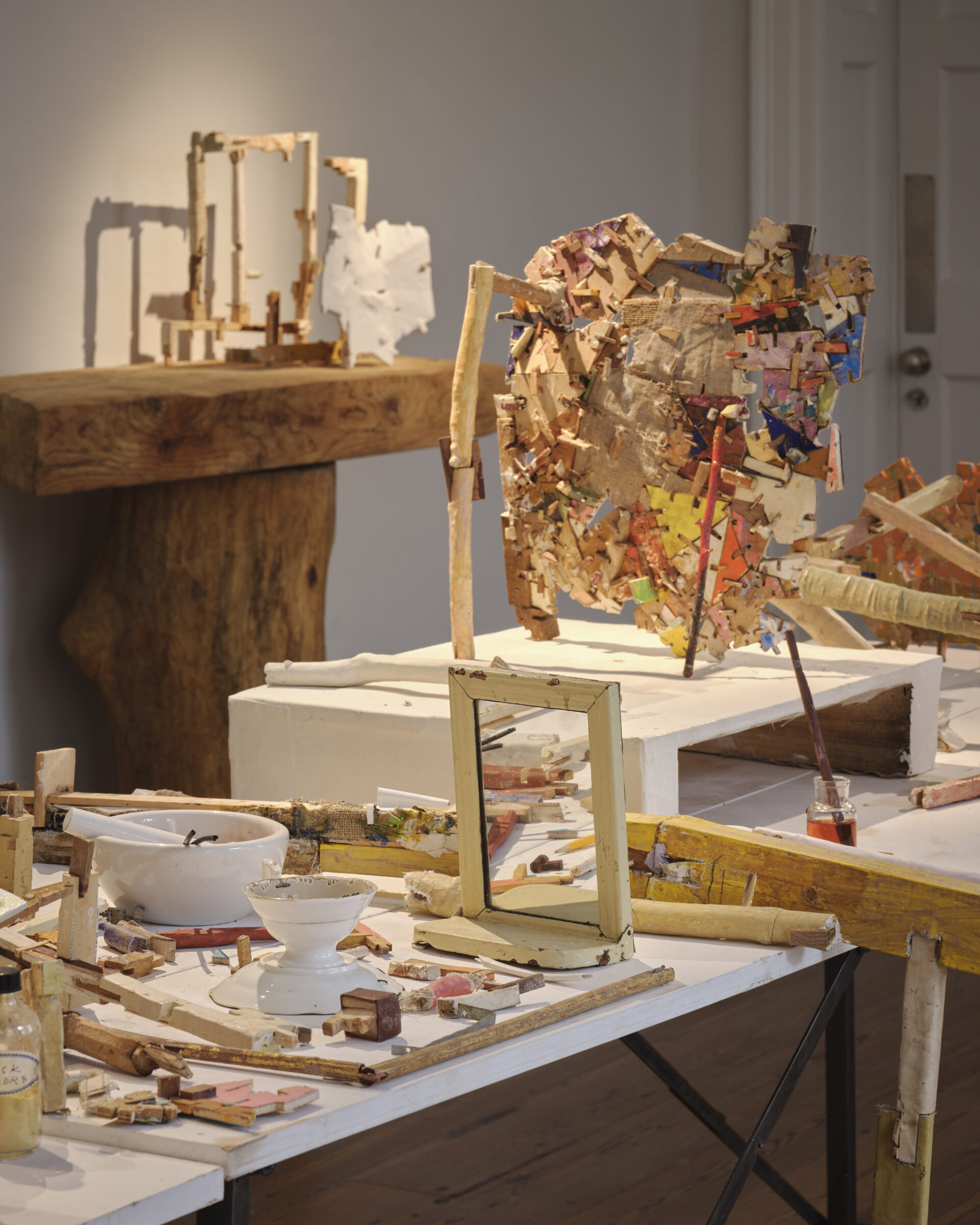
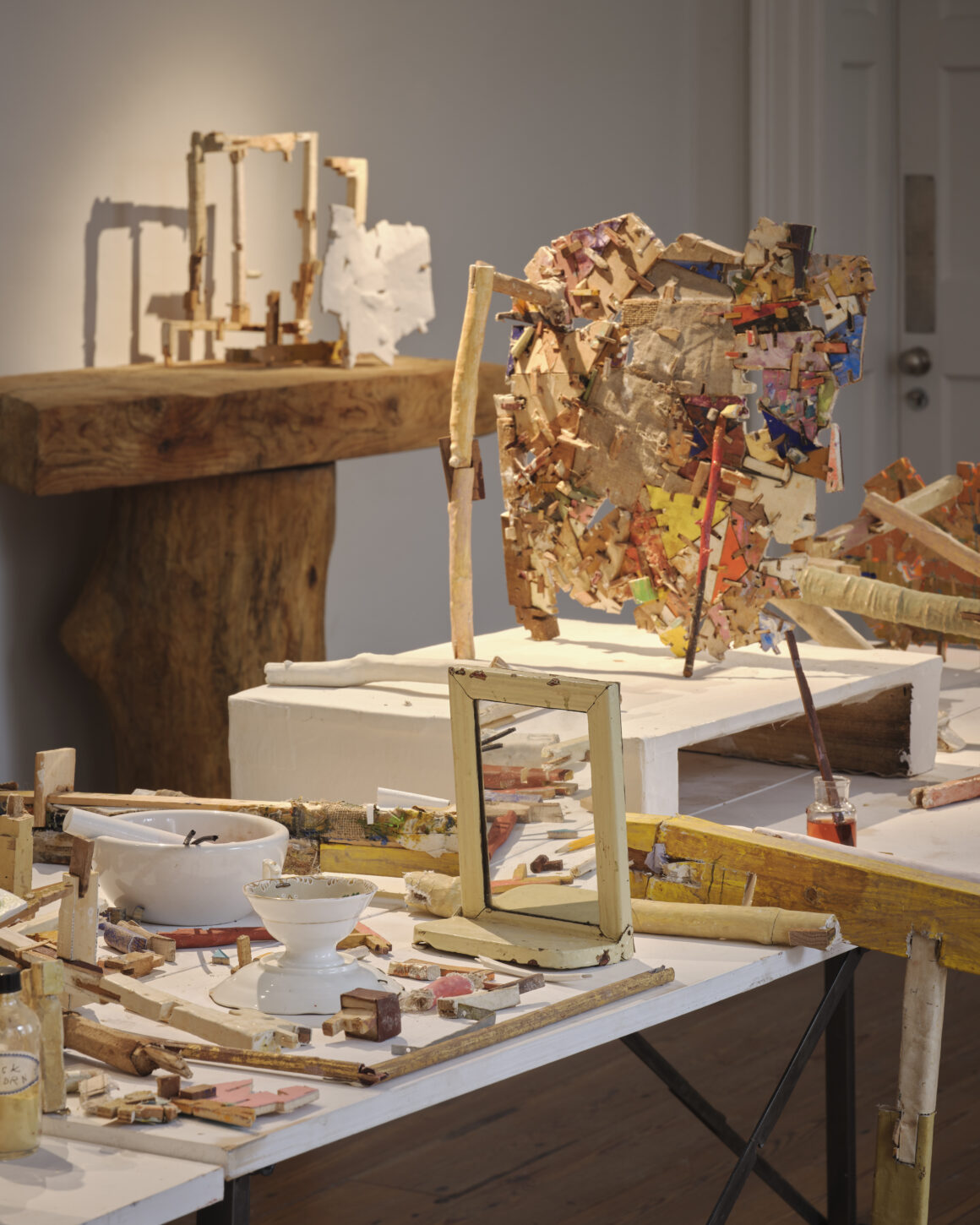
For Helen O’Leary’s exhibition ‘Soft Spot’, an artist’s studio has been installed. Surfaces are bestrewn with tools, jars, buckets, piled canvas, wood scraps, and balls of yarn, while improvised constructions are laid down by the artist, as if in mid-contemplation. Discrete works are hard to discern. In the accompanying booklet, a list of materials is provided in lieu of artwork titles: soil, iron, linen, wood, charcoal, crushed eggshells, oak galls, oyster shell, spun nettle, reclaimed and recycled objects from the artist’s life, and more. It’s an alchemical inventory. I spot powders and potions, mortars and pestles, pitchers and whittled spoons – elements required for processes known only to the magic-maker.
What’s certain is that these are the materials of a life of making, sometimes obscure in origin, accumulated by accident or curiosity, and driven by peculiar passions. The exhibition emerged from what O’Leary calls ‘studio archaeology’ in which her studio becomes an “archaeological site, a dictionary of the savage of age, a compendium of erasures, renovations, and restorations.” It’s an excavation of process and of the artist’s impulses, recalling Louise Bourgeois’s declaration that “[t]he studio of the artist is really the self-portrait” of the artist.
In The Poetics of Space (Presses Universitaires de France, 1958), Gaston Bachelard wrote that a house is more than an architectural form, it is an abode of the human soul, mediating between the self and its longings. Organic and intimate, it is a space for reverie. Similarly, a studio, much used, is that mediating space between the artist and their dreams. Over time, it becomes a cosmos of objects, attached to memories; from them, a thickness of feeling emerges. O’Leary’s objects proliferate, spreading and accreting across space, like fungi unfurling through a forest’s understory, the mycorrhizal network by which trees communicate with each other. They manifest reverie, that inward rearrangement of materials into forms dreamt by the artist.
At first, the plinth and the frame, mainstays of conventional art display, seem absent. It is up to the viewer to search for meaning within the jumbled gallimaufry of objects, to query the commonplace idea of art as transcendent object, rather than process. There is a sense of provisionality – of forms in the process of transforming into others, caught in the struggle between chaos and possibility, intrinsic to making.
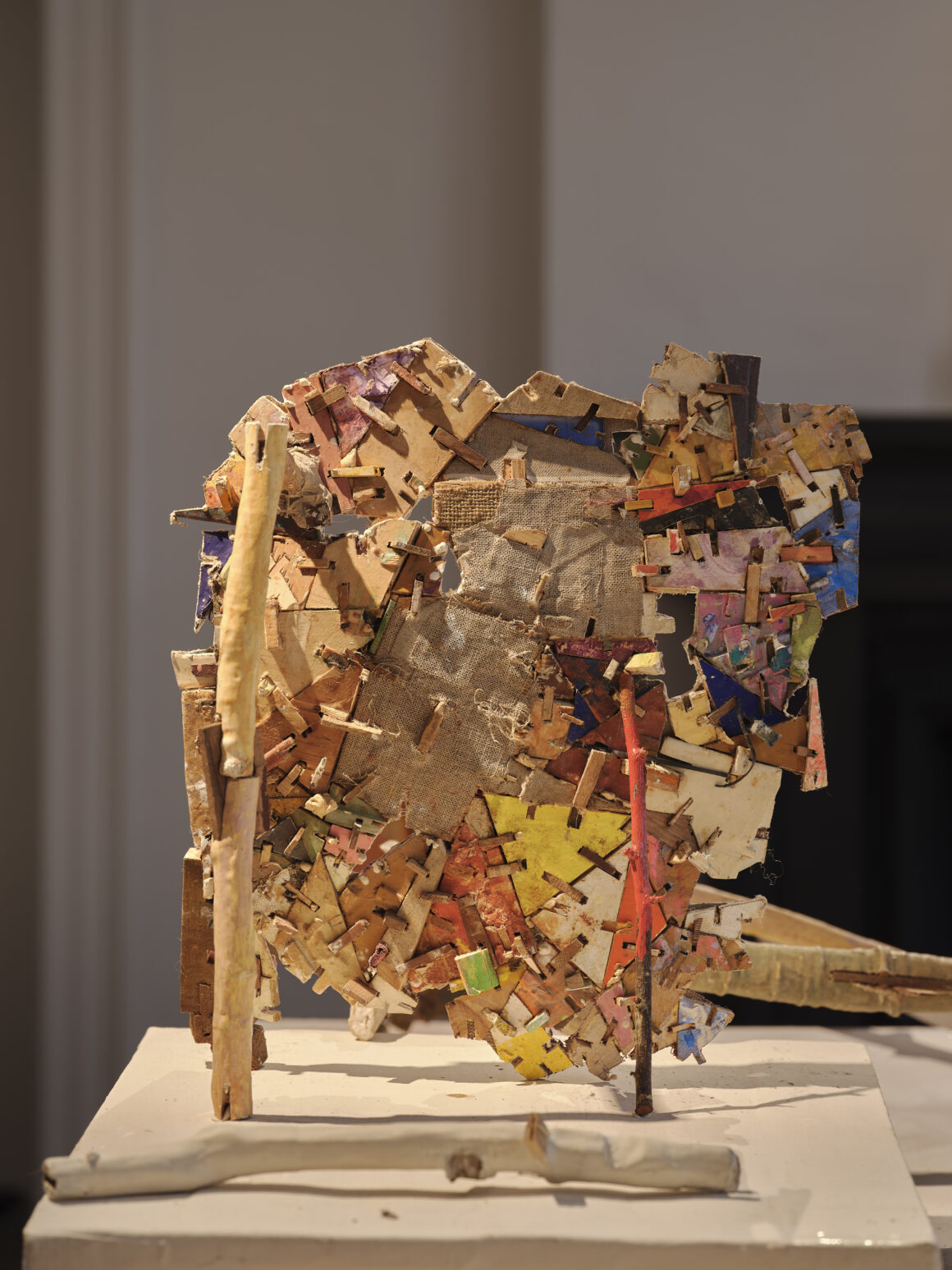
Nevertheless, frames and paintings, nascent and actual, become evident. O’Leary is also known for her ‘history paintings’. Considered the most prestigious genre in Western art tradition, history painting was a form of narrative art that applied classical and idealised conventions to the dramatisation of subjects drawn from classical Greek and Roman mythology, the Bible, and modern history. O’Leary’s history paintings abandon myth and allegory for the messy reality of paint and canvas. Precariously propped, they are shaggy, sutured together, and plastered in paint, conjuring connotations of wounds and their repair, accomplished with simple materials from the artist’s immediate environment. Nearby staves of wood, bone-like, await rehabilitation. On the floor, a crumpled muslin cloth lies in a plate, soaked in crimson dye, like a post-surgery remnant. If violence is a concern of traditional history painting, then its aftermath is O’Leary’s.
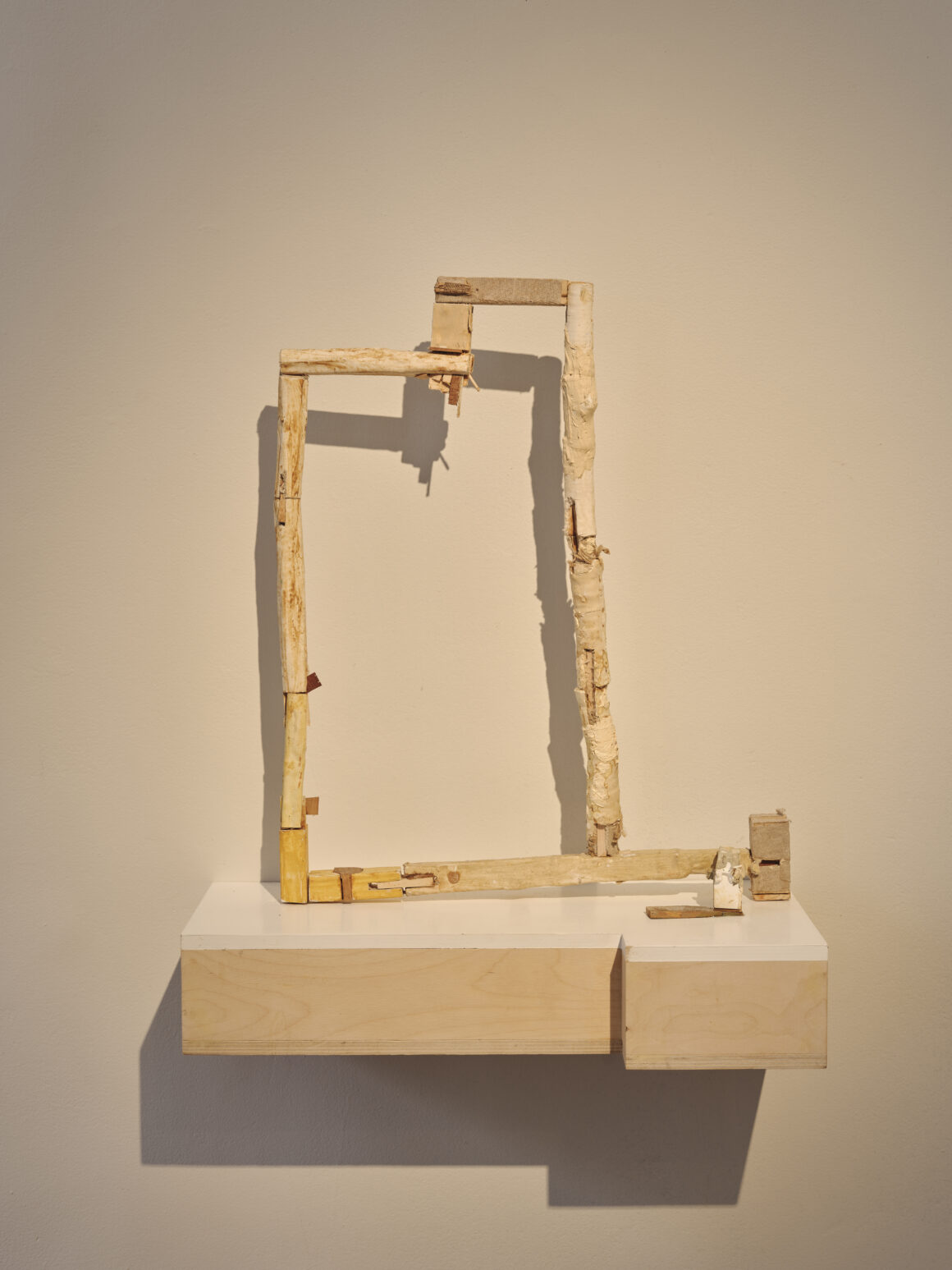
History’s grand events are far from the childhood farm where O’Leary learned of, in the economic precarity following her father’s early death, “staunch practicality, material efficiency, and insistence of self-determination.” O’Leary knits with wood, a practice echoed by the cross-stitch sampler, made circa 1890 by an unknown artist, which hangs above the mantle, emblazoned with the incantation:
MAKE IT DO
WEAR IT OUT
USE IT UP
DO WITHOUT
This is a variation on the American mantra, popularised during the Great Depression and World War II, that promoted extreme frugality and resourcefulness. In the context of this exhibition, the saying complements and foregrounds O’Leary’s ethos of repurposing. A ‘soft spot’ is a strong liking for something or someone, marking a vulnerable point of emotional susceptibility – in this instance, perhaps highlighting the artist’s emotional connection to certain objects and materials that she cannot part with. Soft spots are also fontanelles, those diamond-shaped areas on an infant’s head where the skull bones have not yet fused together. Made of tough membranes, the soft spot can be touched, tenderly. Similarly, a studio could be described as a soft spot, where over time, things are knitted together by a subtle and careful magic.
Phillina Sun is an American writer based in the Northwest of Ireland.