Glór, Ennis
14 June – 6 September 2025
Multispecies ethnographers have used the term ‘contact zones’ to describe spaces where encounters between humans and other species occur.1 Doomsday seed vaults and art exhibitions can both be seen as mediated contact zones, where life or work is removed from its original setting and reframed. This concept is central to ‘Heirloom’, an exhibition by Cork-based artist, Rachel Doolin, currently showing at glór in Ennis.
Through sculptural installation, visual media, and digital experimentation, ‘Heirloom’ highlights the artist’s response to the “profundity of seeds.” The collection and preservation of heirloom seeds is a profound form of resistance to extractive capitalism and industrial agriculture, functioning as an act of multi-species solidarity that supports biodiversity and ecosystem regeneration. For this series, Doolin worked with local collaborators such as Irish Seed Savers in County Clare, who preserve over 800 varieties of heritage, open-pollinated vegetables from Ireland, using seeds and crops to protect biodiversity and celebrate cultural heritage.

The obligation to preserve species locally and globally is important in the Anthropocene, and in the Digitocene.2 This duty extends beyond the physical preservation of life to safeguarding stories, codes, and cultural lineages, often using digital technologies and accompanied by detailed genetic, ecological, and geographic data. Svalbard Global Seed Vault (SGSV) is one safety system designed to preserve and protect against loss of biodiversity. Opened in 2008 within the Arctic Circle, the vault stores backup copies of seeds from 1,700 gene banks worldwide. The vault currently houses 1.3 million seeds in ‘black box conditions’. If any species housed in the seed bank are lost due to disaster, war, or human error, the original gene banks can request replacements from Svalbard to restart their collections. The SGSV represents a vision of ecological reversibility, offering the possibility of undoing catastrophic damage.3
‘Heirloom’ takes as its conceptual and material departure the cryogenically preserved seed specimens held in Svalbard, drawing attention to the precariousness of genetic biodiversity in the face of climate catastrophe and global conflict. A photographic image of the vault’s exterior, taken during a 2017 Arctic residency, is displayed at the centre of glór’s atrium. The work captures the tension between the vault’s role as a contact zone for ecological preservation and the reality that human access to the vault is minimal. Doolin’s works are often community focused and the solitary image of SGSV is startling in its bleakness.
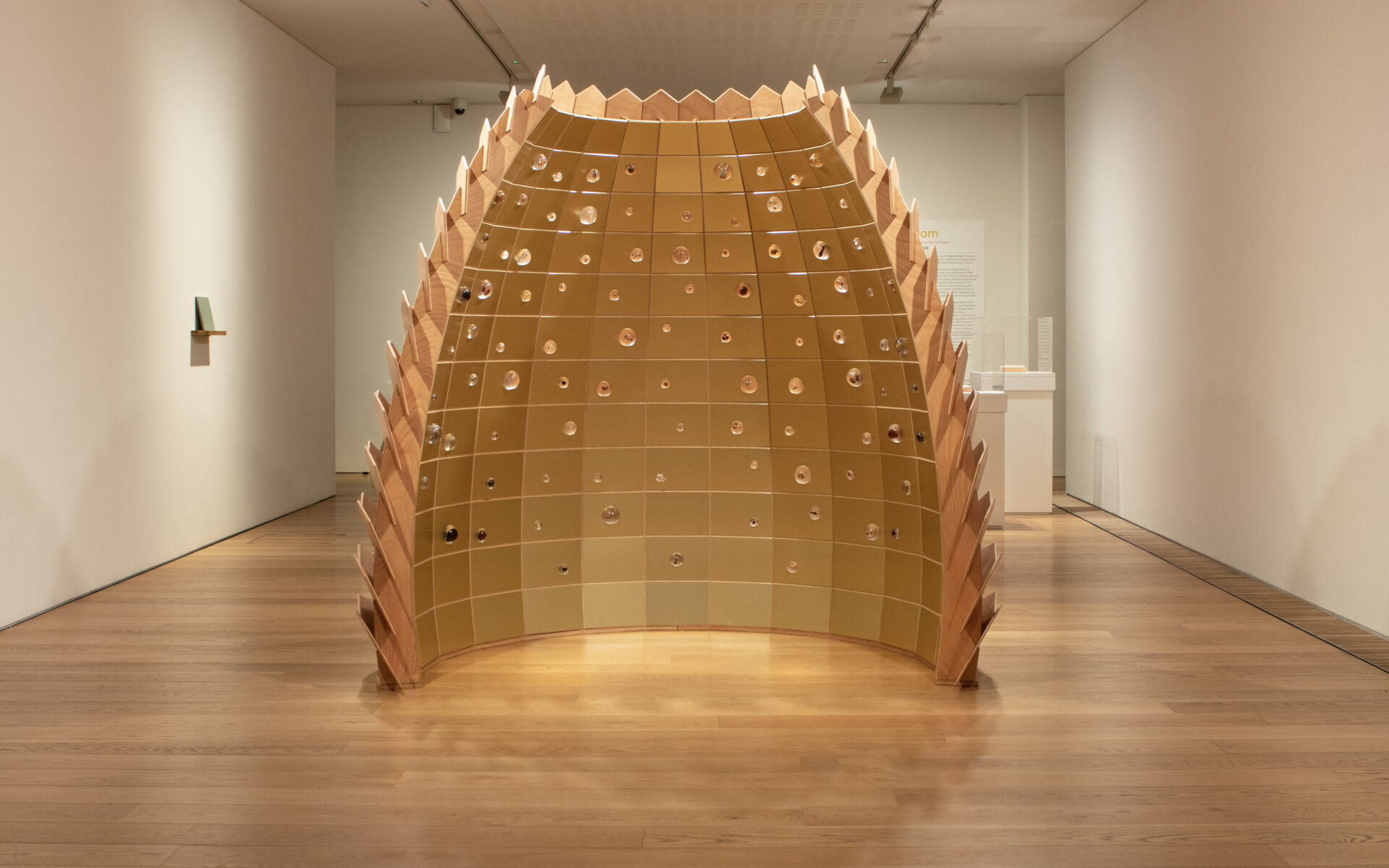
In contrast, installed at the entrance of the glór atrium, the large-scale sculptural installation, SeedARIUM (2022), originates from a community engagement project inspired by the Sanctuary of Hope in Calasparra, Spain, and is conceptually linked to the Svalbard Global Seed Vault. The flawlessly fabricated sculpture houses a collection of seeds donated by individuals across Ireland and abroad, including adults and children, gardeners, growers, and conservationists. Here, there is no scientific classification; the seeds are embedded in bio resin and illuminated by the gallery lighting. SeedARIUM functions as a community archive, shaped by the collective acts of gifting, gathering, and preserving seeds in solidarity.

At the opposite end of the atrium, SeedCLOUD (2022) is an interactive audio-visual sculpture featuring eight seed varieties in individual bowls, each linked to a recorded story, accessed via NFC-enabled devices or a gallery-provided tablet. Global biodiversity projects increasingly use bioinformatics, transforming seeds into digital objects with accompanying genetic, ecological, and geographic data. SeedCLOUD links physical seeds to the digital and offers the stories that contextualise human connections to them. Developed over two years, partly in response to Covid-19 lockdowns, the work invites visitors to experience seeds as vessels of knowledge, connection, and conversation. Recordings are also available on the artist’s website. By placing seeds within an artistic and community context, ‘Heirloom’ invites reflection on the gap between storing seeds as insurance against global catastrophe, and sustaining the local conditions in which life and art can flourish.
Gianna Tomasso is a writer, artist and researcher. Gianna lectures in Limerick School of Art and Design.
1 S. Eben Kirksey and Stefan Helmreich, ‘The Emergence of Multispecies Ethnography,’ Cultural Anthropology, Vol. 25, No. 4, November 2010, pp. 545–576.
2 The neologism ‘Digitocene’ appears to have been first publicly used in 2016 to 2017 as the title and thematic frame of an MA in Digital Art at the Far Eastern Federal University, Vladivostok, Russia, where it was defined as a conceptual epoch shaped by the pervasive influence of digital technologies on culture, perception, and the environment. The term has since been adopted in art criticism, media theory, and ecological discourse.
3 Leon Wolff, ‘The Past Shall Not Begin: Frozen Seeds, Extended Presents and the Politics of Reversibility,’ Security Dialogue, Vol. 52, No. 1, 11 June 2020, pp. 79–95.