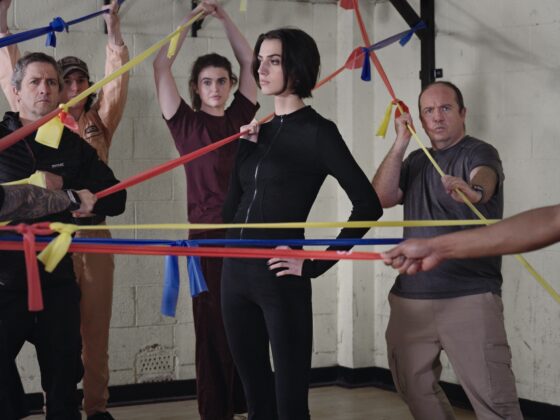
Mermaid Arts Centre
17 January – 28 February 2026
An archive often results from fortuitous luck, foresight, or both, and its true value tends to emerge with time. Happily for posterity, a comprehensive collection of documents and ephemera relating to the Women Artists Action Group (1987 – 1991) is held at the National Irish Visual Arts Library (NIVAL). It was donated by chair and founding member of WAAG, Pauline Cummins. A selection of this material, which includes correspondence, newsletters, a draft constitution, catalogues, and media clippings, was recently on display for the exhibition ‘WAAG: An Archive’ at Mermaid Arts Centre. Its curator Helena Tobin commented, this material facilitates an understanding of “what happened, how it happened, who was involved” and gives “a sense of the time, the context, and the labour.”1
Formed in 1987, around a farmhouse table in Clonmel, County Tipperary, the group – made up of artists, art historians, critics and curators, including Breeda Mooney, Veronica Bolay, Jenny Haughton, Patricia Hurl, Patricia McKenna, Louise Walsh, Alice Maher, and Kathy Prendergast – was outraged by the hostile environment for women practitioners. Their bold determination and unshackled ambition were bolstered by a backdrop of growing feminist and queer activism in Ireland and overseas in the late 80s.
Encouraged by Medb Ruane at the Arts Council, the group’s first task was to assemble a slide library to show the extent and range of women artists in Ireland. In July of that year, 91 artists were represented in a slide exhibition at Project Arts Centre, as part of the Third International Interdisciplinary Congress on Women in Dublin. ‘WAAG: An Archive’ is a fresh iteration of an exhibition last year at South Tipperary Arts Centre (2 May – 21 June 2025), organised in partnership with NIVAL.
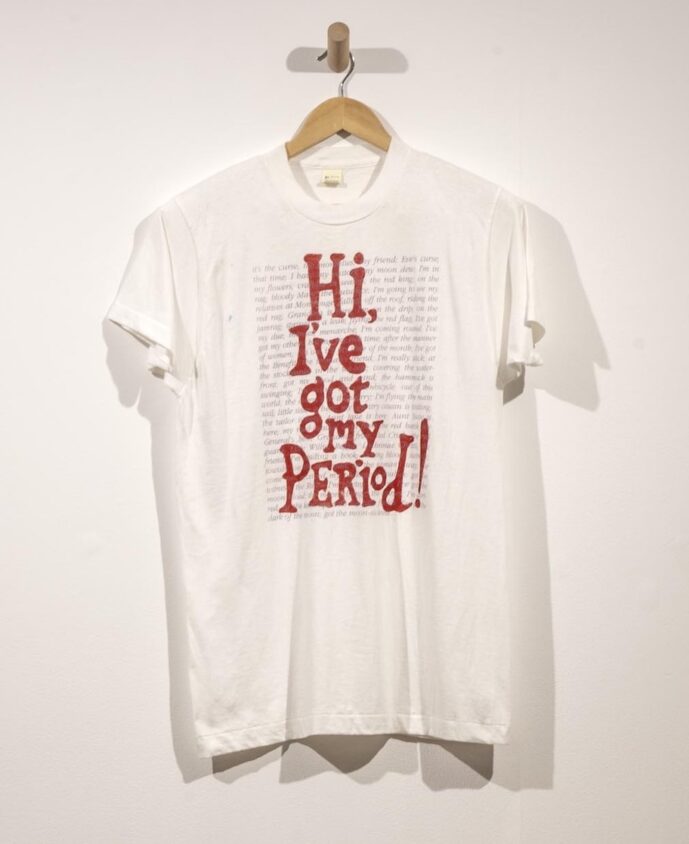
The exhibition curators, Helena Tobin and Iris Vos, attended the launch at Mermaid Arts Centre alongside core WAAG members. The opening took place on a cold and wet January evening but was enthusiastically attended. As with archives, activism also resonates through time, often with contemporary and far-reaching impacts. Among the crowd that gathered were diverse generations for whom the notion of a small collective taking on an obstructive establishment was inspiring and, in some cases, emotional.
WAAG members’ testimonies and the material on view recall an era when typewriters and photocopiers were the height of technology. But, more forcefully, they revisit what Pauline Cummins considers “a decade of horror” in which tragedies such as the ‘Kerry babies’ case, and Ann Lovett’s death had occurred.2 It was a time when, all too often, the responsibility – and the blame – for reproduction was foisted on women within a repressive patriarchal regime.
For older visitors, the exhibition was an occasion for reminiscing. One woman commented that it acted as a bridge to a different past. Veronica Heywood took part in the inaugural WAAG show at the Guinness Hop Store in 1987. [‘WAAG II: Art Beyond Barriers’ was held at the Royal Hospital Kilmainham in 1989]. She recalled having the chilling realisation that a Dublin gallery willing to show the work of a female artist was the exception at that time. It was indignation at this kind of mindset, she said, that sparked a movement that burned very bright for its duration.
Incredulity at the scale of WAAG’s actions was tangible at the launch. Alannah Henry, who was using the collective as a case study in feminist action for a teaching placement, was delighted to be attending an event that highlighted the group’s tireless work and accomplishments. Summing up its legacy, she and a companion noted how much more accessible the art world is for women now, while stressing the need for ongoing vigilance and responsiveness to ever-changing times.
The group’s activity culminated with ‘Women Artists and the Environment’, an ambitious WAAG event in June 1991, hosted in partnership with the International Association of Women in the Arts (IAWA) to celebrate Dublin as European City of Culture. It included site-responsive works by artists from abroad and a symposium at IMMA that was opened by President Mary Robinson, with a keynote speech by renowned American art activists, the Guerrilla Girls.
From small beginnings, WAAG developed as an entity with international reach. With NIWAG as its Northern Irish branch, membership of IAWA since 1988, and links within the US, work was also shown and events held overseas. By the time the collective ceased activity in 1991, its primary aims had been achieved.
Susan Campbell is a visual arts writer, art historian and artist.
1 WAAG Symposium, Part 1: WAAG Legacy, Dr Sarah Kelleher in conversation with artists Pauline Cummins and Louise Walsh, South Tipperary Arts Centre,10 May 2025, youtube.com.
2 Ibid.