VISUAL Carlow
31 January – 10 May 2026
The Digital Gallery at VISUAL Carlow presents ‘DRILL’, a newly commissioned exhibition of moving image and sound installation by Naomi Sex. The artist has written and directed a suite of scripted performances that unfold across six large monitors, dispersed throughout the darkened space. The screens are positioned so that viewers must move between them, navigating the room as if traversing a court. Anchoring the installation is a wall-length photograph of a badminton post, shot side-on. The image implies an invisible boundary, inviting the audience to imagine the net extended across the room.
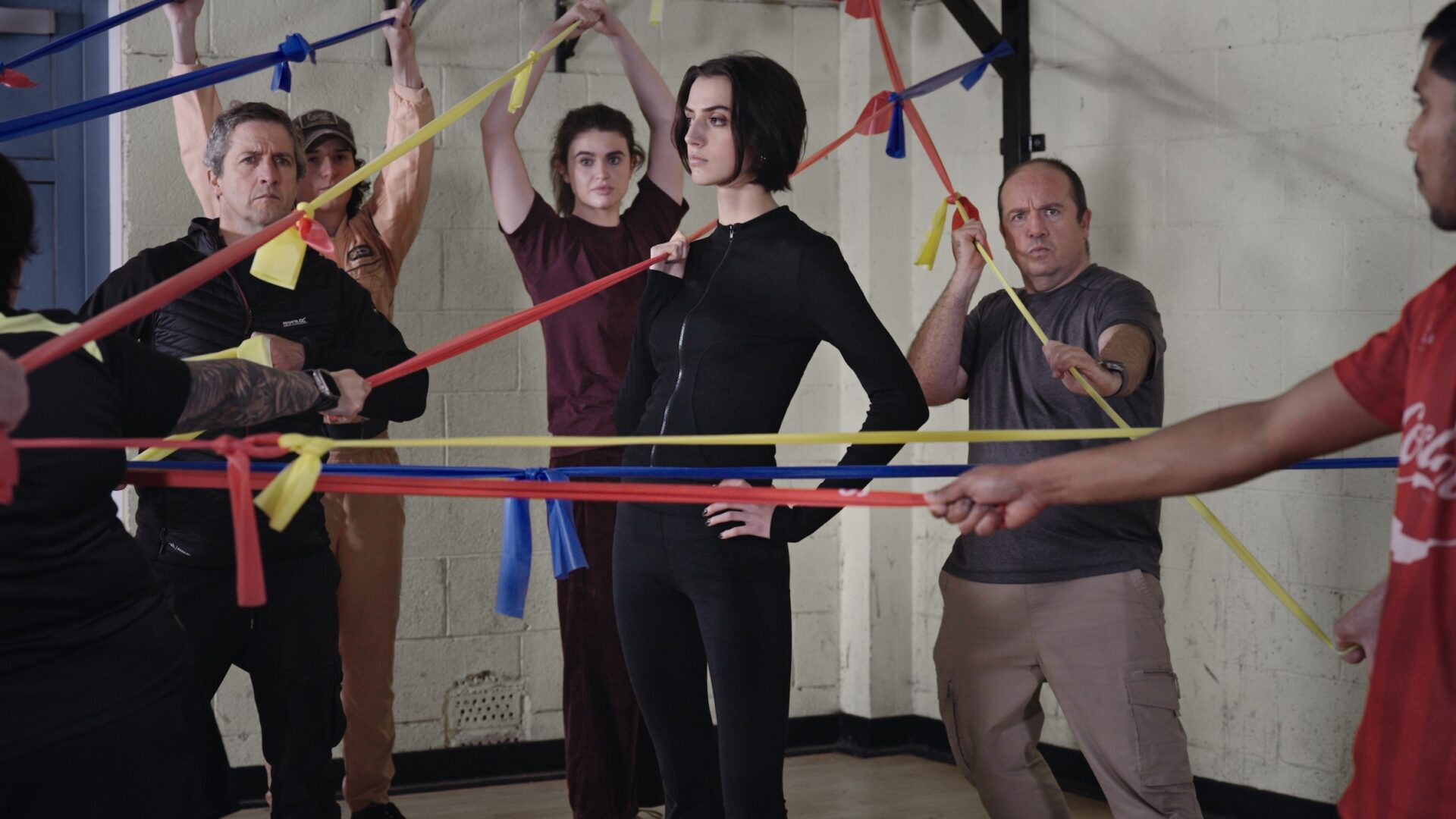
The films are populated with the paraphernalia of sport: free weights, gym mats, rackets, branded sportswear, and resistance bands in primary colours. The artist works with a combination of professional actors and non-actors, whose performances oscillate between heightened theatricality and awkward naturalism. We observe them in conversation with one another and, occasionally, with themselves. The gym becomes a site of rehearsal in which speech and social comportment are subjected to the same rigorous repetition as a forehand swing.
Across a single cycle, the six screens drift in and out of synchronisation. Distinct but interrelated micro-scenarios unfold: a character hesitates before speaking; another argues that they are made to apologise too frequently; someone fixates on how exposed they feel in their gym outfit; others confess to a persistent awkwardness in social situations. The scenes are absurd and faintly comic, their dialogue looping and misfiring with a Beckettian cadence. Language is stretched to reveal its gaps. Exchanges falter, apologies proliferate, intentions are misunderstood. The humour is dry, but the undercurrent is one of vulnerability.
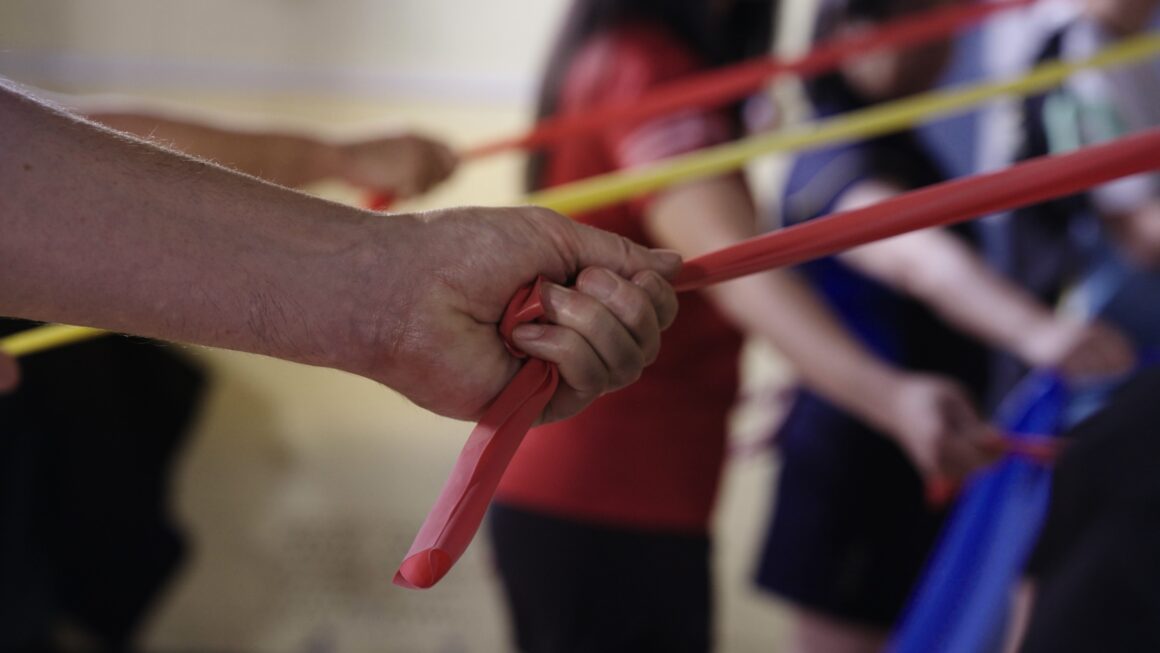
This precariousness of speech is juxtaposed with the confidence of bodies in motion. When the performers rally a shuttlecock or engage in a choreographed drill, their movements are assured and elegant. In contrast, when they stand face to face, attempting ordinary conversation, their gestures stiffen. Arms fold defensively; gazes slide away. In one vignette, a group stands in formation, pulling taut, yellow, red, and blue resistance bands between them. The bands create literal lines of tension, stretching and vibrating as the performers lean back with controlled force. The image operates as a diagram of social strain: connection is maintained, but only through pressure.
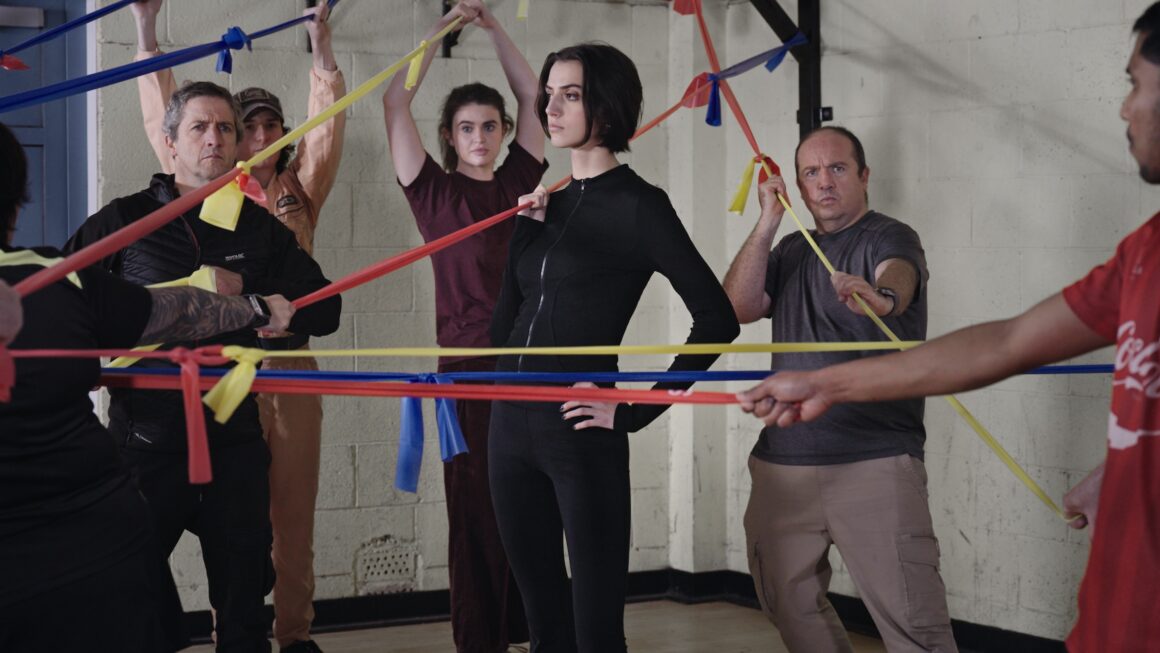
The dialogue in these micro-scenarios suggests a deficit in social fluency, prompting the question of whether these conversations are themselves drills: attempts to practise intimacy, apology, or confrontation. If so, the characters appear caught in a loop where rehearsal never quite becomes mastery. Sports sociologist Henning Eichberg posited that in the West, games have been so intensely codified in the form of sport that the playful impulse from which they sprang has almost been extinguished. Sex’s work may lead us to question whether the same has become true of human relations more broadly. In a society increasingly inclined to instrumentalise visual and verbal communication as a means of advancement, have we obscured the authentic self from which the impulse to communicate first emerged?
The work also resonates with theories of speech acts articulated by J. L. Austin and later expanded by Judith Butler and Eve Kosofsky Sedgwick. Austin proposed that utterances do not merely describe reality but can enact it. He distinguished between locution (what is said), illocution (what is done in saying it), and perlocution (the effects produced by saying it). Butler and Sedgwick mobilised this framework to examine how language performs and regulates gender, sexuality, and social power. In ‘DRILL’, apologies, accusations, and confessions operate as tentative speech acts. The characters attempt to reshape their relational realities through language, yet the perlocutionary effects are unstable. Words are issued, but their consequences remain uncertain.
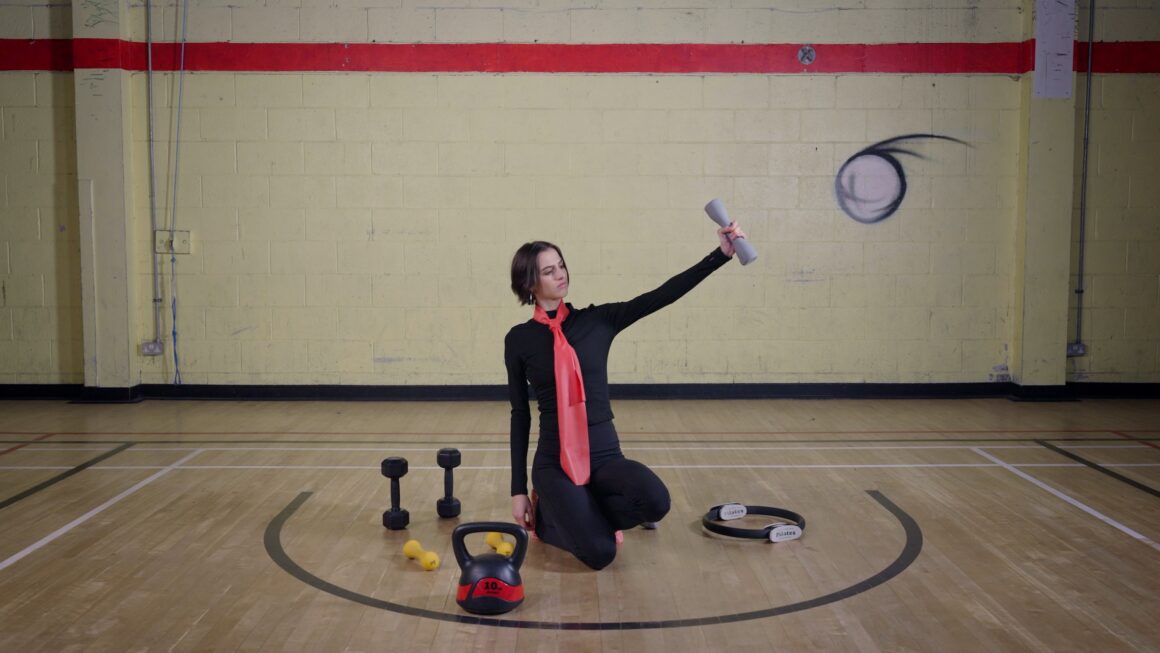
Sex’s installation situates bodies in close proximity, engaged in choreographed exertion, while simultaneously foregrounding the fragility of verbal exchange. The badminton net becomes a central metaphor. In itself the prototypical symbol of connection, the network, it nonetheless marks division between two sides. It is also the necessary structure that enables play. Similarly, the resistance bands require mutual tension to function; without opposing force, they slacken. ‘DRILL’ suggests that social cohesion may depend on a similar dynamic – an ongoing practice of negotiation, repetition, and strain. The exhibition leaves the viewer suspended between the promise of improvement through rehearsal and the recognition that some gaps in communication persist, no matter how diligently we train.
Ella de Búrca is an Irish visual artist and lecturer at SETU Wexford College of Art.
elladeburca.com