GRACE O’BOYLE REFLECTS ON THE CURRENT EXHIBITION AT THE IRISH MUSEUM OF MODERN ART.
‘Technologies of Peace: Art and Transition in Contemporary Europe 1989 – 2026’ (12 Sept 2026 – 9 May 2027) at the Irish Museum of Modern Art (IMMA) is an important exhibition held on a historically layered site. Formerly the Royal Hospital Kilmainham, IMMA’s expansive estate carries deep symbolic and strategic significance. Once a place of healing and military burials, it is now a fertile threshold for discourse, with its architecture and archaeology offering a compelling framework for examining how peace is imagined, negotiated and enacted through artistic practice.
‘Technologies of Peace’ concentrates on the period from 1989 until the present day, ambitiously spanning 17 European countries through the work of 40 artists. The show is divided into five thematic sections: Technologies of Peace, Language and Translation, Trauma and Reverberation, Ecology and Architecture, and Imagining Futures. Within this diversity of practice, the exhibition addresses a range of historical conflicts and political transitions, including the fall of the Iron Curtain, the dissolution of Yugoslavia, and the Northern Ireland peace process.
In 2026, the word ‘technologies’ evokes software, such as ChatGPT or Claude, images of automation, or the influx of data centres colonising our boglands. However, the exhibition’s broader understanding of the term emphasises the application of conceptual knowledge to produce practical and sustainable outcomes. It seeks to explore how artistic practice can metabolise complex histories of conflict into sites of healing and critical engagement, thereby contributing to the ongoing process of peacebuilding.
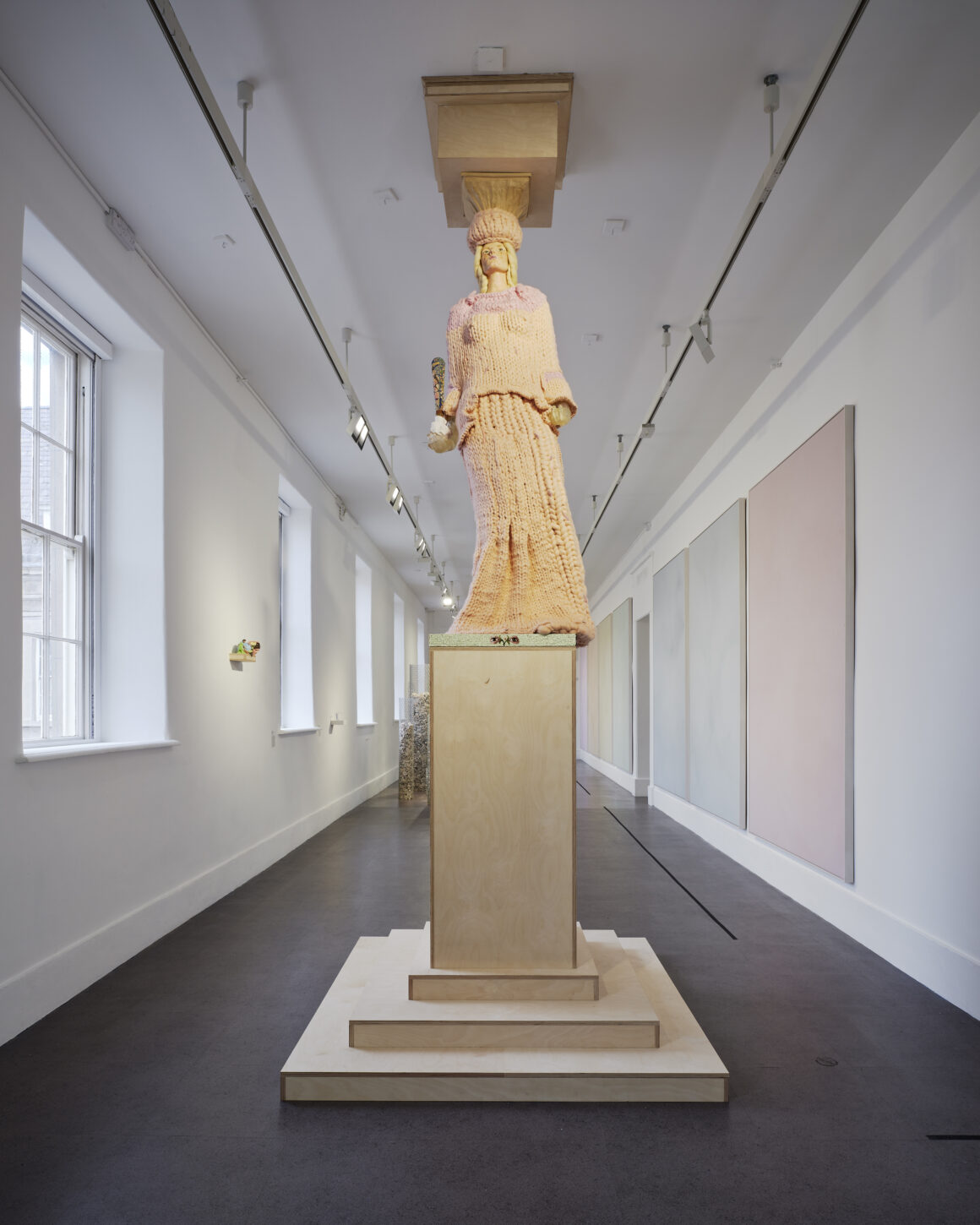
In the south corridor of IMMA, Ursula Burke’s Peach Caryatid (2021) merges porcelain and wool to form the artist’s interpretation of a classical caryatid, a sculpted female figure that functions as a column or pillar supporting the entablature of a building. The figure’s materiality, specifically its woven garb, infers the historical and quiet labour of women during times of conflict. Burke’s engagement with caryatid iconography opens onto wider questions of ownership and cultural memory, recalling the ancient Greek Acropolis Caryatid, which remains at the British Museum, amid the long-running controversy over the museum’s refusal to return the Elgin Marbles to Greece.
These pastel hues are reverberated in Christodoulos Panayiotou’s seven pulp paintings, Untitled (5,10,20,50,100,200,500) (2016), fabricated using withdrawn and demonetised Euro banknotes, acquired by the Bank of France. Without consulting the label text, Panayiotou’s uninscribed paintings are simply ethereal, aesthetic abstractions. However, by engaging with the work’s complex production process and material lineage, questions emerge about our globalised finance systems and how value is temporal and transmutable. There is a latent violence in the pulping process, dissolving disparate forms into a unified whole, which resonates with the European project, in its blending together of nationalities and the illusion of seamless unity.
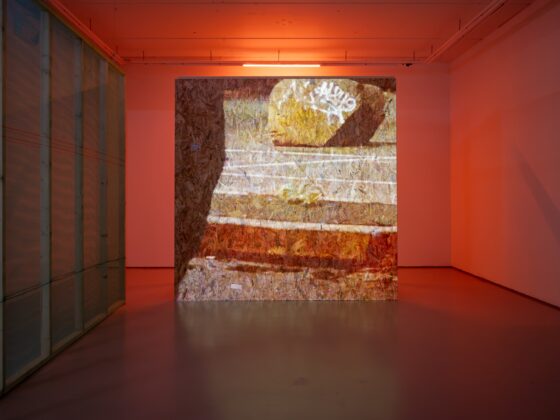
Latent Community – an interdisciplinary collective founded in Athens in 2017 by artists and filmmakers Sotiris Tsiganos and Ionian Bisai – use extensive research methodologies, participatory strategies, and oral histories which form the basis of their practice. An enlarged 35mm photograph of a NATO military training and testing ground in Sardinia highlights the island’s reality of borders. Much of Sardinia is barred to tourists, and even locals; Al Jazeera suggests that about one third of the island is controlled by the Italian military. Layered on top of the photograph are two traditional war rugs, The Pibiones (War Rug #1 and #2) (2024), produced in collaboration with local weavers from Sardinia, using an ancient weaving method native to the island, contrasting its artisanal heritage with contemporary themes of conflict, war and displacement.
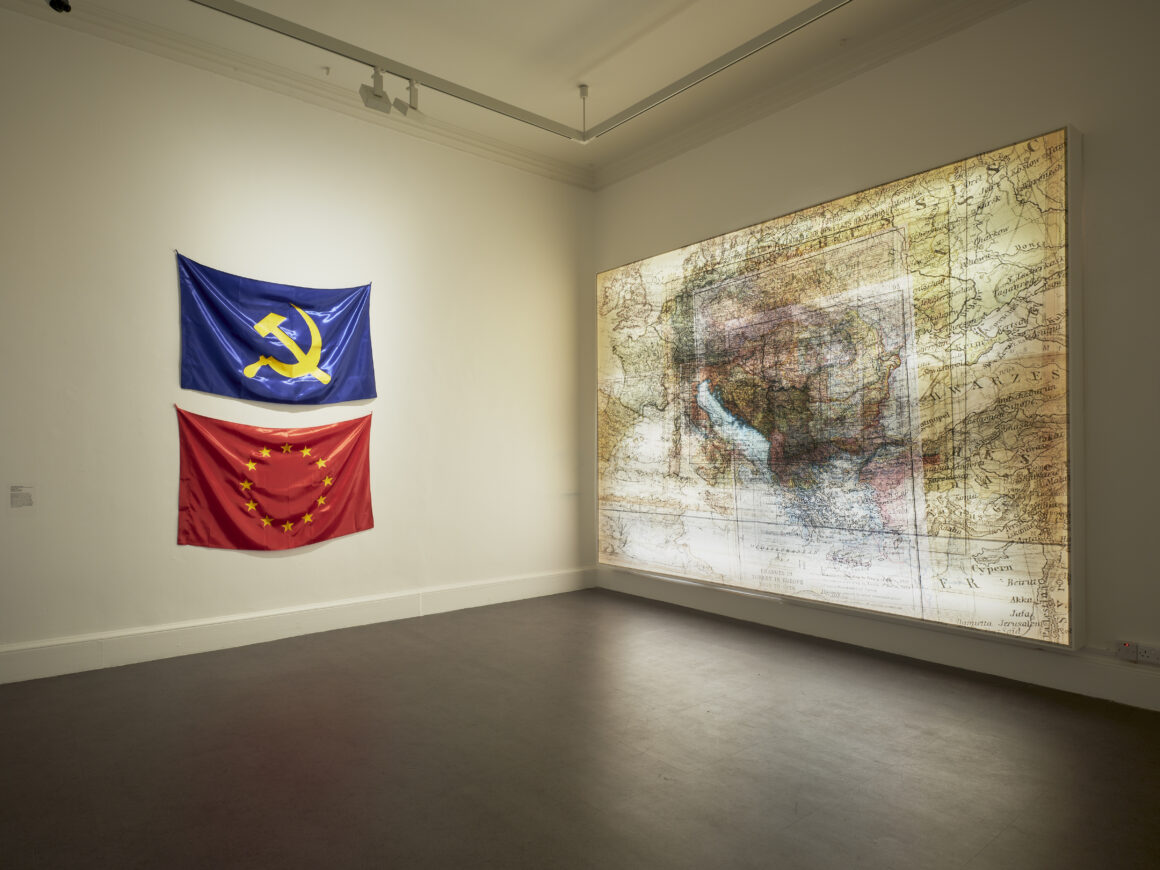
The exhibition draws significantly from IMMA’s permanent collection, presenting work by Willie Doherty, Frances Hegarty, Sandra Johnston, Alastair MacLennan, Mairéad McClean, William McKeown, Paul Seawright, Anne Tallentire, and Cathy Wilkes, among others. The importance of IMMA’s ‘Dwell Here’ residency is further evidenced by the inclusion of works by participating artists Amanda Dunsmore, Ursula Burke, and Glenn Loughran. The works selected from the permanent collection speak to a deeply erudite and multifaceted resource, ripe with further opportunity for curatorial inquiry within the Irish post-conflict context.
Filmed in a former British Army base in Derry, Willie Doherty’s single-channel black and white video, ENDLESS (2020), features the actor Christopher Eccleston as an anguished man whose tormented mind is revealed to the viewer through a complex script that tells the story of both a victim and a perpetrator of violence. Doherty highlights the rise of political deception in a post-truth era, no longer viewed as an ethical transgression, but increasingly deployed as a deliberate tactic and policy directive. ENDLESS does not conclude with hope so much as a warning about the cyclical nature of violence and trauma.
In Francis Hegarty’s film, Turas (Mothertongue) (1995), translating to ‘excursion’ or ‘journey’, the artist gestures towards her mother’s mouth as a repository of language and memory. The work denotes Hegarty’s attempt to reaffirm a linguistic tradition held by her mother. As the Irish language experiences a wave of revivalism in contemporary culture, Hegarty’s film acquires fresh urgency, along with possibilities of cultural restitution.
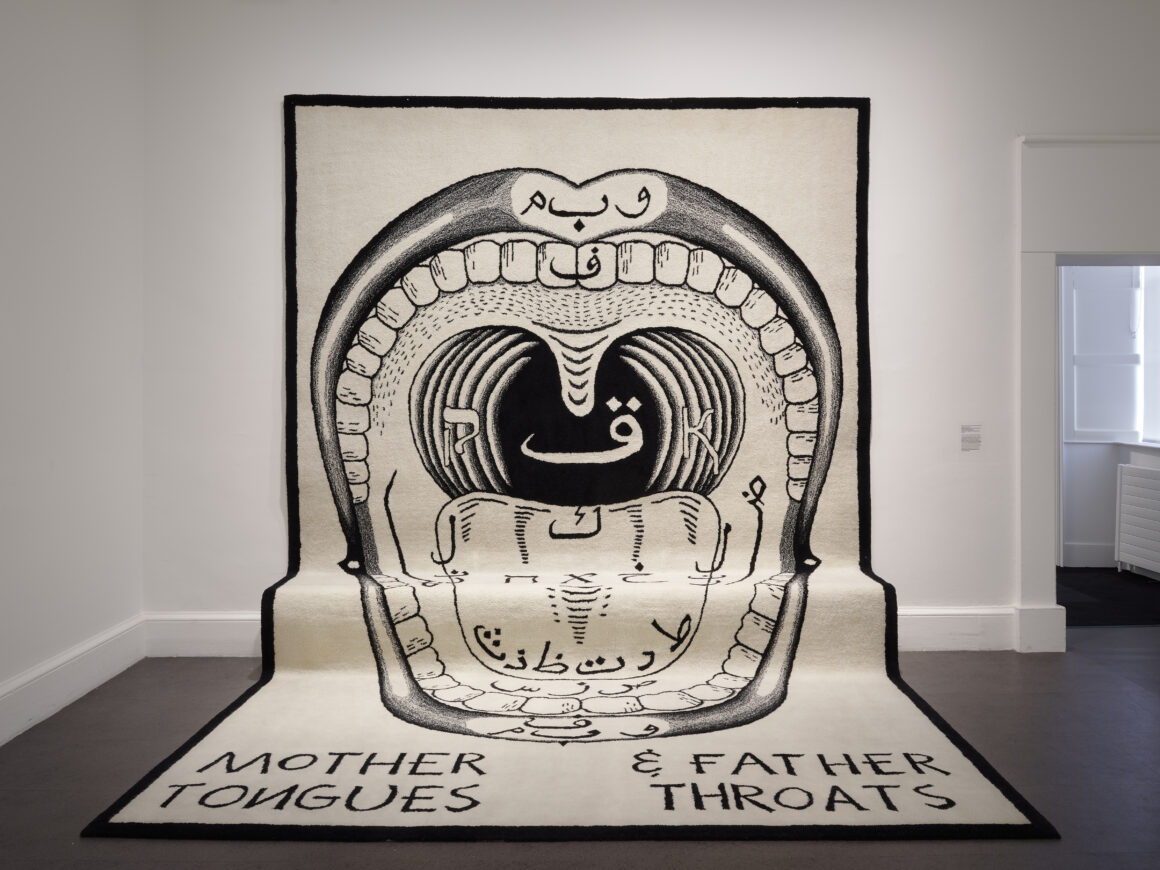
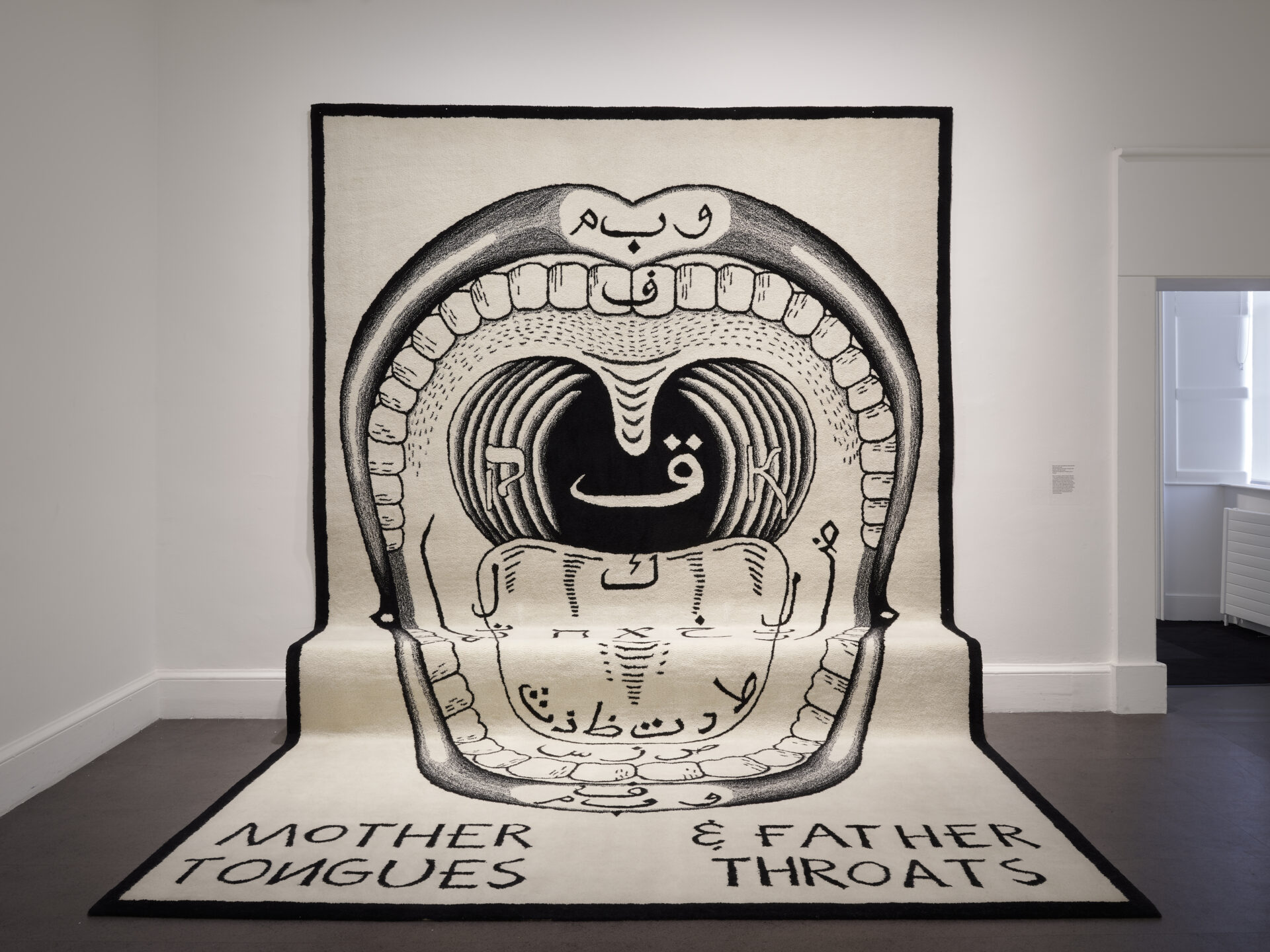
Formed as a reading group in 2006, Slavs and Tatars is an international collective whose practice spans a significant geographical and cultural expanse, from the former Eastern Bloc to the Great Wall of China. Their large-scale wool carpet, entitled Mother Tongues and Father Throats (2012), depicts a tongue and throat diagram that maps the articulation of sounds from the Arabic alphabet. It deals with the guttural sound of ‘kh’, a phoneme absent from the Latin alphabet, constituting a linguistic division between the East and West. Furthering the significant presence of textile practices throughout the exhibition, Małgorzata Mirga-Tas’s fabric collages of extraordinary Romani women foreground the capacity of fabric and cloth to archive collective memory and process experiences of conflict and displacement.
Under Annie Fletcher’s directorship, IMMA has embedded itself within a wider European network of artists, collectives, researchers, and institutions who align with the museum’s commitment to imagining peace. Within this institutional framework, ‘Technologies of Peace’ allows interrogation to occur, contradictions and complexities to arise, and nuanced positions to unfold. In this sense, IMMA becomes more than the host of the exhibition; it embodies the very principles that the project seeks to explore.
Grace O’ Boyle is a curator from Donegal who is currently based in Dublin.