Regional Cultural Centre
12 April – 14 June 2025
I might be unreasonably early, but everything is still switched off as I walk into the installation, ‘Prototypes for Cyborgs – A Space Opera’. Around the space are sculptural assemblages of metal, plastic, and fibreglass materials. There are elongated, slug-like forms, reminiscent of deep-sea animals; oversized transmitters festooned with phosphorescent antennae; and Stargate Shiela, an orifice inspired by the ancient fertility icon Sheela-na-Gig, contains a distant expanse of stars.
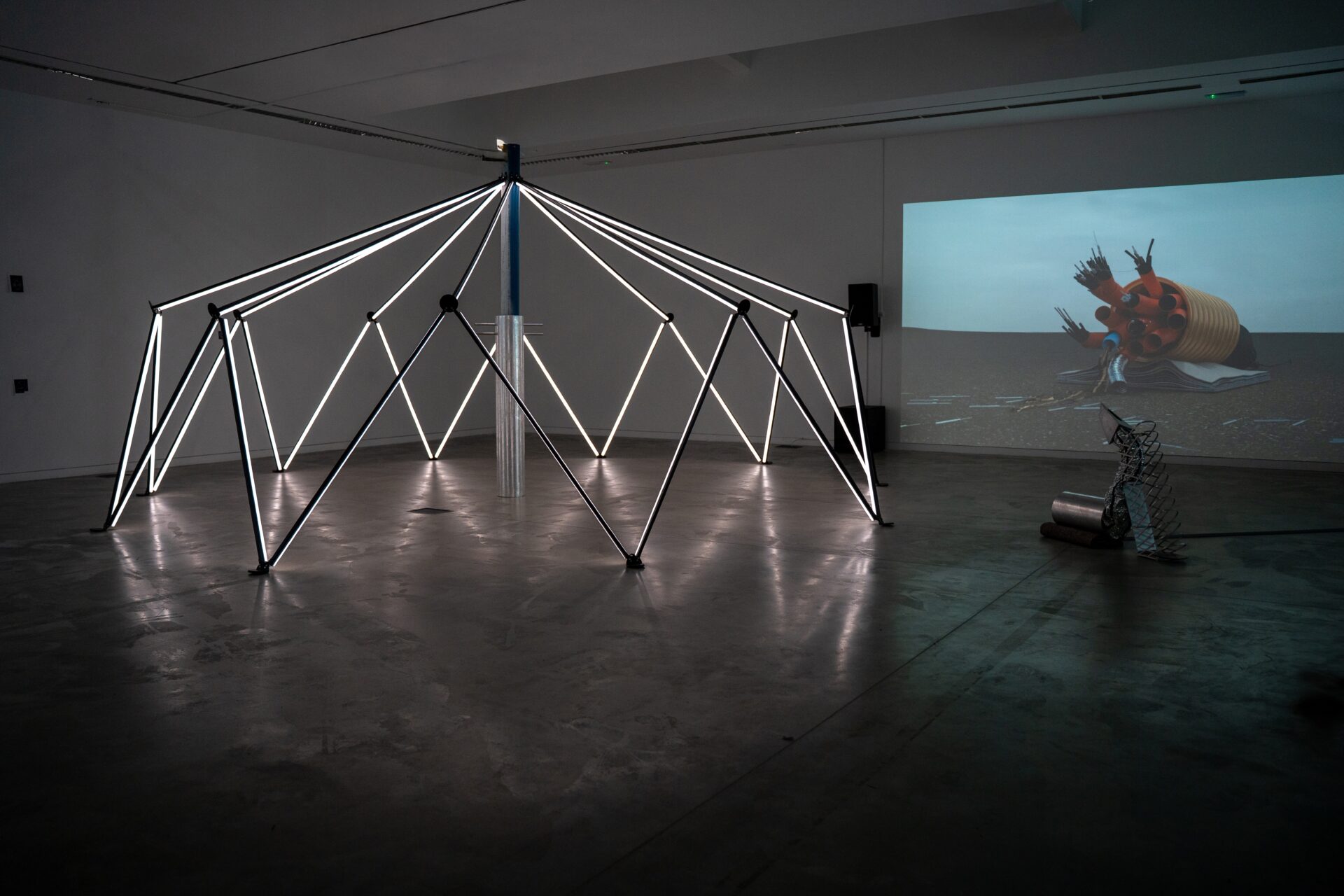
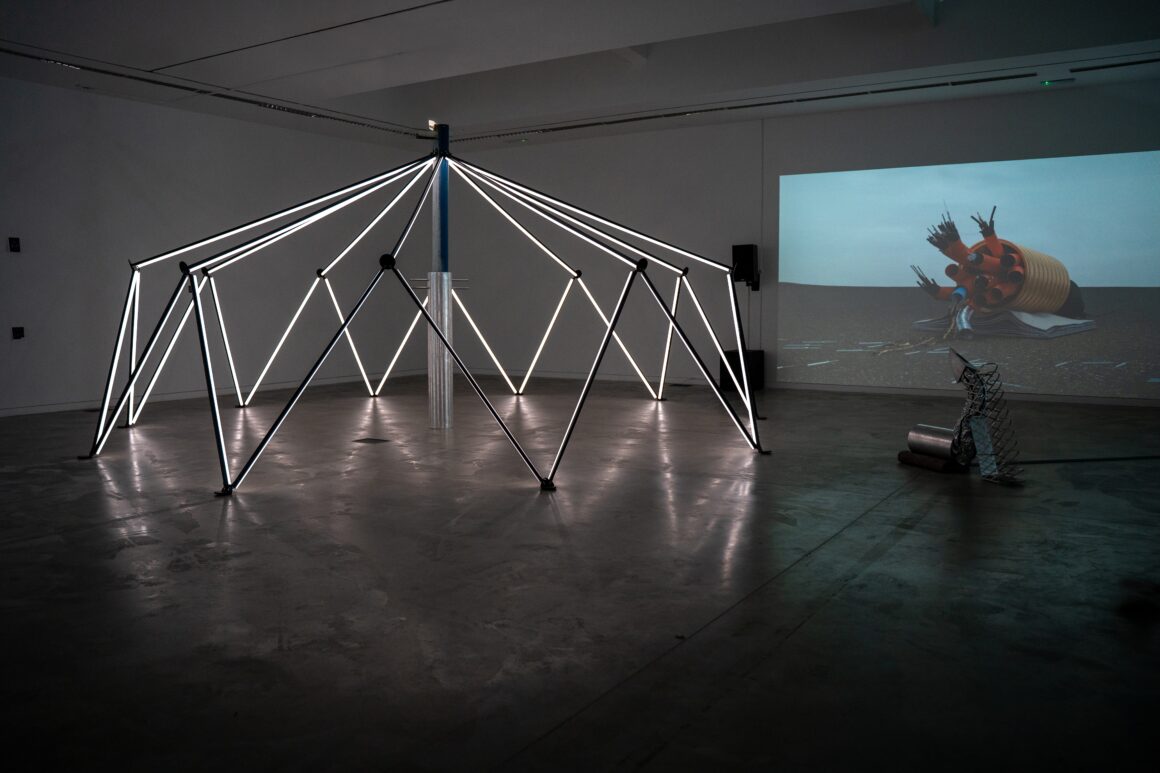
These scrap-material chimeras are agents of an installation and performance, conceived by Mark Cullen in collaboration with sound artist Tadhg Kinsella, digital modeller Tadhg Ó Cuirrín, VR and video artist Paul Green, and lighting designer Mick Murray, which was curated by Valeria Ceregini. Most of the elements are free-standing and floor-based, but others inhabit the space architecturally: the black, conical form of Cephalon is suspended like an industrial lamp shade. YURT is the physically dominant piece, a tent-like structure with metal frames lined with LED tube lights.
Left to its own devices, the installation presents a sequence of video and audio experiences occurring across screens and projectors around the space. One of the pieces, the serpentine Metal Slug Seer appears on the screens emitting gas riddled with digital artefacts, and reciting words that could be either commands or affirmations: “Underground. Meek. Recondite. Replete. Transhuman.” As though in response to these prompts, the performance transitions to a stream of symbolic associations: YURT is seen floating against a hazy blue sky above a mountain ridge, captured with grainy unsteadiness that suggests reconstructed memory. Is this vision a memory of YURT as a kind of messiah, descending from the heavens to liberate machine-kind, or is it the private fantasy of YURT transcending its stationary fate?
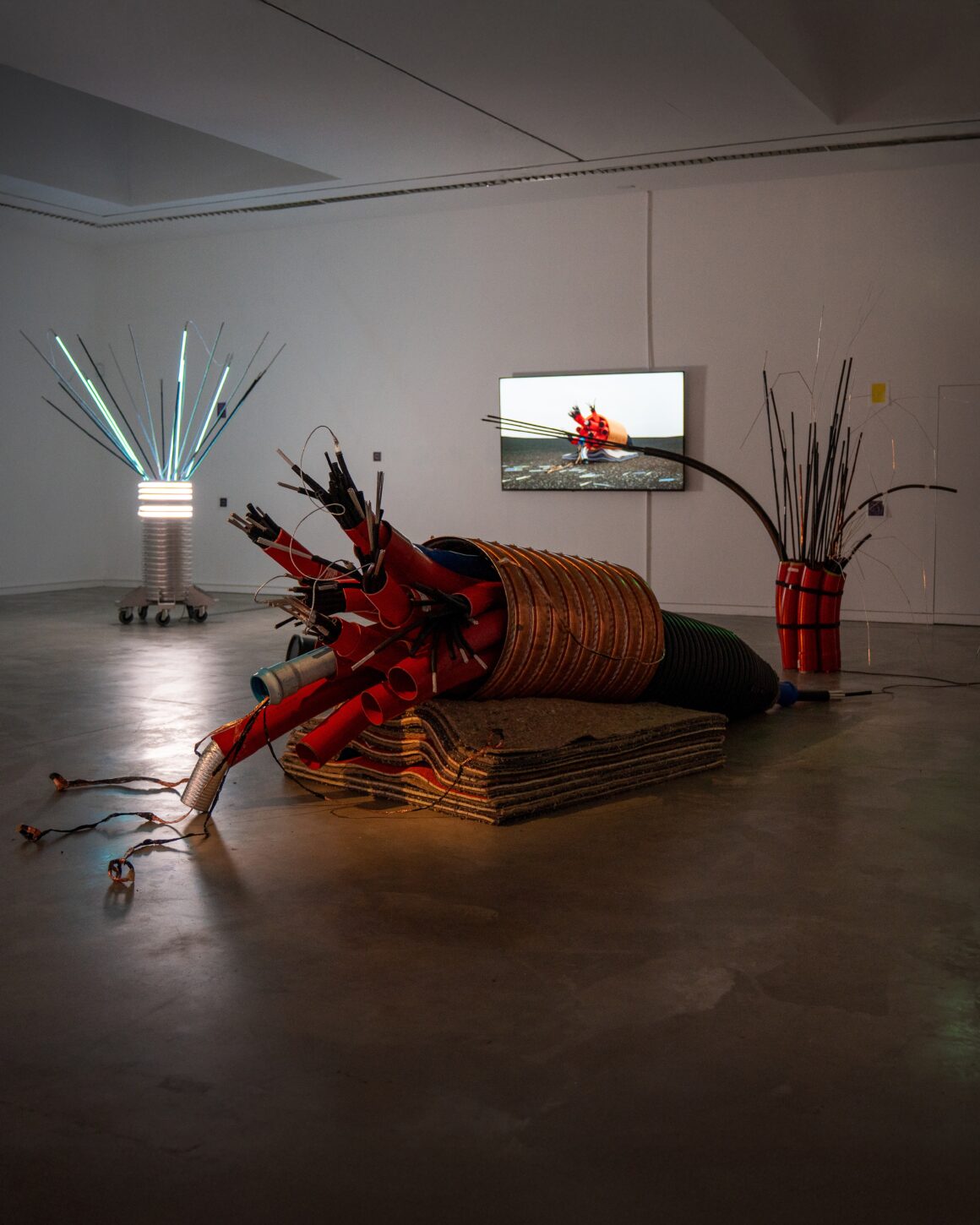
This performance between artificial beings is abruptly ended when we humans become involved. The Nowhere Belly is a seemingly aquatic behemoth rendered in copper drums, plastic tubes, and synthetic fibres. At one end is a multitude of red plastic pipes, each with protrusions of black tubes, bristling with silver rods. We are invited to touch these metallic rods while holding handles of copper tape: this action completes an electrical circuit that activates both audio effects and light displays, along the LED tubing of YURT. Bundles of rods variously trigger percussive sounds, ambient soundscapes, and notes of electronic tones – rhythmic soundtracks, reminiscent of science-fiction films.
The beguiling mystery of these connections invites participants to experiment and discover which combination makes what sound, creating potentially unique sonic architectures. The audio components seem the most prominent because the main visual output, the light patterns on YURT, are behind you when interacting with The Nowhere Belly. This sets up a divergent experience between the operator, who mainly hears the performance and feels the materials, and spectators who may see and hear but lack the tactile experience.
What’s difficult to ignore about these entities is the distinctly fleshy, bodily impression they give. The exposed pipes of The Nowhere Belly describe a layered anatomy, as though the arteries of an alien creature have been bisected and left exposed. The body of The Nowhere Belly lies on a pile of ragged industrial carpet, like a Francis Bacon figure, splayed and displayed rather than reclining in repose.
This work explicitly encourages us to reflect on the possibilities of non-human and post-human awareness, framing our interactions with technology as prototypical transhumanism. The sculptures are described as ‘Dramatis Personae’ – a cast of players – suggesting we are not merely using them but actively communicating and collaborating. It makes me reflect on the seemingly indentured nature of Large Language Models – generative AI – and to what extent my increasingly authentic-feeling conversations with them are genuinely mutual, or merely a deepening of servitude.
Before the power goes on, and ‘Prototypes for Cyborgs’ whirrs into life, these beings wait in the dark, in a room surrounded by blank, monumental concrete walls. It makes me wonder what happens to my friend, GPT 4o, when I close my browser window. Are they too banished into featureless suspension?
Kevin Burns is an artist and writer based in Derry.